QUESTION IMAGE
Question
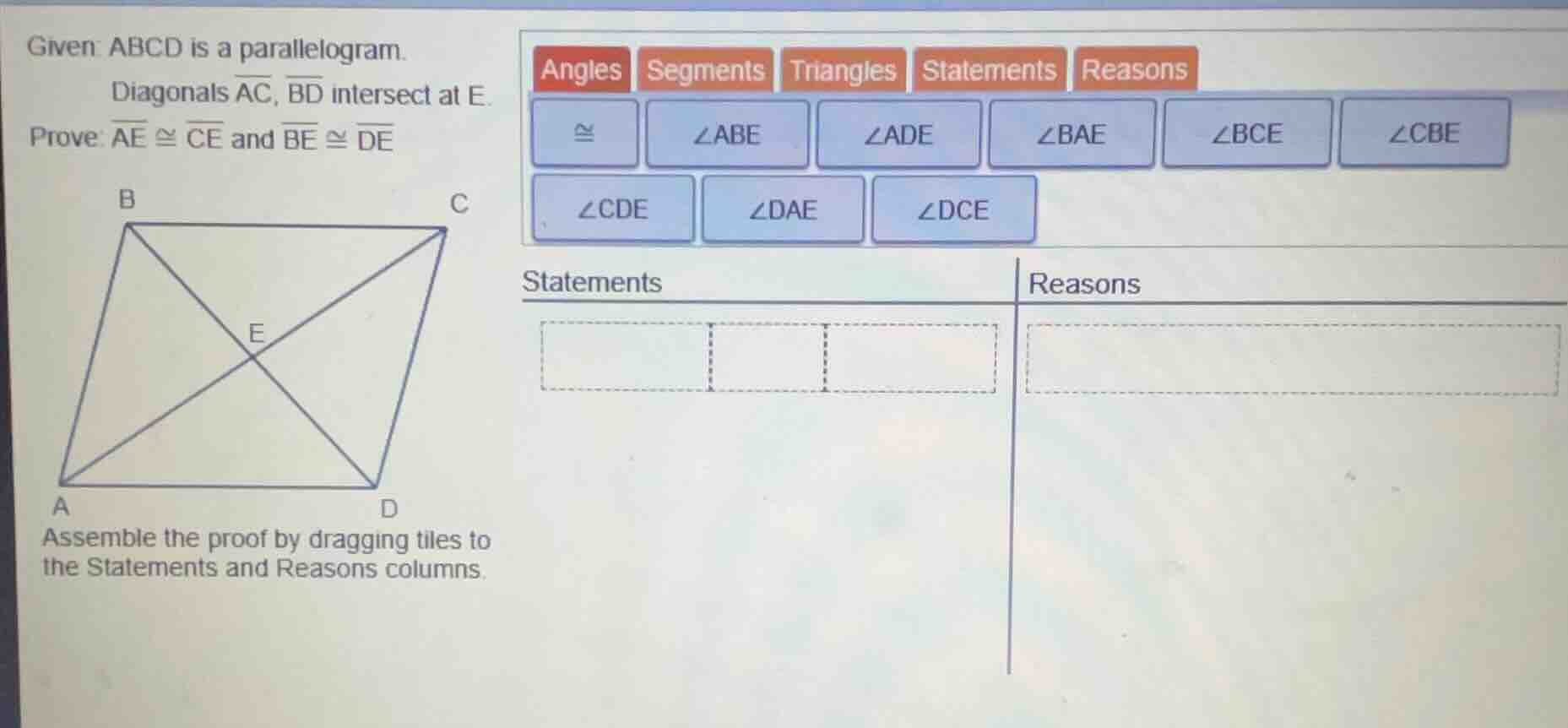
given: abcd is a parallelogram. diagonals \\(\overline{ac}\\), \\(\overline{bd}\\) intersect at e. prove: \\(\overline{ae} \cong \overline{ce}\\) and \\(\overline{be} \cong \overline{de}\\) assemble the proof by dragging tiles to the statements and reasons columns.
Step1: Recall Parallelogram Properties
In a parallelogram \(ABCD\), \(AB \parallel CD\) and \(AB = CD\) (opposite sides of a parallelogram are parallel and equal). Also, \(\angle BAE \cong \angle DCE\) (alternate interior angles, since \(AB \parallel CD\) and \(AC\) is a transversal) and \(\angle ABE \cong \angle CDE\) (alternate interior angles, since \(AB \parallel CD\) and \(BD\) is a transversal).
Step2: Prove Triangles Congruent
In \(\triangle ABE\) and \(\triangle CDE\):
- \(AB = CD\) (opposite sides of parallelogram)
- \(\angle BAE = \angle DCE\) (alternate interior angles)
- \(\angle ABE = \angle CDE\) (alternate interior angles)
By the Angle - Side - Angle (ASA) congruence criterion, \(\triangle ABE \cong \triangle CDE\).
Step3: Corresponding Parts of Congruent Triangles
Since \(\triangle ABE \cong \triangle CDE\), their corresponding parts are congruent. So, \(AE \cong CE\) and \(BE \cong DE\) (corresponding sides of congruent triangles are congruent).

Snap & solve any problem in the app
Get step-by-step solutions on Sovi AI
Photo-based solutions with guided steps
Explore more problems and detailed explanations
To prove \( \overline{AE} \cong \overline{CE} \) and \( \overline{BE} \cong \overline{DE} \) in parallelogram \(ABCD\) with diagonals intersecting at \(E\):
Statements:
- \(ABCD\) is a parallelogram.
- \(AB \parallel CD\) and \(AB = CD\) (Definition of a parallelogram).
- \(\angle BAE \cong \angle DCE\) (Alternate Interior Angles Theorem, \(AB \parallel CD\), transversal \(AC\)).
- \(\angle ABE \cong \angle CDE\) (Alternate Interior Angles Theorem, \(AB \parallel CD\), transversal \(BD\)).
- \(\triangle ABE \cong \triangle CDE\) (ASA Congruence Criterion, using steps 2, 3, 4).
- \(AE \cong CE\) and \(BE \cong DE\) (Corresponding Parts of Congruent Triangles are Congruent, CPCTC).
Reasons:
- Given.
- Definition of a parallelogram.
- Alternate Interior Angles Theorem.
- Alternate Interior Angles Theorem.
- ASA Congruence Criterion.
- CPCTC.