QUESTION IMAGE
Question
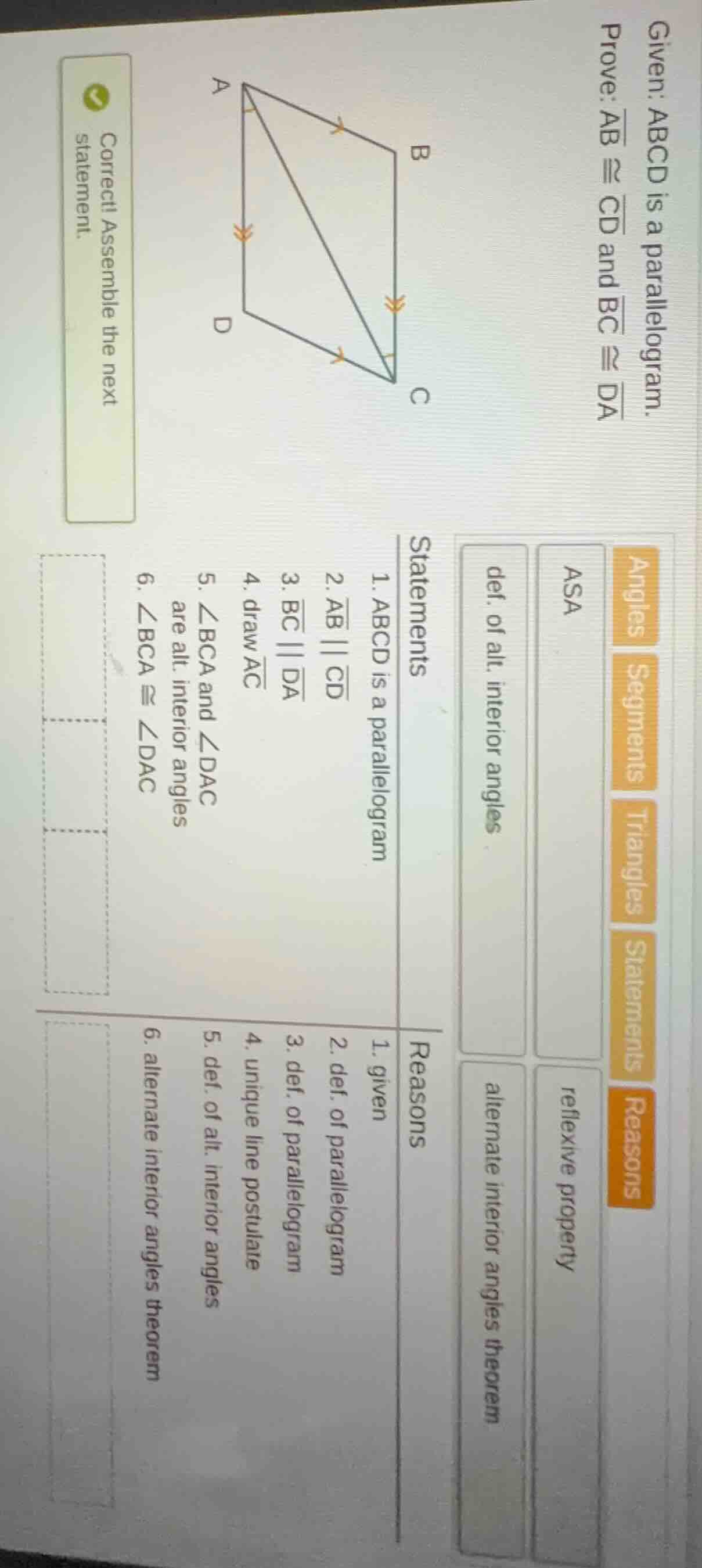
given: abcd is a parallelogram. prove: \\(\overline{ab} \cong \overline{cd}\\) and \\(\overline{bc} \cong \overline{da}\\)\
correctly assemble the next statement.\
statements\
- abcd is a parallelogram\
- \\(\overline{ab} \parallel \overline{cd}\\)\
- \\(\overline{bc} \parallel \overline{da}\\)\
- draw \\(\overline{ac}\\)\
- \\(\angle bca\\) and \\(\angle dac\\) are alt. interior angles\
- \\(\angle bca \cong \angle dac\\)\
reasons\
- given\
- def. of parallelogram\
- def. of parallelogram\
- unique line postulate\
- def. of alt. interior angles\
- alternate interior angles theorem
To solve the proof that \( \overline{AB} \cong \overline{CD} \) and \( \overline{BC} \cong \overline{DA} \) in parallelogram \( ABCD \), we follow these steps:
Step 1: Recall the definition of a parallelogram
A parallelogram is a quadrilateral with both pairs of opposite sides parallel. So, \( \overline{AB} \parallel \overline{CD} \) and \( \overline{BC} \parallel \overline{DA} \) (by the definition of a parallelogram).
Step 2: Draw the diagonal \( \overline{AC} \)
We draw the diagonal \( \overline{AC} \) to form two triangles, \( \triangle ABC \) and \( \triangle CDA \). This is justified by the unique line postulate (we can draw a unique line segment between two points \( A \) and \( C \)).
Step 3: Identify alternate interior angles
Since \( \overline{AB} \parallel \overline{CD} \) and \( \overline{AC} \) is a transversal, \( \angle BAC \cong \angle DCA \) (alternate interior angles theorem). Similarly, since \( \overline{BC} \parallel \overline{DA} \) and \( \overline{AC} \) is a transversal, \( \angle BCA \cong \angle DAC \) (alternate interior angles theorem).
Step 4: Use the reflexive property
The diagonal \( \overline{AC} \) is common to both \( \triangle ABC \) and \( \triangle CDA \), so \( \overline{AC} \cong \overline{AC} \) by the reflexive property of congruence.
Step 5: Prove the triangles are congruent
By the ASA (Angle - Side - Angle) congruence criterion, \( \triangle ABC \cong \triangle CDA \). We have \( \angle BAC \cong \angle DCA \), \( \overline{AC} \cong \overline{AC} \), and \( \angle BCA \cong \angle DAC \).
Step 6: Corresponding parts of congruent triangles are congruent (CPCTC)
Since \( \triangle ABC \cong \triangle CDA \), their corresponding sides are congruent. So, \( \overline{AB} \cong \overline{CD} \) and \( \overline{BC} \cong \overline{DA} \) (by CPCTC).
If we are looking at the next statement after identifying the alternate interior angles (\( \angle BCA \cong \angle DAC \)):
The reason for \( \angle BCA \cong \angle DAC \) is the alternate interior angles theorem (because \( \overline{BC} \parallel \overline{DA} \) and \( \overline{AC} \) is a transversal, so alternate interior angles are congruent).
If we are assembling the proof table:
| Statements | Reasons |
|---|---|
| 2. \( \overline{AB} \parallel \overline{CD} \), \( \overline{BC} \parallel \overline{DA} \) | 2. Def. of parallelogram |
| 3. Draw \( \overline{AC} \) | 3. Unique line postulate |
| 4. \( \angle BAC \cong \angle DCA \), \( \angle BCA \cong \angle DAC \) | 4. Alternate interior angles theorem |
| 5. \( \overline{AC} \cong \overline{AC} \) | 5. Reflexive property |
| 6. \( \triangle ABC \cong \triangle CDA \) | 6. ASA |
| 7. \( \overline{AB} \cong \overline{CD} \), \( \overline{BC} \cong \overline{DA} \) | 7. CPCTC |
If we focus on the part related to \( \angle BCA \cong \angle DAC \):
The statement \( \angle BCA \cong \angle DAC \) has the reason "alternate interior angles theorem" (because \( \overline{BC}\parallel\overline{DA} \) and \( \overline{AC} \) is a transversal, so the alternate interior angles formed are congruent).
If we are to fill the next statement after \( \angle BCA \cong \angle DAC \) in the given table structure:
The next step would be to state that \( \overline{AC}\cong\overline{AC} \) (reason: reflexive property) and then use ASA to prove \( \triangle ABC\cong\triangle CDA \), and then by CPCTC we get \( \overline{AB}\cong\overline{CD} \) and \( \overline{BC}\cong\overline{DA} \).
But if we are just looking at the…

Snap & solve any problem in the app
Get step-by-step solutions on Sovi AI
Photo-based solutions with guided steps
Explore more problems and detailed explanations
To solve the proof that \( \overline{AB} \cong \overline{CD} \) and \( \overline{BC} \cong \overline{DA} \) in parallelogram \( ABCD \), we follow these steps:
Step 1: Recall the definition of a parallelogram
A parallelogram is a quadrilateral with both pairs of opposite sides parallel. So, \( \overline{AB} \parallel \overline{CD} \) and \( \overline{BC} \parallel \overline{DA} \) (by the definition of a parallelogram).
Step 2: Draw the diagonal \( \overline{AC} \)
We draw the diagonal \( \overline{AC} \) to form two triangles, \( \triangle ABC \) and \( \triangle CDA \). This is justified by the unique line postulate (we can draw a unique line segment between two points \( A \) and \( C \)).
Step 3: Identify alternate interior angles
Since \( \overline{AB} \parallel \overline{CD} \) and \( \overline{AC} \) is a transversal, \( \angle BAC \cong \angle DCA \) (alternate interior angles theorem). Similarly, since \( \overline{BC} \parallel \overline{DA} \) and \( \overline{AC} \) is a transversal, \( \angle BCA \cong \angle DAC \) (alternate interior angles theorem).
Step 4: Use the reflexive property
The diagonal \( \overline{AC} \) is common to both \( \triangle ABC \) and \( \triangle CDA \), so \( \overline{AC} \cong \overline{AC} \) by the reflexive property of congruence.
Step 5: Prove the triangles are congruent
By the ASA (Angle - Side - Angle) congruence criterion, \( \triangle ABC \cong \triangle CDA \). We have \( \angle BAC \cong \angle DCA \), \( \overline{AC} \cong \overline{AC} \), and \( \angle BCA \cong \angle DAC \).
Step 6: Corresponding parts of congruent triangles are congruent (CPCTC)
Since \( \triangle ABC \cong \triangle CDA \), their corresponding sides are congruent. So, \( \overline{AB} \cong \overline{CD} \) and \( \overline{BC} \cong \overline{DA} \) (by CPCTC).
If we are looking at the next statement after identifying the alternate interior angles (\( \angle BCA \cong \angle DAC \)):
The reason for \( \angle BCA \cong \angle DAC \) is the alternate interior angles theorem (because \( \overline{BC} \parallel \overline{DA} \) and \( \overline{AC} \) is a transversal, so alternate interior angles are congruent).
If we are assembling the proof table:
| Statements | Reasons |
|---|---|
| 2. \( \overline{AB} \parallel \overline{CD} \), \( \overline{BC} \parallel \overline{DA} \) | 2. Def. of parallelogram |
| 3. Draw \( \overline{AC} \) | 3. Unique line postulate |
| 4. \( \angle BAC \cong \angle DCA \), \( \angle BCA \cong \angle DAC \) | 4. Alternate interior angles theorem |
| 5. \( \overline{AC} \cong \overline{AC} \) | 5. Reflexive property |
| 6. \( \triangle ABC \cong \triangle CDA \) | 6. ASA |
| 7. \( \overline{AB} \cong \overline{CD} \), \( \overline{BC} \cong \overline{DA} \) | 7. CPCTC |
If we focus on the part related to \( \angle BCA \cong \angle DAC \):
The statement \( \angle BCA \cong \angle DAC \) has the reason "alternate interior angles theorem" (because \( \overline{BC}\parallel\overline{DA} \) and \( \overline{AC} \) is a transversal, so the alternate interior angles formed are congruent).
If we are to fill the next statement after \( \angle BCA \cong \angle DAC \) in the given table structure:
The next step would be to state that \( \overline{AC}\cong\overline{AC} \) (reason: reflexive property) and then use ASA to prove \( \triangle ABC\cong\triangle CDA \), and then by CPCTC we get \( \overline{AB}\cong\overline{CD} \) and \( \overline{BC}\cong\overline{DA} \).
But if we are just looking at the reason for \( \angle BCA \cong \angle DAC \):
The reason for \( \angle BCA \cong \angle DAC \) is the alternate interior angles theorem (since \( \overline{BC}\parallel\overline{DA} \) and \( \overline{AC} \) is a transversal, alternate interior angles are congruent).
If we are to answer in the context of the given table (after step 6 in the statements column which is \( \angle BCA \cong \angle DAC \)):
The reason for \( \angle BCA \cong \angle DAC \) is "alternate interior angles theorem" (because \( \overline{BC}\parallel\overline{DA} \) and \( \overline{AC} \) is a transversal, so the alternate interior angles \( \angle BCA \) and \( \angle DAC \) are congruent).
If we are to provide the next statement in the proof (after establishing \( \angle BCA \cong \angle DAC \)):
We can state that \( \overline{AC}\cong\overline{AC} \) (by reflexive property) and then use ASA to show \( \triangle ABC\cong\triangle CDA \), and then by CPCTC \( \overline{AB}\cong\overline{CD} \) and \( \overline{BC}\cong\overline{DA} \). But based on the given table and the step for \( \angle BCA \cong \angle DAC \), the reason for \( \angle BCA \cong \angle DAC \) is the alternate interior angles theorem.
If we are to choose from the given options (in the "Reasons" column) for the statement \( \angle BCA \cong \angle DAC \):
The correct reason is "alternate interior angles theorem" (the option with "alternate interior angles theorem" in the "Reasons" section).
So, if we are to fill the reason for \( \angle BCA \cong \angle DAC \):
The reason is the alternate interior angles theorem.
If we are to write the next statement after \( \angle BCA \cong \angle DAC \):
The next statement could be \( \overline{AC}\cong\overline{AC} \) (reason: reflexive property) or we can directly move to proving the triangles congruent. But in the context of the given table, after stating \( \angle BCA \cong \angle DAC \) (statement 6), the next step would be related to the congruence of the triangles.
However, if we are to answer the question about the reason for \( \angle BCA \cong \angle DAC \):
The answer is that the reason for \( \angle BCA \cong \angle DAC \) is the alternate interior angles theorem.