QUESTION IMAGE
Question
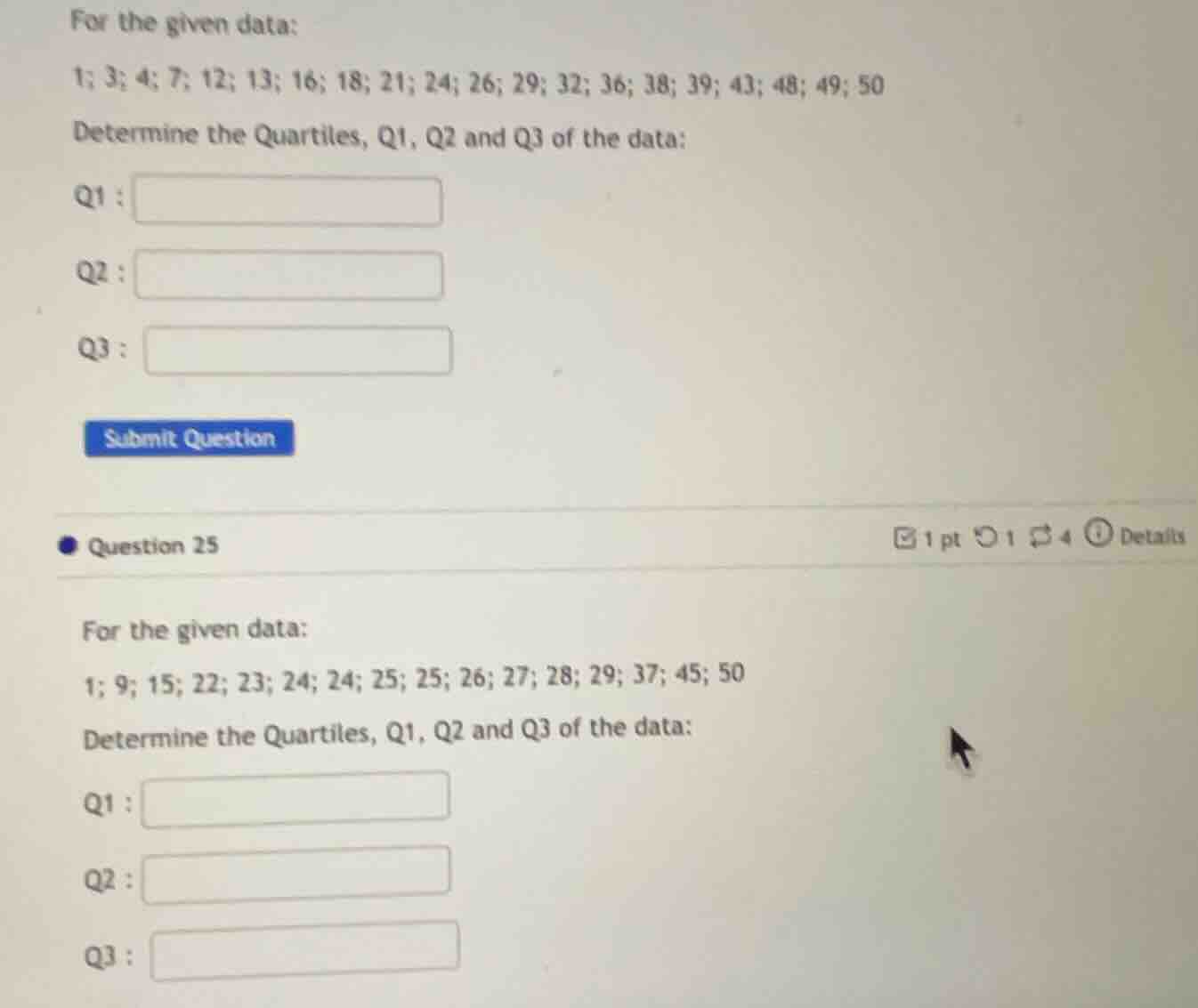
for the given data:
1; 3; 4; 7; 12; 13; 16; 18; 21; 24; 26; 29; 32; 36; 38; 39; 43; 48; 49; 50
determine the quartiles, q1, q2 and q3 of the data:
q1 :
q2 :
q3 :
submit question
question 25
for the given data:
1; 9; 15; 22; 23; 24; 24; 25; 25; 26; 27; 28; 29; 37; 45; 50
determine the quartiles, q1, q2 and q3 of the data:
q1 :
q2 :
q3 :
First Dataset: \( 1; 3; 4; 7; 12; 13; 16; 18; 21; 24; 26; 29; 32; 36; 38; 39; 43; 48; 49; 50 \)
Step 1: Find the number of data points (\( n \))
The dataset has \( n = 20 \) values (already sorted).
Step 2: Calculate positions for quartiles
- Q2 (Median): Position \( = \frac{n + 1}{2} = \frac{20 + 1}{2} = 10.5 \).
The median is the average of the 10th and 11th values: \( 24 \) (10th) and \( 26 \) (11th).
\( Q2 = \frac{24 + 26}{2} = 25 \).
- Q1 (Lower Quartile): Position \( = \frac{n + 1}{4} = \frac{20 + 1}{4} = 5.25 \).
This lies between the 5th and 6th values: \( 12 \) (5th) and \( 13 \) (6th).
\( Q1 = 12 + 0.25(13 - 12) = 12.25 \).
- Q3 (Upper Quartile): Position \( = \frac{3(n + 1)}{4} = \frac{3(20 + 1)}{4} = 15.75 \).
This lies between the 15th and 16th values: \( 38 \) (15th) and \( 39 \) (16th).
\( Q3 = 38 + 0.75(39 - 38) = 38.75 \).
Second Dataset: \( 1; 9; 15; 22; 23; 24; 24; 25; 25; 26; 27; 28; 29; 37; 45; 50 \)
Step 1: Find the number of data points (\( n \))
The dataset has \( n = 16 \) values (already sorted).
Step 2: Calculate positions for quartiles
- Q2 (Median): Position \( = \frac{n + 1}{2} = \frac{16 + 1}{2} = 8.5 \).
The median is the average of the 8th and 9th values: \( 25 \) (8th) and \( 25 \) (9th).
\( Q2 = \frac{25 + 25}{2} = 25 \).
- Q1 (Lower Quartile): Position \( = \frac{n + 1}{4} = \frac{16 + 1}{4} = 4.25 \).
This lies between the 4th and 5th values: \( 22 \) (4th) and \( 23 \) (5th).
\( Q1 = 22 + 0.25(23 - 22) = 22.25 \).
- Q3 (Upper Quartile): Position \( = \frac{3(n + 1)}{4} = \frac{3(16 + 1)}{4} = 12.75 \).
This lies between the 12th and 13th values: \( 28 \) (12th) and \( 29 \) (13th).
\( Q3 = 28 + 0.75(29 - 28) = 28.75 \).
Final Answers:
First Dataset:
- \( Q1 = 12.25 \)
- \( Q2 = 25 \)
- \( Q3 = 38.75 \)
Second Dataset:
- \( Q1 = 22.25 \)
- \( Q2 = 25 \)
- \( Q3 = 28.75 \)

Snap & solve any problem in the app
Get step-by-step solutions on Sovi AI
Photo-based solutions with guided steps
Explore more problems and detailed explanations
First Dataset: \( 1; 3; 4; 7; 12; 13; 16; 18; 21; 24; 26; 29; 32; 36; 38; 39; 43; 48; 49; 50 \)
Step 1: Find the number of data points (\( n \))
The dataset has \( n = 20 \) values (already sorted).
Step 2: Calculate positions for quartiles
- Q2 (Median): Position \( = \frac{n + 1}{2} = \frac{20 + 1}{2} = 10.5 \).
The median is the average of the 10th and 11th values: \( 24 \) (10th) and \( 26 \) (11th).
\( Q2 = \frac{24 + 26}{2} = 25 \).
- Q1 (Lower Quartile): Position \( = \frac{n + 1}{4} = \frac{20 + 1}{4} = 5.25 \).
This lies between the 5th and 6th values: \( 12 \) (5th) and \( 13 \) (6th).
\( Q1 = 12 + 0.25(13 - 12) = 12.25 \).
- Q3 (Upper Quartile): Position \( = \frac{3(n + 1)}{4} = \frac{3(20 + 1)}{4} = 15.75 \).
This lies between the 15th and 16th values: \( 38 \) (15th) and \( 39 \) (16th).
\( Q3 = 38 + 0.75(39 - 38) = 38.75 \).
Second Dataset: \( 1; 9; 15; 22; 23; 24; 24; 25; 25; 26; 27; 28; 29; 37; 45; 50 \)
Step 1: Find the number of data points (\( n \))
The dataset has \( n = 16 \) values (already sorted).
Step 2: Calculate positions for quartiles
- Q2 (Median): Position \( = \frac{n + 1}{2} = \frac{16 + 1}{2} = 8.5 \).
The median is the average of the 8th and 9th values: \( 25 \) (8th) and \( 25 \) (9th).
\( Q2 = \frac{25 + 25}{2} = 25 \).
- Q1 (Lower Quartile): Position \( = \frac{n + 1}{4} = \frac{16 + 1}{4} = 4.25 \).
This lies between the 4th and 5th values: \( 22 \) (4th) and \( 23 \) (5th).
\( Q1 = 22 + 0.25(23 - 22) = 22.25 \).
- Q3 (Upper Quartile): Position \( = \frac{3(n + 1)}{4} = \frac{3(16 + 1)}{4} = 12.75 \).
This lies between the 12th and 13th values: \( 28 \) (12th) and \( 29 \) (13th).
\( Q3 = 28 + 0.75(29 - 28) = 28.75 \).
Final Answers:
First Dataset:
- \( Q1 = 12.25 \)
- \( Q2 = 25 \)
- \( Q3 = 38.75 \)
Second Dataset:
- \( Q1 = 22.25 \)
- \( Q2 = 25 \)
- \( Q3 = 28.75 \)