QUESTION IMAGE
Question
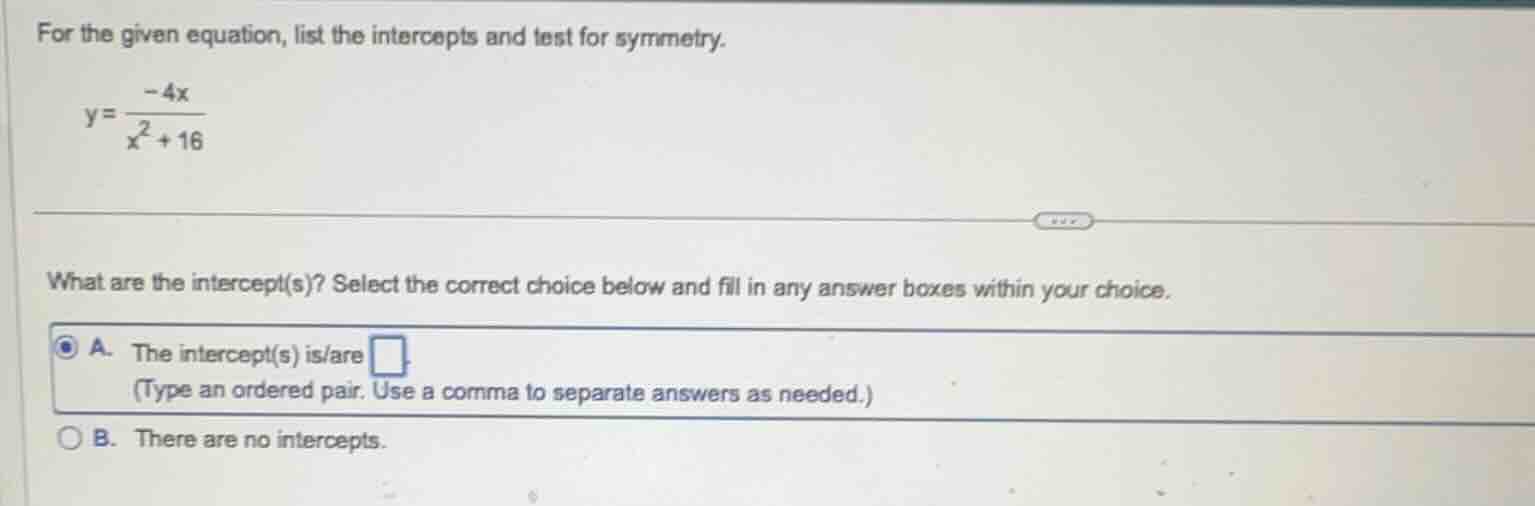
for the given equation, list the intercepts and test for symmetry.
$y = \frac{-4x}{x^2 + 16}$
what are the intercept(s)? select the correct choice below and fill in any answer boxes within your choice.
a. the intercept(s) is/are \square
(type an ordered pair. use a comma to separate answers as needed.)
b. there are no intercepts.
Step1: Find x-intercept (set y=0)
Set $y=0$, so $0=\frac{-4x}{x^2+16}$. Multiply both sides by $x^2+16$ (which is never 0):
$0=-4x$
Solve for $x$: $x=0$
The x-intercept is the ordered pair $(0,0)$.
Step2: Find y-intercept (set x=0)
Substitute $x=0$ into the equation:
$y=\frac{-4(0)}{0^2+16}=0$
The y-intercept is the ordered pair $(0,0)$.
Step3: Test symmetry about y-axis
Replace $x$ with $-x$:
$y=\frac{-4(-x)}{(-x)^2+16}=\frac{4x}{x^2+16}$
This is not equal to the original $\frac{-4x}{x^2+16}$, so no symmetry about y-axis.
Step4: Test symmetry about origin
Replace $x$ with $-x$ and $y$ with $-y$:
$-y=\frac{-4(-x)}{(-x)^2+16}=\frac{4x}{x^2+16}$
Multiply both sides by $-1$: $y=\frac{-4x}{x^2+16}$, which matches the original equation. So symmetric about the origin.

Snap & solve any problem in the app
Get step-by-step solutions on Sovi AI
Photo-based solutions with guided steps
Explore more problems and detailed explanations
Intercepts:
A. The intercept(s) is/are $(0,0)$
Symmetry:
The graph is symmetric about the origin, and has no symmetry about the y-axis or x-axis.