QUESTION IMAGE
Question
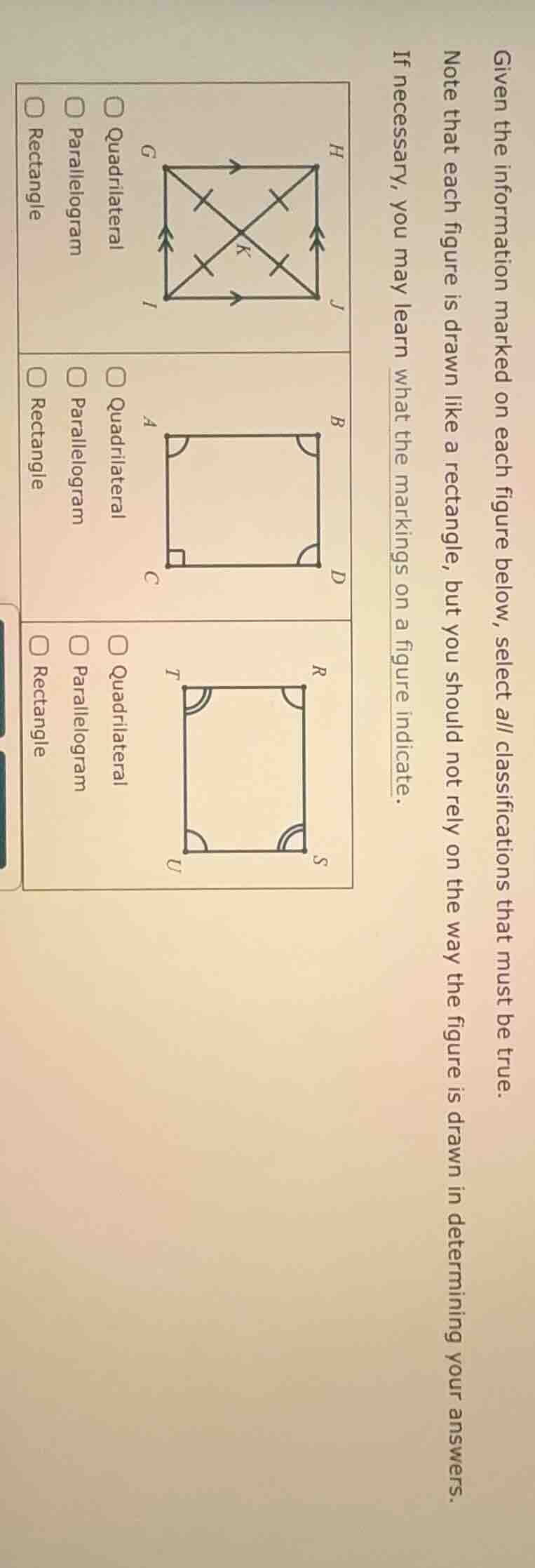
given the information marked on each figure below, select all classifications that must be true. note that each figure is drawn like a rectangle, but you should not rely on the way the figure is drawn in determining your answers. if necessary, you may learn what the markings on a figure indicate.
First Figure (GHIJ with diagonals and sides marked):
- Quadrilateral: Any four - sided figure is a quadrilateral, so this must be true.
- Parallelogram: The markings show that opposite sides are parallel (arrow markings) and diagonals bisect each other (cross markings on diagonals), which are properties of a parallelogram.
- Rectangle: A parallelogram with congruent diagonals (marked as equal with cross markings) is a rectangle.
- Quadrilateral: It has four sides, so it is a quadrilateral.
- Parallelogram: If we consider the angles, in a quadrilateral, if some angles are right angles and others are marked, but since it has four sides and we can infer from the right - angle markings (at A and C) and the other angle markings that opposite sides are parallel (since consecutive angles are supplementary in a parallelogram - like situation). Also, a quadrilateral with right angles at some vertices and the figure being a four - sided closed figure with angle markings consistent with a parallelogram.
- Rectangle: A parallelogram with a right angle (angle C is a right angle) is a rectangle.
- Quadrilateral: It has four sides, so it is a quadrilateral.
- Parallelogram: The angle markings (two pairs of congruent angles) suggest that opposite sides are parallel (since consecutive angles are supplementary in a parallelogram).
- Rectangle: A parallelogram with angle markings that are consistent with right angles? Wait, no. Wait, the angle markings here: if we look at the angle arcs, two angles at the top and two at the bottom. Wait, actually, in a quadrilateral, if it is a parallelogram (from angle markings suggesting opposite angles are equal) and if we assume that the angles are right angles? No, wait, the key is: a quadrilateral is always a quadrilateral. For parallelogram, the angle markings (two pairs of equal - measure angles) imply that opposite sides are parallel (since in a quadrilateral, if opposite angles are equal, it is a parallelogram). But for rectangle, we need right angles. Wait, the figure is drawn like a rectangle, but we should rely on markings. Wait, the angle markings: if we have two angles at the top (R and T) with the same arc and two at the bottom (S and U) with the same arc. But without a right - angle marking, can we say it's a rectangle? Wait, no. Wait, maybe I made a mistake. Wait, the problem says "select all classifications that must be true".
Wait, re - evaluating:
- Quadrilateral: Four - sided, so must be true.
- Parallelogram: The angle markings (two pairs of congruent angles) mean that opposite angles are equal, which is a property of a parallelogram. So it is a parallelogram.
- Rectangle: Wait, no. Because we don't have a right - angle marking. Wait, maybe the angle arcs are of right angles? The problem says "you may learn what the markings on a figure indicate". If the angle markings are right - angle arcs (the curved markings for right angles), then:
If the angle markings are right angles, then a parallelogram with a right angle is a rectangle. But from the diagram, the angle markings at R, S, T, U: if two of the top angles and two of the bottom angles are right angles (the curved markings for right angles), then:
- Quadrilateral: yes.
- Parallelogram: yes (opposite sides parallel as it's a four - sided figure with right angles implying opposite sides parallel).
- Rectangle: yes (parallelogram with right angles).
Wait, maybe the angle markings are right - angle indicators. So:

Snap & solve any problem in the app
Get step-by-step solutions on Sovi AI
Photo-based solutions with guided steps
Explore more problems and detailed explanations
Quadrilateral (selected), Parallelogram (selected), Rectangle (selected)