QUESTION IMAGE
Question
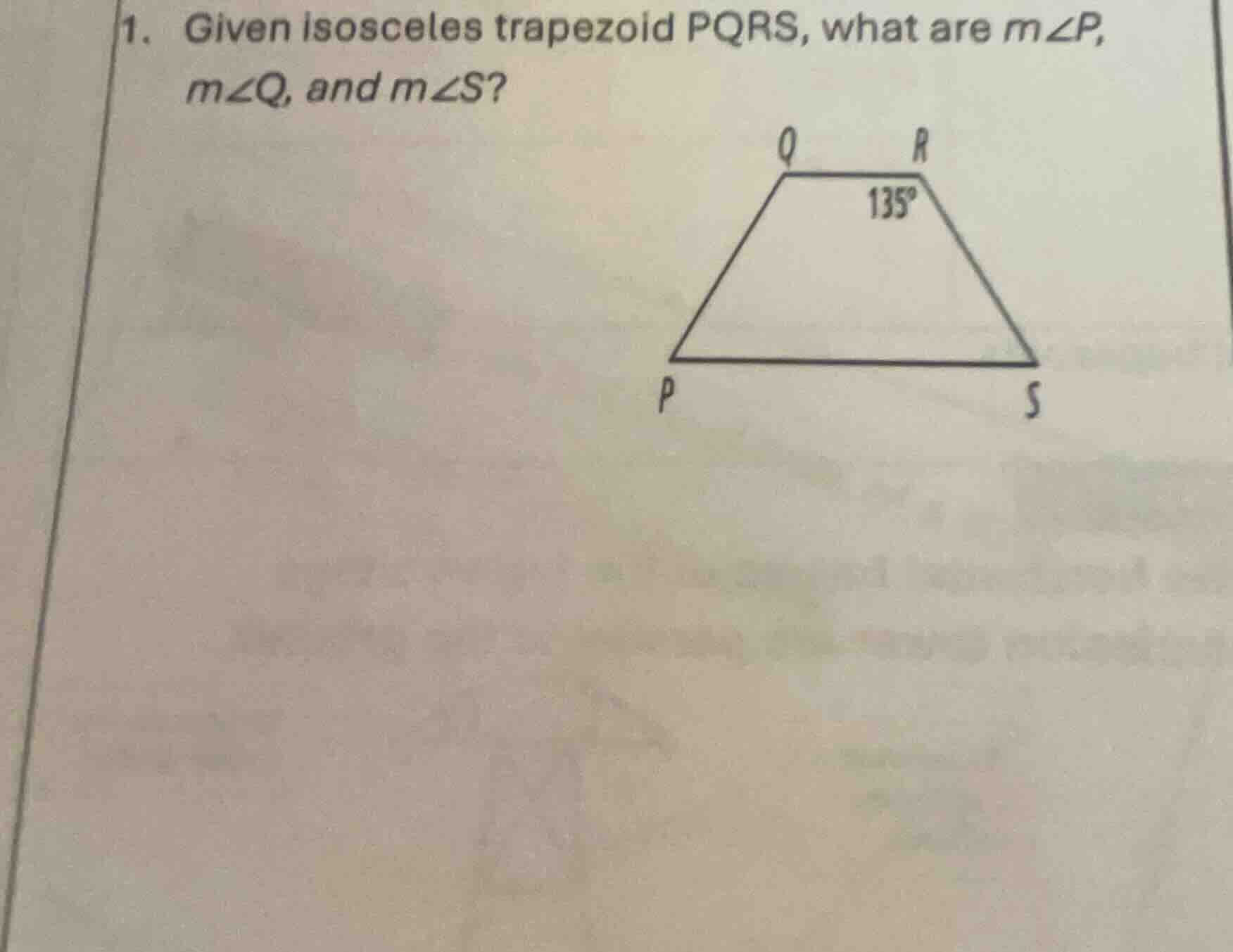
- given isosceles trapezoid pqrs, what are ( mangle p ), ( mangle q ), and ( mangle s )?
Step1: Recall properties of isosceles trapezoid
In an isosceles trapezoid, consecutive angles between the bases are supplementary (sum to \(180^\circ\)), and base angles are equal. Also, angles adjacent to each non - parallel side are supplementary. Here, \(QR\parallel PS\), so \(\angle Q\) and \(\angle P\) are supplementary, \(\angle R\) and \(\angle S\) are supplementary, and \(\angle P=\angle S\), \(\angle Q = \angle R\). Given \(m\angle R = 135^\circ\), so \(m\angle Q=m\angle R = 135^\circ\) (base angles of isosceles trapezoid are equal for the upper base).
Step2: Calculate \(m\angle P\) and \(m\angle S\)
Since \(\angle Q\) and \(\angle P\) are supplementary (because \(QR\parallel PS\) and they are same - side interior angles), we have \(m\angle P=180^\circ - m\angle Q\). Substituting \(m\angle Q = 135^\circ\), we get \(m\angle P=180^\circ- 135^\circ = 45^\circ\). And since \(\angle P=\angle S\) (base angles of isosceles trapezoid), \(m\angle S = 45^\circ\).

Snap & solve any problem in the app
Get step-by-step solutions on Sovi AI
Photo-based solutions with guided steps
Explore more problems and detailed explanations
\(m\angle P = 45^\circ\), \(m\angle Q=135^\circ\), \(m\angle S = 45^\circ\)