QUESTION IMAGE
Question
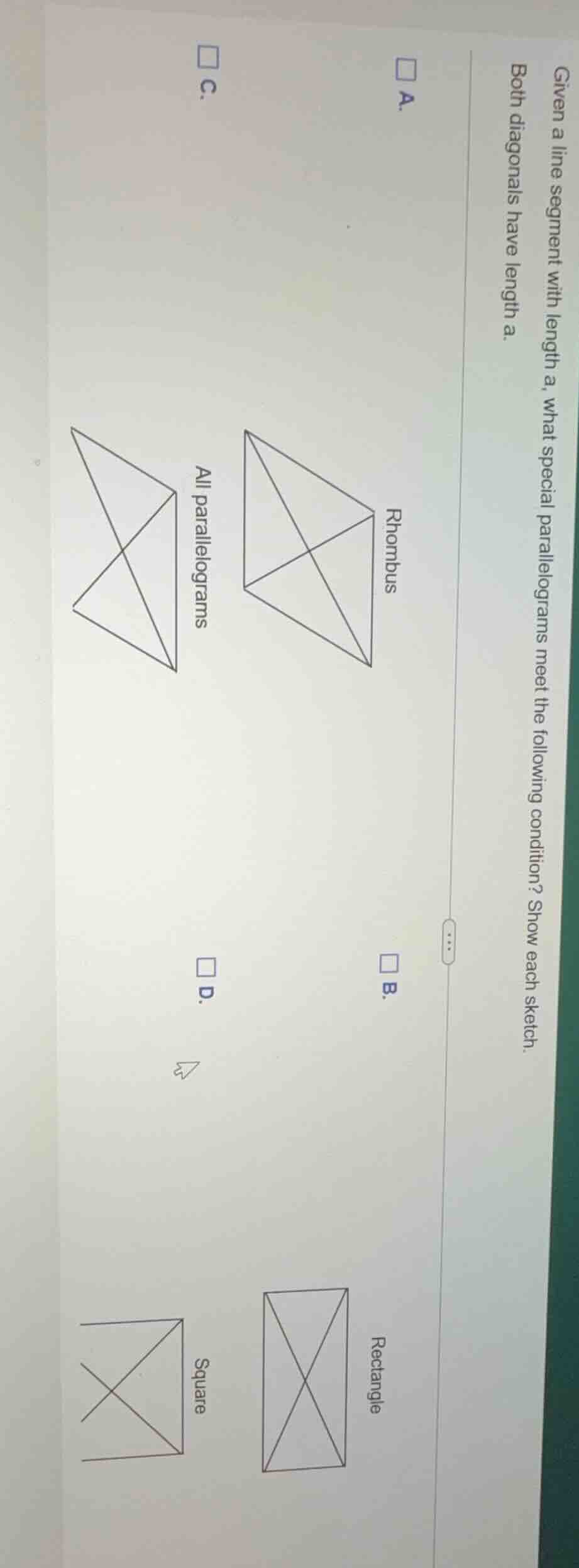
given a line segment with length a, what special parallelograms meet the following condition? show each sketch. both diagonals have length a.
□ a. rhombus
□ b. rectangle
□ c. all parallelograms
□ d. square
Step1: Recall properties of parallelograms
- Rhombus: Diagonals are not equal in length (they bisect each other at right angles, but lengths differ unless it's a square).
- Rectangle: Diagonals are equal in length (property of rectangles: diagonals of a rectangle are congruent).
- All parallelograms: In general parallelograms, diagonals bisect each other but are not necessarily equal. Only rectangles (and squares, which are special rectangles) have equal diagonals among parallelograms.
- Square: A square is a special rectangle (and rhombus), so its diagonals are equal. But we need to check which parallelograms have diagonals of length \(a\) (equal length).
Step2: Analyze each option
- Option A (Rhombus): Diagonals of a rhombus are not equal unless it's a square. So a general rhombus does not have equal diagonals. Eliminate A.
- Option B (Rectangle): By property of rectangles, diagonals are equal. So if a rectangle is a parallelogram with diagonals of length \(a\), it satisfies the condition.
- Option C (All parallelograms): As mentioned, most parallelograms (like rhombus, non - rectangular parallelograms) do not have equal diagonals. So this is incorrect.
- Option D (Square): A square is a special case of a rectangle (and rhombus). While a square has equal diagonals, the set of rectangles (including squares) is a more general set that satisfies the "diagonals equal" property among parallelograms. But we need to see which option is correct. Wait, actually, the question is about which special parallelograms have both diagonals of length \(a\) (i.e., equal diagonals). The property of equal diagonals in parallelograms is a defining property of rectangles (and squares, which are rectangles). So rectangles (including squares) have equal diagonals. But let's re - check:
Wait, the key is: In a parallelogram, if diagonals are equal, then it is a rectangle (theorem). So the parallelograms with equal diagonals are rectangles (and squares, which are special rectangles). So among the options, rectangle (B) and square (D) have equal diagonals. But let's check the options again. Wait, the problem says "what special parallelograms meet the following condition? Both diagonals have length \(a\)".
Wait, maybe I misread. Let's re - express:
- Rhombus: diagonals are perpendicular bisectors, not equal (unless square).
- Rectangle: diagonals are equal (by definition of rectangle: a parallelogram with right angles, and diagonals are equal).
- All parallelograms: No, only rectangles (and squares) in parallelograms have equal diagonals.
- Square: A square is a rectangle with all sides equal. So square is a special rectangle.
So the parallelograms with equal diagonals are rectangles (and squares). So among the options, B (Rectangle) and D (Square) have equal diagonals. But let's check the original problem's options. Wait, maybe the question is which of the given options (A - D) are parallelograms with equal diagonals.
Wait, the correct answer: The property of a parallelogram having equal diagonals is equivalent to it being a rectangle (including square). So:
- Rectangle (B): Yes, diagonals are equal.
- Square (D): Yes, diagonals are equal (since square is a rectangle).
- Rhombus (A): No.
- All parallelograms (C): No.
But maybe the question is a multiple - choice where we have to select the correct ones. Wait, the user's problem has checkboxes for A, B, C, D. Let's re - evaluate:
The theorem: In a parallelogram, if the diagonals are equal, then the parallelogram is a rectangle. So the set of parallelograms with equ…

Snap & solve any problem in the app
Get step-by-step solutions on Sovi AI
Photo-based solutions with guided steps
Explore more problems and detailed explanations
B. Rectangle, D. Square