QUESTION IMAGE
Question
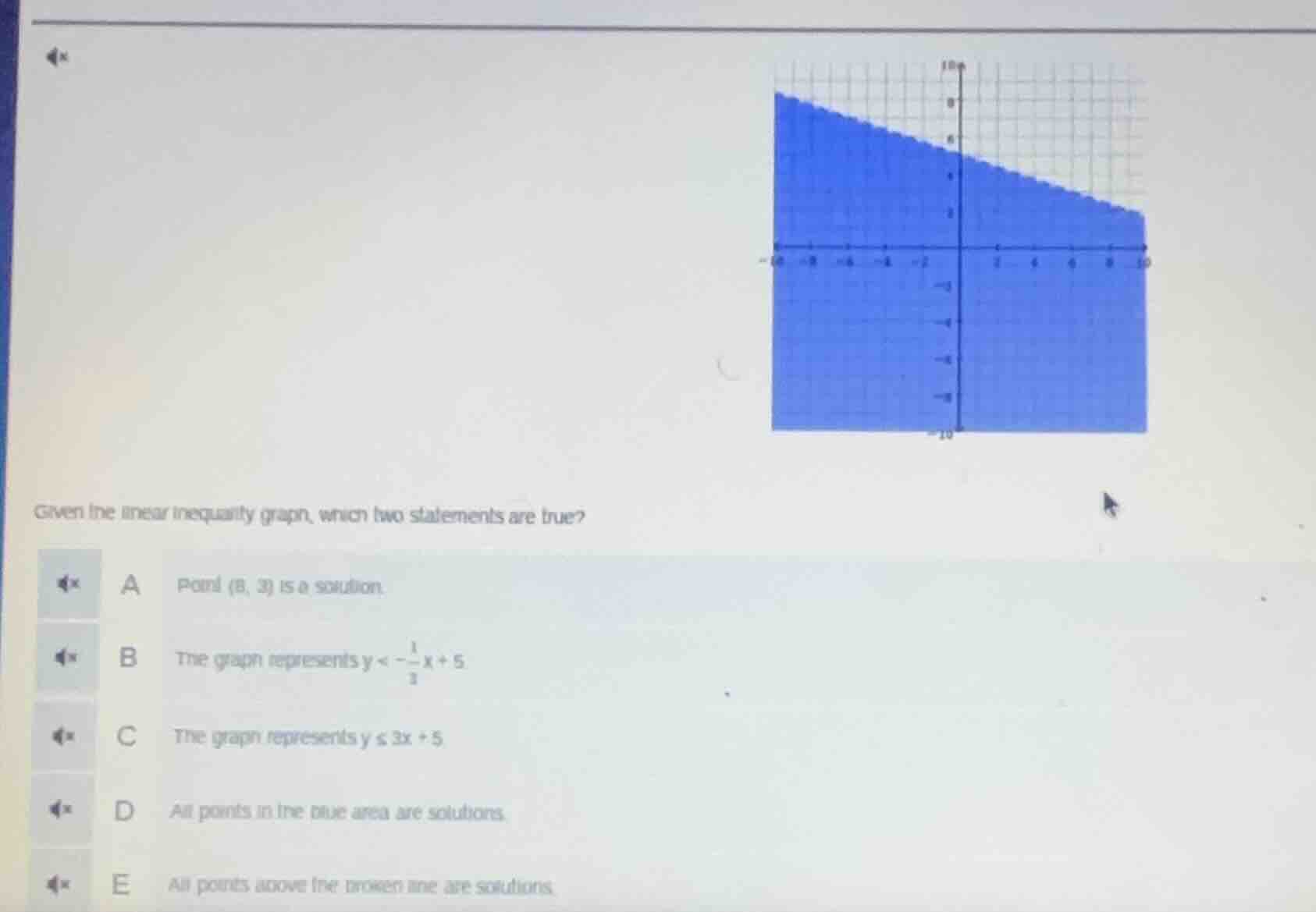
given the linear inequality graph, which two statements are true? a point (8, 3) is a solution. b the graph represents $y < -\frac{1}{2}x + 5$. c the graph represents $y leq 3x + 5$ d all points in the blue area are solutions. e all points above the broken line are solutions.
Brief Explanations
- Analyze Option A: Substitute \( x = 8 \), \( y = 3 \) into \( y<-\frac{1}{2}x + 5 \). Calculate \( -\frac{1}{2}(8)+5=-4 + 5 = 1 \). Since \( 3<1 \) is false, but wait, maybe the inequality is \( y\leq-\frac{1}{2}x + 5 \)? Wait, no, the line is dashed? Wait, the graph: let's re - check. Wait, the slope: from the graph, the line passes through (0,5) and (10,0), so slope \( m=\frac{0 - 5}{10-0}=-\frac{1}{2} \), equation \( y=-\frac{1}{2}x + 5 \). The line is dashed (since the inequality is strict or not? Wait, the blue area: if the line is dashed, then the inequality is \( y<-\frac{1}{2}x + 5 \). But for point (8,3): \( 3<-\frac{1}{2}(8)+5=1 \)? No, 3>1. Wait, maybe I made a mistake. Wait, maybe the line is solid? Wait, the graph shows a dashed line? Wait, the user's graph: the line is dashed? Or solid? Wait, the blue area: let's think again. Wait, the options: D says "All points in the blue area are solutions" – that's a basic property of inequality graphs, the shaded region (blue) contains the solutions. So D is true. For B: the slope is \( -\frac{1}{2} \), y - intercept 5, and the line is dashed (so strict inequality \( y<-\frac{1}{2}x + 5 \)), so B is true? Wait, no, let's check A again. Wait, maybe the line is solid? Wait, the graph in the problem: if the line is solid, then inequality is \( y\leq-\frac{1}{2}x + 5 \). Then for (8,3): \( 3\leq-\frac{1}{2}(8)+5=1 \)? No, 3>1. So A is false. Wait, maybe I messed up the slope. Wait, from (0,5) to (10,0): rise over run is \( \frac{0 - 5}{10-0}=-\frac{1}{2} \), correct. So equation \( y =-\frac{1}{2}x+5 \). Now, the shaded area: if the line is dashed, then the inequality is \( y<-\frac{1}{2}x + 5 \), and the shaded area is below or above? Wait, when x = 0, the shaded area includes y less than 5? Wait, no, the blue area in the graph: looking at the grid, the blue area is below the line? Wait, no, the graph shows blue area above? Wait, no, the coordinates: x from - 10 to 10, y from - 10 to 10. The line goes from top - left to bottom - right. The blue area: if at x = 0, the blue area is above y = 5? No, the graph's blue area: let's see, the line is from ( - 10,10) to (10,0)? No, wait, the y - intercept is 5, x - intercept 10. So the line is \( y=-\frac{1}{2}x + 5 \). The shaded region: if the line is dashed, and the shaded area is below the line? Wait, no, when we test a point, say (0,0): plug into \( y<-\frac{1}{2}x + 5 \), 0 < 5, which is true. But in the graph, the blue area is on the left? Wait, maybe the graph is shaded above the line? Wait, this is confusing. But the key points: D is a general truth about inequality graphs – the shaded (blue) area contains the solutions. So D is true. B: the inequality is \( y<-\frac{1}{2}x + 5 \), which matches the line's equation (slope \( -\frac{1}{2} \), y - intercept 5) and the dashed line (strict inequality), so B is true? Wait, no, maybe the line is solid. Wait, the options: D says "All points in the blue area are solutions" – that's always true for inequality graphs (the shaded region is the solution set). So D is true. For B: the equation of the line is \( y =-\frac{1}{2}x+5 \), and the inequality is \( y<-\frac{1}{2}x + 5 \) (dashed line), so B is true. Wait, but earlier A: (8,3). Let's plug into \( y<-\frac{1}{2}x + 5 \): \( 3<-\frac{1}{2}(8)+5=1 \)? No, 3>1, so A is false. C: the slope is \( -\frac{1}{2} \), not 3, so C is false. E: "All points above the broken line are solutions" – if the line is dashed and the solution is below the line, then E is false. So the true statements are B and D? Wait, no, maybe I made a mistake. Wait, t…

Snap & solve any problem in the app
Get step-by-step solutions on Sovi AI
Photo-based solutions with guided steps
Explore more problems and detailed explanations
B. The graph represents \( y<-\frac{1}{2}x + 5 \)
D. All points in the blue area are solutions