QUESTION IMAGE
Question
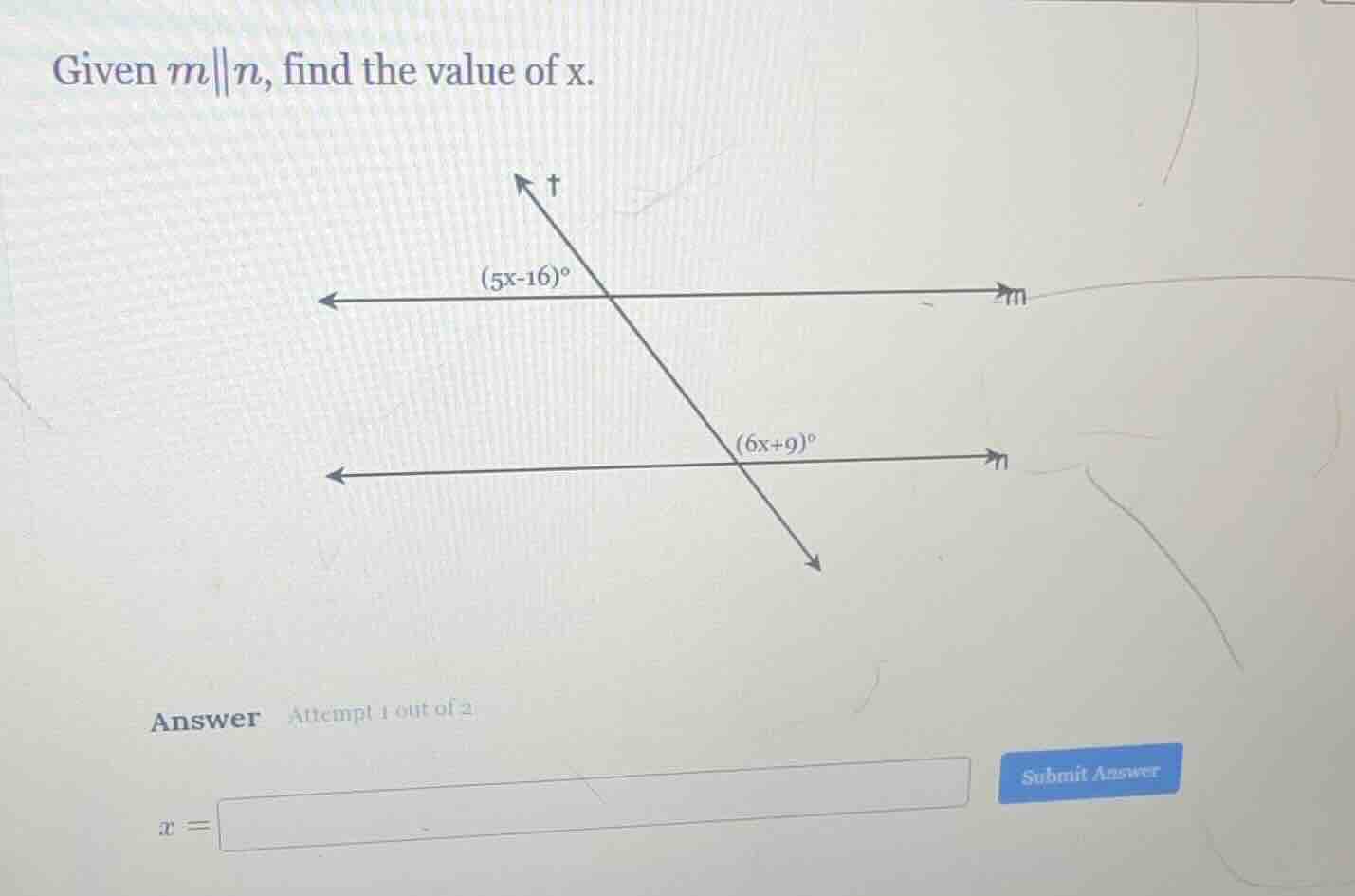
given ( m parallel n ), find the value of ( x ).
Step1: Identify angle relationship
Since \( m \parallel n \) and \( t \) is a transversal, the two angles \( (5x - 16)^\circ \) and \( (6x + 9)^\circ \) are same - side interior angles? Wait, no, actually, looking at the diagram, the angle \( (5x - 16)^\circ \) and the angle adjacent to \( (6x + 9)^\circ \) (vertically opposite or supplementary? Wait, no, when two parallel lines are cut by a transversal, same - side interior angles are supplementary, but also, the angle \( (5x - 16)^\circ \) and \( (6x + 9)^\circ \) are actually supplementary? Wait, no, let's re - examine. Wait, the angle \( (5x - 16)^\circ \) and the angle that is vertical to the angle adjacent to \( (6x + 9)^\circ \)? Wait, no, actually, the two angles \( (5x - 16)^\circ \) and \( (6x + 9)^\circ \) are same - side interior angles? Wait, no, when \( m\parallel n \), and \( t \) is a transversal, the angle \( (5x - 16)^\circ \) and \( (6x + 9)^\circ \) are supplementary? Wait, no, actually, the correct relationship is that they are same - side interior angles, so they should be supplementary? Wait, no, let's think again. Wait, the angle \( (5x - 16)^\circ \) and the angle \( (6x + 9)^\circ \) are actually supplementary? Wait, no, maybe they are alternate - exterior or alternate - interior? Wait, no, looking at the diagram, the angle \( (5x - 16)^\circ \) and \( (6x + 9)^\circ \) are same - side interior angles, so their sum is \( 180^\circ \)? Wait, no, that can't be. Wait, no, actually, the angle \( (5x - 16)^\circ \) and \( (6x + 9)^\circ \) are supplementary because they are same - side interior angles. Wait, let's check: if \( m\parallel n \), then same - side interior angles are supplementary. So \( (5x - 16)+(6x + 9)=180 \).
Step2: Solve the equation
Combine like terms: \( 5x-16 + 6x + 9=180 \)
\( 11x-7 = 180 \)
Add 7 to both sides: \( 11x=180 + 7=187 \)
Divide both sides by 11: \( x=\frac{187}{11}=17 \)
Wait, wait, that's a mistake. Wait, no, actually, the two angles \( (5x - 16)^\circ \) and \( (6x + 9)^\circ \) are actually supplementary? Wait, no, maybe they are alternate - interior angles? Wait, no, let's look at the diagram again. The angle \( (5x - 16)^\circ \) and \( (6x + 9)^\circ \): when \( m\parallel n \), the angle \( (5x - 16)^\circ \) and \( (6x + 9)^\circ \) are same - side interior angles, so they should be supplementary. Wait, but let's re - do the equation.
Wait, \( (5x-16)+(6x + 9)=180 \)
\( 5x+6x-16 + 9=180 \)
\( 11x-7 = 180 \)
\( 11x=180 + 7=187 \)
\( x = 17 \)
Wait, but let's check the other way. Maybe the angles are equal? If they are alternate - interior angles, then \( 5x-16=6x + 9 \), which would give \( -x=25 \), \( x=-25 \), which is not possible. So the correct relationship is supplementary. So \( 5x-16+6x + 9 = 180 \), leading to \( 11x-7=180 \), \( 11x = 187 \), \( x = 17 \).

Snap & solve any problem in the app
Get step-by-step solutions on Sovi AI
Photo-based solutions with guided steps
Explore more problems and detailed explanations
\( x = 17 \)