QUESTION IMAGE
Question
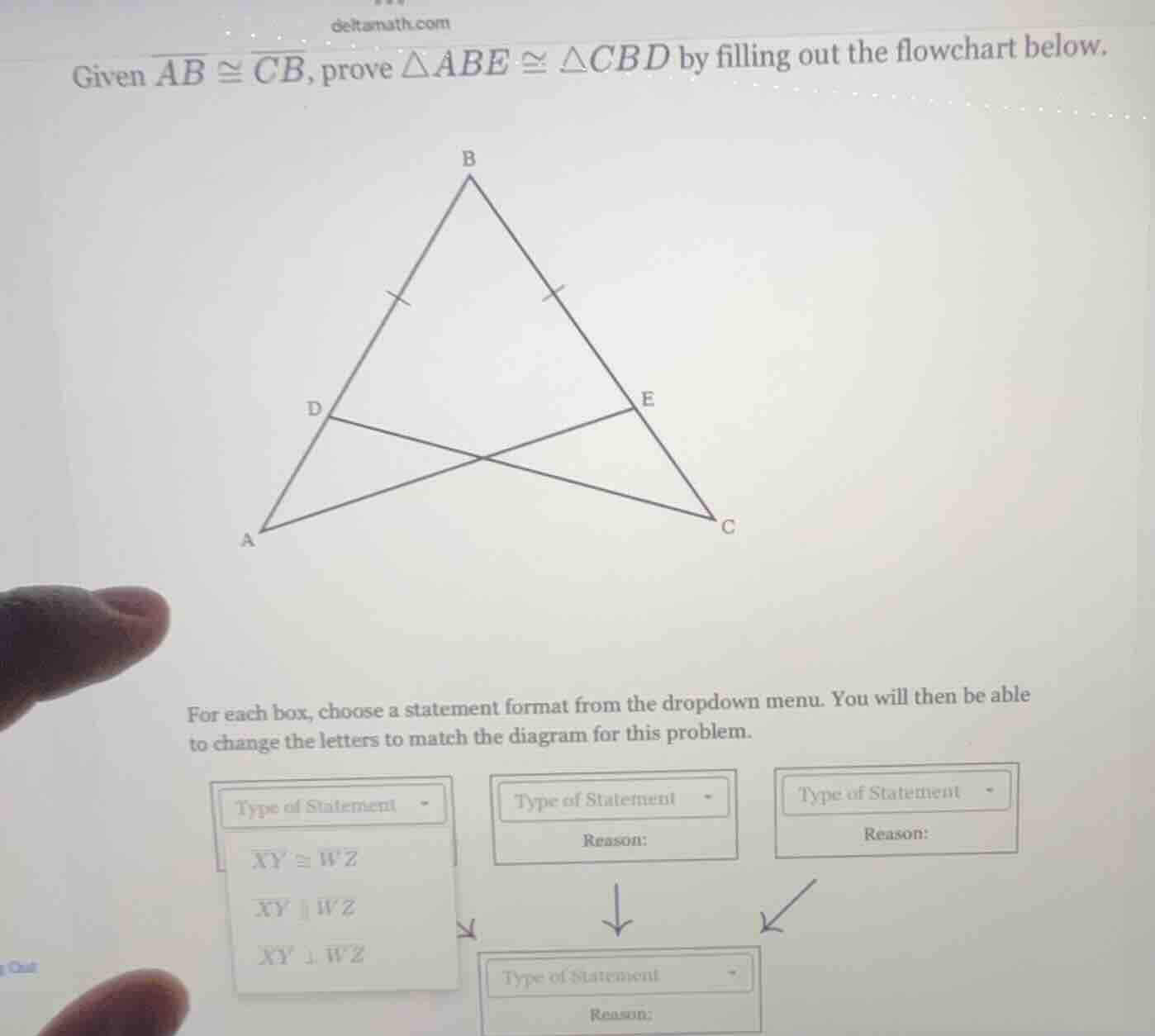
given \\(\overline{ab} \cong \overline{cb}\\), prove \\(\triangle abe \cong \triangle cbd\\) by filling out the flowchart below.
for each box, choose a statement format from the dropdown menu. you will then be able to change the letters to match the diagram for this problem.
type of statement
\\(\overline{xy} \cong \overline{wz}\\)
\\(\overline{xy} \parallel \overline{wz}\\)
\\(\overline{xy} \perp \overline{wz}\\)
type of statement
reason:
type of statement
reason:
type of statement
reason:
Step1: Identify Common Angle
$\angle ABE \cong \angle CBD$ (Vertical angles or common angle at B? Wait, actually, $\angle B$ is common? Wait, no, looking at the diagram, $\angle ABE$ and $\angle CBD$: Wait, AB ≅ CB (given). Then, let's see the triangles: $\triangle ABE$ and $\triangle CBD$.
First, $\angle B$ is common to both triangles? Wait, no, the angle at B: in $\triangle ABE$ and $\triangle CBD$, $\angle ABE$ and $\angle CBD$ are the same angle (since they are the angle at vertex B for both triangles). So $\angle ABE \cong \angle CBD$ (Reflexive property, or common angle).
Step2: Identify Equal Sides
Given $\overline{AB} \cong \overline{CB}$.
Step3: Identify Another Pair of Sides or Angles
Looking at the diagram, $\overline{BE}$ and $\overline{BD}$: Wait, the marks on AB and CB: AB and CB are marked as equal (the tick marks). So AB ≅ CB (given). Then, what about $\overline{BE}$ and $\overline{BD}$? Wait, maybe $\overline{BE} \cong \overline{BD}$? Wait, no, maybe the triangles have another pair. Wait, maybe $\angle A \cong \angle C$? No, that's not given. Wait, maybe it's SAS. Let's check:
If we have AB ≅ CB (given), $\angle ABE \cong \angle CBD$ (common angle), and then BE ≅ BD? Wait, no, maybe the diagram has BE and BD as equal? Wait, the original triangle at the top: B, with D on AB and E on CB, so AB and CB are equal (tick marks), so AB = CB. Then, D is on AB, E is on CB, so AD = AB - BD, CE = CB - BE. But maybe BD = BE? Wait, the diagram has tick marks on AB and CB, so AB ≅ CB. Then, angle at B is common, so $\angle ABE = \angle CBD$. Then, if we can show BE ≅ BD, but maybe that's not necessary. Wait, maybe the triangles are congruent by SAS: AB ≅ CB, $\angle ABE \cong \angle CBD$, and BE ≅ BD? No, maybe the other way. Wait, maybe $\overline{AE} \cong \overline{CD}$? No, that's what we need to prove. Wait, maybe the flowchart is to fill in the statements and reasons.
Let's structure the proof:
To prove $\triangle ABE \cong \triangle CBD$:
- $\overline{AB} \cong \overline{CB}$ (Given)
- $\angle ABE \cong \angle CBD$ (Common angle, or Reflexive property)
- $\overline{BE} \cong \overline{BD}$ (Wait, no, maybe $\overline{BE} \cong \overline{BD}$? Wait, the diagram has D on AB and E on CB, with AB ≅ CB. Maybe BD = BE? If the top triangle is isoceles (AB ≅ CB), then maybe BD = BE. So $\overline{BE} \cong \overline{BD}$ (Given? Or maybe from the diagram).
Wait, maybe the steps are:
- Statement 1: $\overline{AB} \cong \overline{CB}$ (Given)
- Reason 1: Given
- Statement 2: $\angle ABE \cong \angle CBD$ (Common angle)
- Reason 2: Reflexive property (or common angle)
- Statement 3: $\overline{BE} \cong \overline{BD}$ (If the diagram shows BD ≅ BE, maybe from the tick marks? Wait, the top triangle has AB and CB with tick marks, so AB ≅ CB. Then D is on AB, E is on CB, so if BD = BE, then AB - BD = CB - BE, so AD = CE. But maybe the triangles are congruent by SAS: AB ≅ CB, $\angle ABE \cong \angle CBD$, BE ≅ BD. Then SAS would apply.
So the flowchart would have:
First box: $\overline{AB} \cong \overline{CB}$ (Type of Statement: $\overline{XY} \cong \overline{WZ}$ with XY=AB, WZ=CB)
Reason: Given
Second box: $\angle ABE \cong \angle CBD$ (Type of Statement: $\angle XY Z \cong \angle W V U$)
Reason: Common angle (or Reflexive property)
Third box: $\overline{BE} \cong \overline{BD}$ (Type of Statement: $\overline{XY} \cong \overline{WZ}$ with XY=BE, WZ=BD)
Reason: Maybe given, or from the diagram (if BD and BE are marked equal)
Then the conclusion: $\triangle ABE \cong \triangle CBD$ by SAS.
But since the problem…

Snap & solve any problem in the app
Get step-by-step solutions on Sovi AI
Photo-based solutions with guided steps
Explore more problems and detailed explanations
To prove $\triangle ABE \cong \triangle CBD$:
- Statement: $\overline{AB} \cong \overline{CB}$
Type of Statement: $\overline{XY} \cong \overline{WZ}$ (with $XY = AB$, $WZ = CB$)
Reason: Given
- Statement: $\angle ABE \cong \angle CBD$
Type of Statement: $\angle XY Z \cong \angle W V U$ (with $\angle XYZ = \angle ABE$, $\angle WVU = \angle CBD$)
Reason: Reflexive Property (common angle at $B$)
- Statement: $\overline{BE} \cong \overline{BD}$
Type of Statement: $\overline{XY} \cong \overline{WZ}$ (with $XY = BE$, $WZ = BD$)
Reason: (If $BD = BE$ from diagram, e.g., tick marks or given; otherwise, adjust based on diagram)
By the SAS Congruence Criterion, $\triangle ABE \cong \triangle CBD$.
(Note: The specific dropdown choices depend on the diagram’s markings, but the logical flow uses SAS with the given $AB \cong CB$, common angle $\angle ABE \cong \angle CBD$, and a third pair of equal sides/angles.)