QUESTION IMAGE
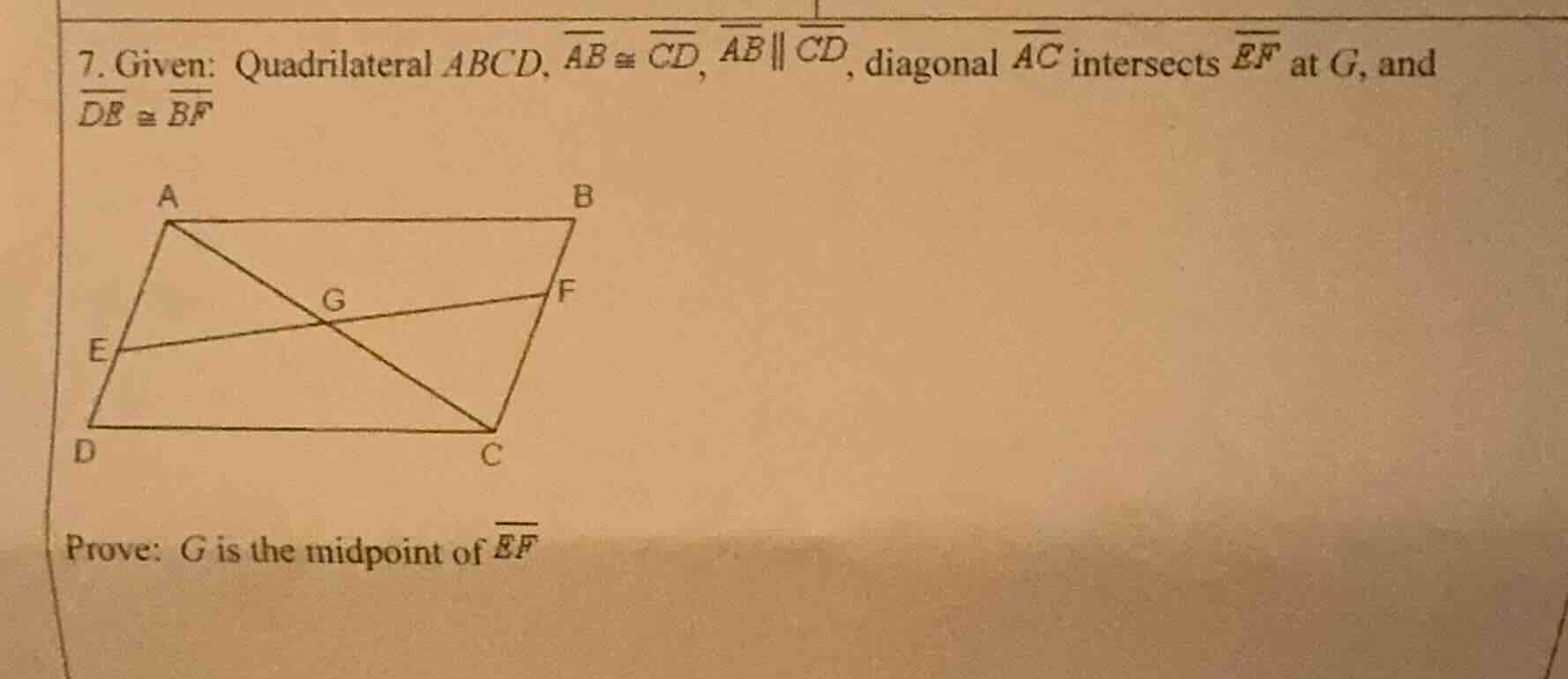
Question
- given: quadrilateral abcd, \\(\overline{ab} \cong \overline{cd}\\), \\(\overline{ab} \parallel \overline{cd}\\), diagonal \\(\overline{ac}\\) intersects \\(\overline{ef}\\) at g, and \\(\overline{de} \cong \overline{bf}\\)
prove: g is the midpoint of \\(\overline{ef}\\)
Step1: Prove ABCD is a parallelogram
Given \( \overline{AB} \cong \overline{CD} \) and \( \overline{AB} \parallel \overline{CD} \), by the definition of a parallelogram (a quadrilateral with one pair of opposite sides both congruent and parallel), quadrilateral \( ABCD \) is a parallelogram. Thus, \( \overline{AD} \cong \overline{BC} \) (opposite sides of a parallelogram are congruent) and \( \angle D \cong \angle B \) (opposite angles of a parallelogram are congruent).
Step2: Prove \( \triangle ADE \cong \triangle CBF \)
We know \( \overline{DE} \cong \overline{BF} \) (given), \( \overline{AD} \cong \overline{BC} \) (from Step 1), and \( \angle D \cong \angle B \) (from Step 1). By the Side - Angle - Side (SAS) congruence criterion, \( \triangle ADE \cong \triangle CBF \).
Step3: Prove \( \overline{AE} \cong \overline{CF} \)
Since \( \triangle ADE \cong \triangle CBF \) (from Step 2), their corresponding sides are congruent. So, \( \overline{AE} \cong \overline{CF} \).
Step4: Prove \( \angle EAG \cong \angle FCG \)
Since \( AB \parallel CD \), \( \angle BAC \cong \angle DCA \) (alternate interior angles). Also, from \( \triangle ADE \cong \triangle CBF \), \( \angle DAE \cong \angle BCF \). Then \( \angle DAE+\angle BAC=\angle BCF + \angle DCA \), so \( \angle EAG \cong \angle FCG \).
Step5: Prove \( \triangle AEG \cong \triangle CFG \)
We have \( \overline{AE} \cong \overline{CF} \) (from Step 3), \( \angle EAG \cong \angle FCG \) (from Step 4), and \( \angle AGE \cong \angle CGF \) (vertical angles are congruent). By the Angle - Angle - Side (AAS) congruence criterion, \( \triangle AEG \cong \triangle CFG \).
Step6: Prove G is the midpoint of \( \overline{EF} \)
Since \( \triangle AEG \cong \triangle CFG \) (from Step 5), their corresponding sides \( \overline{EG} \cong \overline{FG} \). By the definition of a midpoint (a point that divides a segment into two congruent segments), \( G \) is the midpoint of \( \overline{EF} \).

Snap & solve any problem in the app
Get step-by-step solutions on Sovi AI
Photo-based solutions with guided steps
Explore more problems and detailed explanations
By proving the necessary congruences of triangles and using the properties of parallelograms, we have shown that \( G \) is the midpoint of \( \overline{EF} \).