QUESTION IMAGE
Question
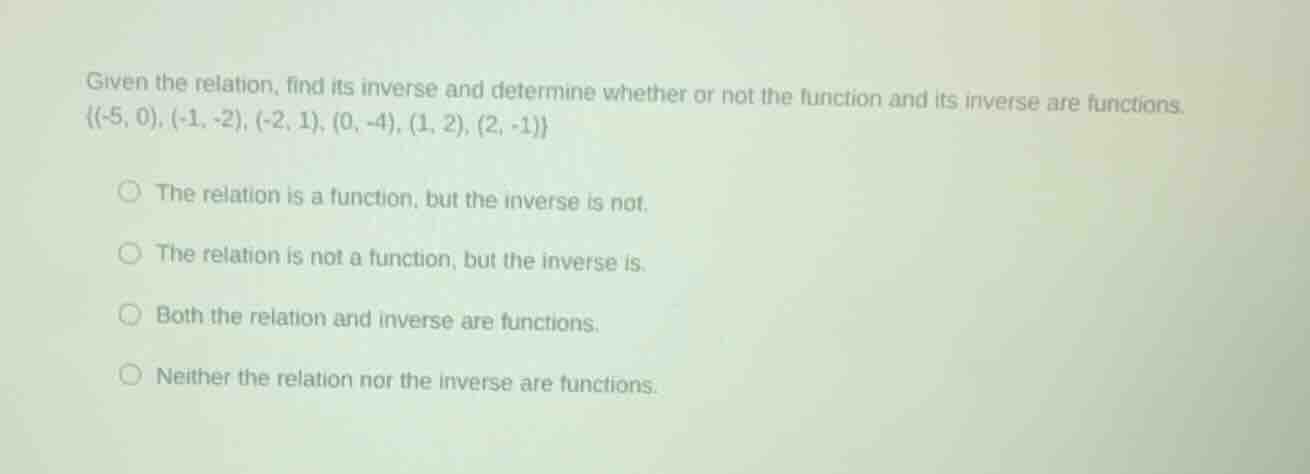
given the relation, find its inverse and determine whether or not the function and its inverse are functions. {(-5, 0), (-1, -2), (-2, 1), (0, -4), (1, 2), (2, -1)}
the relation is a function, but the inverse is not.
the relation is not a function, but the inverse is.
both the relation and inverse are functions.
neither the relation nor the inverse are functions.
Step1: Check if the relation is a function
A relation is a function if each input (x - value) has exactly one output (y - value). In the given relation \(\{(-5,0),(-1, - 2),(-2,1),(0,-4),(1,2),(2,-1)\}\), all the x - values (-5, - 1, - 2, 0, 1, 2) are unique. So, each x - value has exactly one y - value. Thus, the relation is a function.
Step2: Find the inverse of the relation
To find the inverse of a relation, we swap the x and y values of each ordered pair. The original relation has ordered pairs \((x,y)\), so the inverse relation will have ordered pairs \((y,x)\).
- For \((-5,0)\), the inverse pair is \((0,-5)\)
- For \((-1,-2)\), the inverse pair is \((-2,-1)\)
- For \((-2,1)\), the inverse pair is \((1,-2)\)
- For \((0,-4)\), the inverse pair is \((-4,0)\)
- For \((1,2)\), the inverse pair is \((2,1)\)
- For \((2,-1)\), the inverse pair is \((-1,2)\)
So the inverse relation is \(\{(0,-5),(-2,-1),(1,-2),(-4,0),(2,1),(-1,2)\}\)
Step3: Check if the inverse is a function
In the inverse relation, we check the x - values (which were the y - values of the original relation). The x - values of the inverse relation are 0, - 2, 1, - 4, 2, - 1. All of these x - values are unique. So each input (x - value) in the inverse relation has exactly one output (y - value). Thus, the inverse relation is also a function.

Snap & solve any problem in the app
Get step-by-step solutions on Sovi AI
Photo-based solutions with guided steps
Explore more problems and detailed explanations
C. Both the relation and inverse are functions.