QUESTION IMAGE
Question
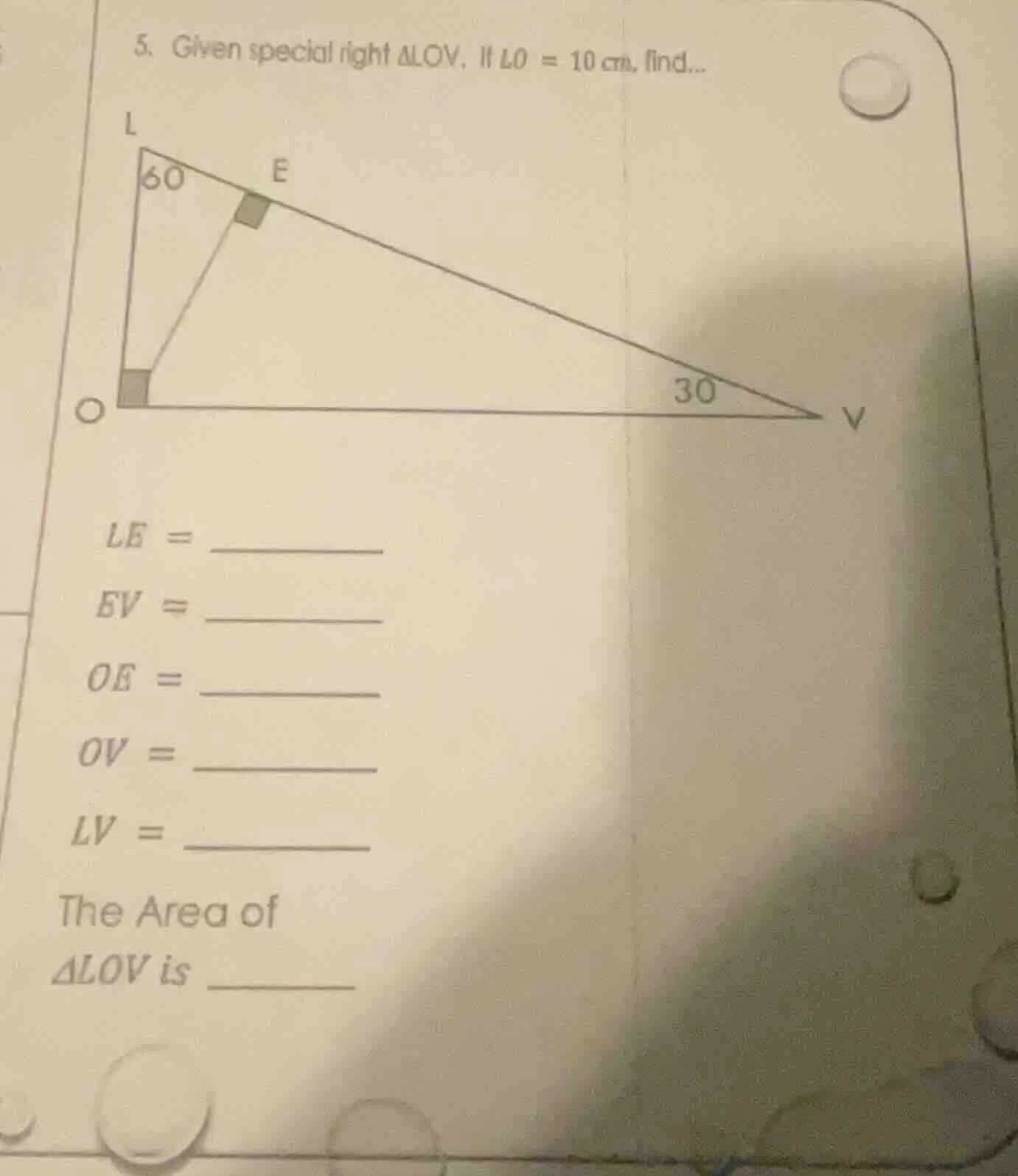
- given special right δlov, if lo = 10 cm, find...
le = ______
ev = ______
oe = ______
ov = ______
lv = ______
the area of
δlov is ______
Step1: Analyze \(\triangle LOV\)
\(\triangle LOV\) is a 30 - 60 - 90 right triangle with \(\angle O = 90^{\circ}\), \(\angle L=60^{\circ}\), \(\angle V = 30^{\circ}\) and \(LO = 10\space cm\). In a 30 - 60 - 90 triangle, the sides are in the ratio \(1:\sqrt{3}:2\) (opposite to \(30^{\circ}\), \(60^{\circ}\), \(90^{\circ}\) respectively). The side opposite \(30^{\circ}\) (\(LO\)) is the shorter leg, the side opposite \(60^{\circ}\) (\(OV\)) is the longer leg (\(= \text{shorter leg}\times\sqrt{3}\)), and the hypotenuse (\(LV\)) \(=\text{shorter leg}\times2\)
Step2: Find \(LV\)
Since \(LO\) is opposite \(30^{\circ}\), hypotenuse \(LV = 2\times LO\)
\(LV=2\times10 = 20\space cm\)
Step3: Find \(OV\)
\(OV\) is opposite \(60^{\circ}\), so \(OV=LO\times\sqrt{3}\)
\(OV = 10\sqrt{3}\space cm\)
Step4: Analyze \(\triangle LOE\)
\(\triangle LOE\) is also a 30 - 60 - 90 triangle (since \(\angle O = 90^{\circ}\), \(\angle LOE = 90^{\circ}-\angle EOV\), but also \(\angle L = 60^{\circ}\), \(\angle OLE=30^{\circ}\) as \(OE\perp LV\)). In \(\triangle LOE\), \(LO = 10\space cm\) (hypotenuse of \(\triangle LOE\) ? Wait, no. Wait, \(\angle OEL = 90^{\circ}\), \(\angle L = 60^{\circ}\), so \(\angle LOE=30^{\circ}\). So in \(\triangle LOE\), the side opposite \(30^{\circ}\) is \(LE\), hypotenuse is \(LO = 10\space cm\)
Step5: Find \(LE\)
In \(\triangle LOE\), \(\angle LOE = 30^{\circ}\), so \(LE=\frac{1}{2}LO\) (since in a 30 - 60 - 90 triangle, the side opposite \(30^{\circ}\) is half the hypotenuse)
\(LE=\frac{10}{2}=5\space cm\)
Step6: Find \(OE\)
In \(\triangle LOE\), \(OE=\sqrt{LO^{2}-LE^{2}}\) (by Pythagoras) or \(OE = LE\times\sqrt{3}\) (since it's opposite \(60^{\circ}\))
\(OE = 5\sqrt{3}\space cm\)
Step7: Find \(EV\)
Since \(LV=20\space cm\) and \(LE = 5\space cm\), \(EV=LV - LE\)
\(EV=20 - 5=15\space cm\)
Step8: Area of \(\triangle LOV\)
Area of a right triangle \(=\frac{1}{2}\times\text{base}\times\text{height}\)
Here, base \(=OV = 10\sqrt{3}\space cm\), height \(=LO = 10\space cm\)
Area \(=\frac{1}{2}\times10\times10\sqrt{3}=50\sqrt{3}\space cm^{2}\) or using \(LO = 10\) (shorter leg) and \(OV = 10\sqrt{3}\) (longer leg)
Alternatively, since \(LO = 10\), \(OV=10\sqrt{3}\), Area \(=\frac{1}{2}\times10\times10\sqrt{3}=50\sqrt{3}\approx86.6\space cm^{2}\) (if we take \(\sqrt{3}\approx1.732\))

Snap & solve any problem in the app
Get step-by-step solutions on Sovi AI
Photo-based solutions with guided steps
Explore more problems and detailed explanations
s:
\(LE=\boldsymbol{5\space cm}\)
\(EV=\boldsymbol{15\space cm}\)
\(OE=\boldsymbol{5\sqrt{3}\space cm\approx8.66\space cm}\)
\(OV=\boldsymbol{10\sqrt{3}\space cm\approx17.32\space cm}\)
\(LV=\boldsymbol{20\space cm}\)
Area of \(\triangle LOV=\boldsymbol{50\sqrt{3}\space cm^{2}\approx86.6\space cm^{2}}\)