QUESTION IMAGE
Question
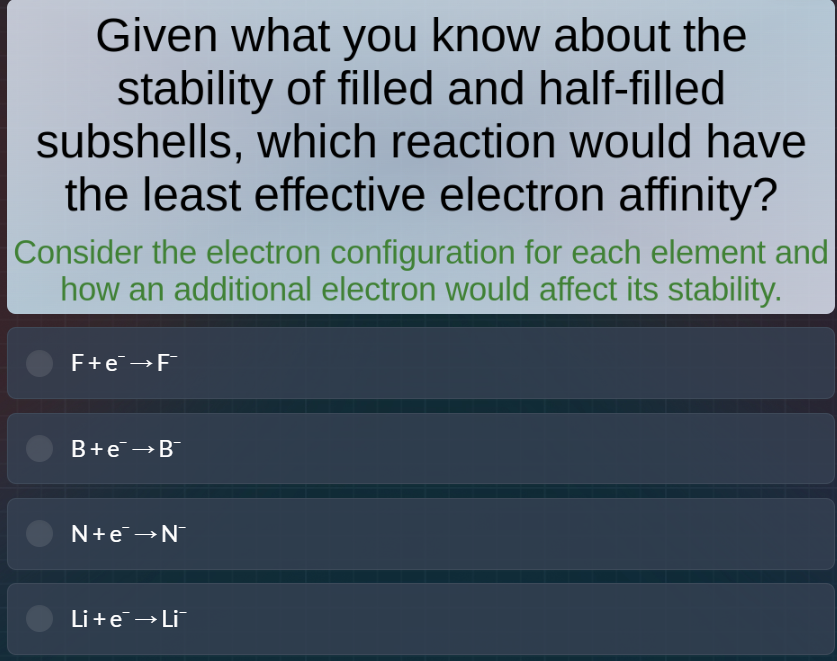
given what you know about the stability of filled and half-filled subshells, which reaction would have the least effective electron affinity?
consider the electron configuration for each element and how an additional electron would affect its stability.
f+e⁻→f⁻
b+e⁻→b⁻
n+e⁻→n⁻
li+e⁻→li⁻
Brief Explanations
Electron affinity is the energy change when an electron is added to a neutral atom. Atoms with stable electron configurations (filled/half-filled subshells) resist gaining electrons, resulting in a less effective (lower or positive) electron affinity:
- Fluorine (F): Electron configuration is $1s^22s^22p^5$. Gaining an electron fills the 2p subshell, which is favorable, so it has a high effective electron affinity.
- Boron (B): Electron configuration is $1s^22s^22p^1$. Gaining an electron fills the 2p orbital partially, which is favorable.
- Nitrogen (N): Electron configuration is $1s^22s^22p^3$. This has a stable half-filled 2p subshell. Adding an electron disrupts this stability, requiring energy (low/positive electron affinity, the least effective).
- Lithium (Li): Electron configuration is $1s^22s^1$. Gaining an electron fills the 2s subshell, which is favorable.

Snap & solve any problem in the app
Get step-by-step solutions on Sovi AI
Photo-based solutions with guided steps
Explore more problems and detailed explanations
N+e⁻→N⁻