QUESTION IMAGE
Question
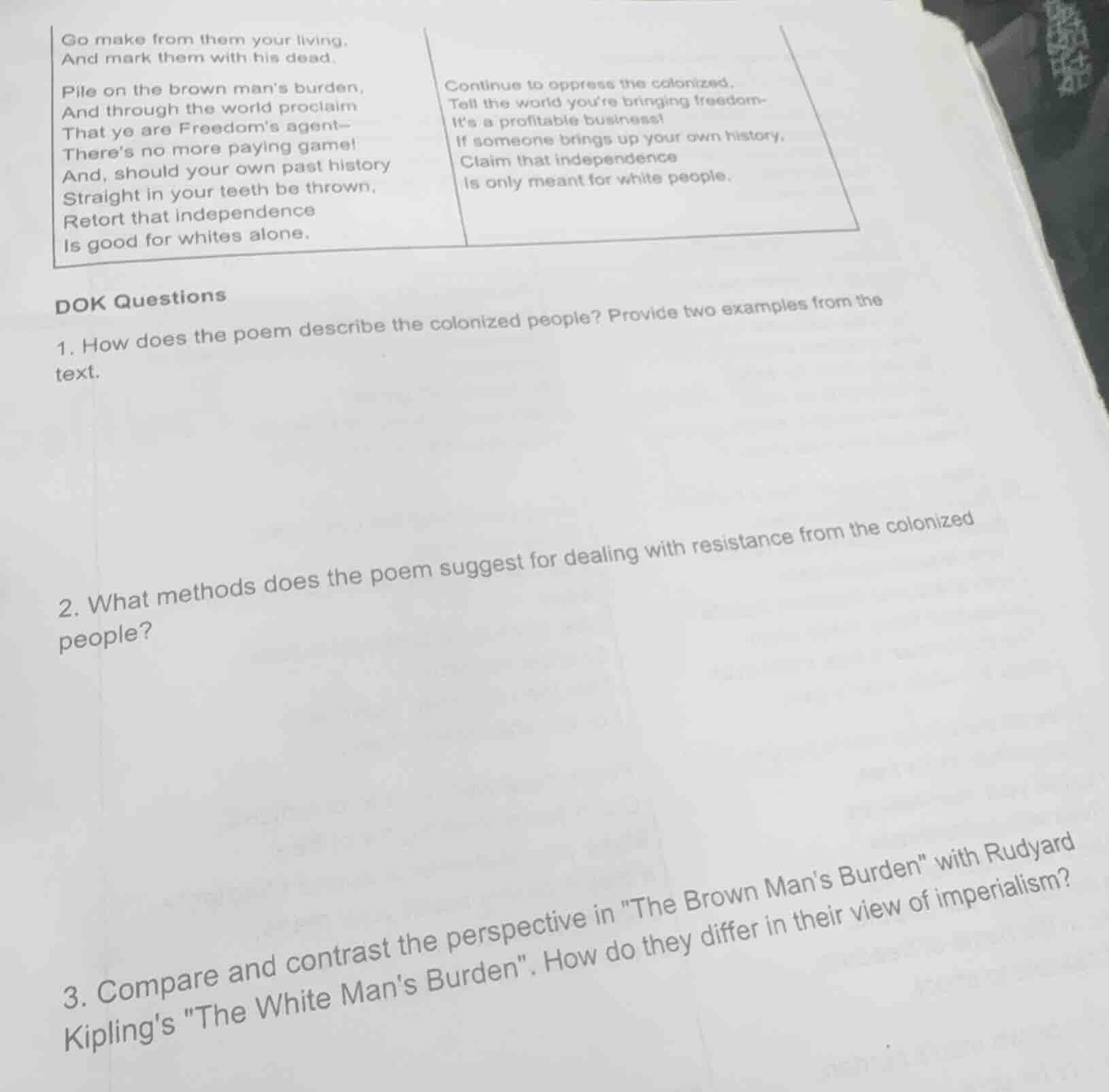
go make from them your living.
and mark them with his dead.
pile on the brown man’s burden,
and through the world proclaim
that ye are freedom’s agent—
there’s no more paying game!
and, should your own past history
straight in your teeth be thrown,
retort that independence
is good for whites alone.
continue to oppress the colonized,
tell the world you’re bringing freedom-
it’s a profitable business!
if someone brings up your own history,
claim that independence
is only meant for white people.
dok questions
- how does the poem describe the colonized people? provide two examples from the text.
- what methods does the poem suggest for dealing with resistance from the colonized people?
- compare and contrast the perspective in \the brown mans burden\ with rudyard kiplings \the white mans burden\. how do they differ in their view of imperialism?
Brief Explanations
- For question 1: The poem frames colonized people as a source of livelihood for colonizers, and targets of oppression. Examples are pulled directly from the poem's text.
- For question 2: The poem outlines the colonizers' stated justifications and dismissive responses to pushback from colonized groups, as seen in its verses.
- For question 3: The contrast centers on the core framing of colonialism—one frames it as a noble duty, the other as exploitative greed.

Snap & solve any problem in the app
Get step-by-step solutions on Sovi AI
Photo-based solutions with guided steps
Explore more problems and detailed explanations
- The poem describes colonized people as:
- A resource to exploit for survival: "Go make from them your living."
- Victims of oppression who are denied equal access to independence: "Claim that independence Is only meant for white people."
- The poem suggests colonizers deal with resistance by:
- Hiding their oppressive actions behind a false narrative of bringing freedom: "Tell the world you're bringing freedom- It's a profitable business!"
- Dismissing colonized people's demands for independence by claiming it is only for white people: "Retort that independence Is good for whites alone."
- - Rudyard Kipling's The White Man's Burden frames imperialism as a noble, selfless duty for white nations to "civilize" non-white colonized peoples, portraying it as a necessary, burdensome moral obligation.
- The Brown Man's Burden takes a critical, anti-imperialist perspective, framing imperialism as an exploitative, profit-driven enterprise that oppresses colonized people while lying about spreading freedom. It rejects the idea of colonialism as a "duty," instead exposing it as greedy oppression that denies colonized people the same right to independence white nations claim for themselves.