QUESTION IMAGE
Question
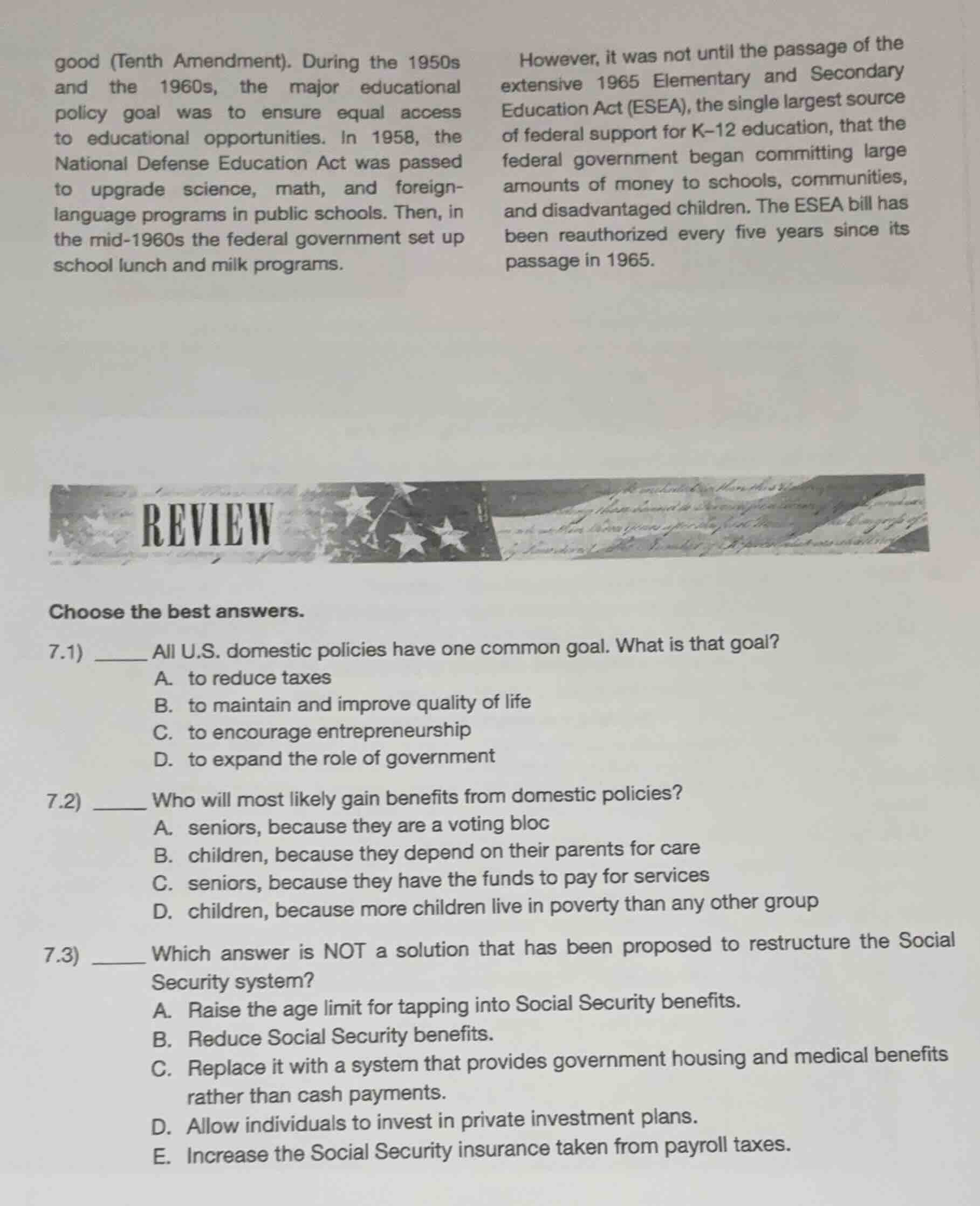
good (tenth amendment). during the 1950s and the 1960s, the major educational policy goal was to ensure equal access to educational opportunities. in 1958, the national defense education act was passed to upgrade science, math, and foreign - language programs in public schools. then, in the mid - 1960s the federal government set up school lunch and milk programs. however, it was not until the passage of the extensive 1965 elementary and secondary education act (esea), the single largest source of federal support for k - 12 education, that the federal government began committing large amounts of money to schools, communities, and disadvantaged children. the esea bill has been reauthorized every five years since its passage in 1965.
review
choose the best answers.
7.1) ______ all u.s. domestic policies have one common goal. what is that goal?
a. to reduce taxes
b. to maintain and improve quality of life
c. to encourage entrepreneurship
d. to expand the role of government
7.2) ______ who will most likely gain benefits from domestic policies?
a. seniors, because they are a voting bloc
b. children, because they depend on their parents for care
c. seniors, because they have the funds to pay for services
d. children, because more children live in poverty than any other group
7.3) ______ which answer is not a solution that has been proposed to restructure the social security system?
a. raise the age limit for tapping into social security benefits.
b. reduce social security benefits.
c. replace it with a system that provides government housing and medical benefits rather than cash payments.
d. allow individuals to invest in private investment plans.
e. increase the social security insurance taken from payroll taxes.
7.1) U.S. domestic policies cover areas like education, social welfare, and public services, all aimed at supporting citizens' well-being. Reducing taxes, encouraging entrepreneurship, and expanding government are narrow or not universal goals, while maintaining/improving quality of life is overarching.
7.2) Domestic policies often target vulnerable groups. Data shows children are the largest group living in poverty in the U.S., making them primary beneficiaries of policies addressing disadvantage (like the education and nutrition programs noted in the text).
7.3) Common proposals for Social Security reform include raising the eligibility age, cutting benefits, increasing payroll taxes, and allowing private investments. Replacing it with housing/medical benefits instead of cash is not a widely proposed restructuring solution.

Snap & solve any problem in the app
Get step-by-step solutions on Sovi AI
Photo-based solutions with guided steps
Explore more problems and detailed explanations
7.1) B. to maintain and improve quality of life
7.2) D. children, because more children live in poverty than any other group
7.3) C. Replace it with a system that provides government housing and medical benefits rather than cash payments.