QUESTION IMAGE
Question
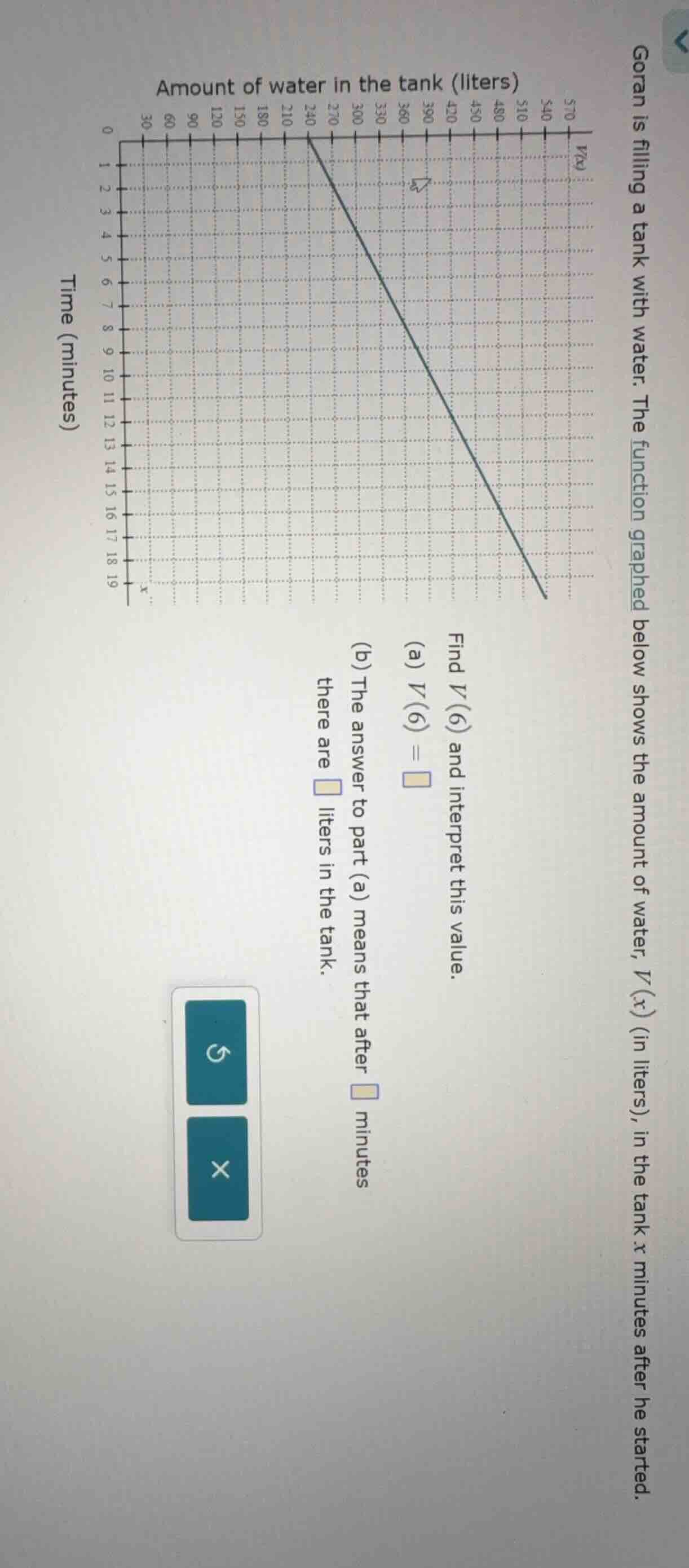
goran is filling a tank with water. the function graphed below shows the amount of water, v(x) (in liters), in the tank x minutes after he started.
amount of water in the tank (liters)
find v(6) and interpret this value.
(a) v(6) =
(b) the answer to part (a) means that after square minutes there are square liters in the tank.
Part (a)
Step1: Identify the graph's axes
The x - axis represents time (in minutes) and the y - axis represents the amount of water \(V(x)\) (in liters). We need to find \(V(6)\), which means we look for the value of \(y\) when \(x = 6\) (since \(x\) is time in minutes).
Step2: Analyze the graph's slope and equation (or read from the graph)
From the graph, we can see that the line passes through \((0,240)\) (when \(x = 0\), \(V(0)=240\)) and we can find the slope. Let's take two points. Let's assume another point, for example, when \(x = 18\), we can check the value, but more simply, since it's a linear graph, we can see the rate of change. But actually, by looking at the grid, when \(x = 6\), we can trace up from \(x = 6\) on the x - axis to the line and then left to the y - axis. From the graph, when \(x = 6\), the value of \(V(x)\) is 360? Wait, no, wait. Wait, the initial point is (0,240)? Wait, no, looking at the graph, the y - axis starts at 0, and the line starts at (0,240)? Wait, no, the x - axis is time (minutes) from 0 to 19, and the y - axis is liters from 0 to 570. Wait, actually, when \(x = 0\), the value is 240? Wait, no, the first point on the line is at \(x = 0\), \(y = 240\)? Wait, no, looking at the graph, the line starts at (0,240) and goes down? Wait, no, the problem says Goran is filling the tank, so the amount should be increasing. Wait, maybe I misread the graph. Wait, the y - axis is labeled "Amount of water in the tank (liters)" and the x - axis is time (minutes). Wait, the line is going up? Wait, the arrow is pointing, maybe the line is from (0,240) and as \(x\) increases, \(V(x)\) increases? Wait, no, the numbers on the y - axis: 0,30,60,90,120,150,180,210,240,270,300,330,360,390,420,450,480,510,540,570. Wait, the line starts at (0,240) and goes up. So when \(x = 0\), \(V(0)=240\). Let's find the slope. Let's take two points: \((0,240)\) and let's say when \(x = 18\), what's \(V(18)\)? Wait, no, we need \(x = 6\). Let's see the grid. Each small square on the x - axis: from 0 to 1 is 1 minute, so each x - unit is 1 minute. Each y - unit: from 0 to 30 is 30 liters. So the line has a slope. Let's calculate the slope \(m=\frac{V(x_2)-V(x_1)}{x_2 - x_1}\). Let's take \(x_1 = 0\), \(V(x_1)=240\) and \(x_2 = 18\), \(V(x_2)=570\)? No, that can't be. Wait, maybe the line is from (0,240) and the slope is \(\frac{360 - 240}{6-0}=\frac{120}{6} = 20\) liters per minute. So the equation of the line is \(V(x)=240 + 20x\). Then when \(x = 6\), \(V(6)=240+20\times6=240 + 120=360\). Or by reading from the graph, when we go to \(x = 6\) (6 minutes) on the x - axis, and then up to the line, the y - value (amount of water) is 360 liters.
Step1: Interpret \(V(6)\)
The function \(V(x)\) gives the amount of water in the tank \(x\) minutes after Goran started filling the tank. So \(V(6)\) means that after \(x = 6\) minutes (since \(x\) is the input which is time in minutes) the amount of water in the tank is \(V(6)\) liters. From part (a), \(V(6)=360\) liters. So the answer to part (a) means that after 6 minutes there are 360 liters in the tank.

Snap & solve any problem in the app
Get step-by-step solutions on Sovi AI
Photo-based solutions with guided steps
Explore more problems and detailed explanations
(for part a):
\(V(6)=\boxed{360}\)