QUESTION IMAGE
Question
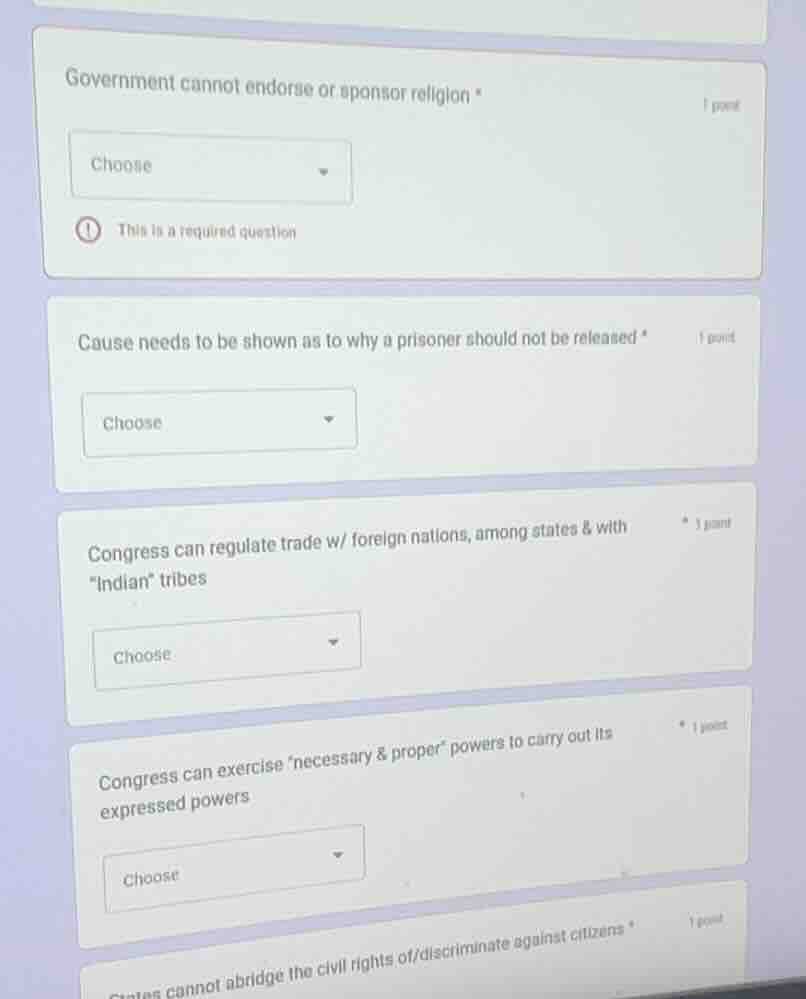
government cannot endorse or sponsor religion *
choose
this is a required question
cause needs to be shown as to why a prisoner should not be released *
choose
congress can regulate trade w/ foreign nations, among states & with \indian\ tribes
choose
congress can exercise
ecessary & proper\ powers to carry out its expressed powers
choose
states cannot abridge the civil rights of/discriminate against citizens *
To answer these questions, we analyze each one based on U.S. Constitutional law and related legal concepts:
1. "Government cannot endorse or sponsor religion"
This refers to the Establishment Clause of the First Amendment, which prohibits government from establishing or endorsing a religion. The principle is often summarized as the "separation of church and state" in terms of government endorsement. The term for this principle is related to the Establishment Clause (or the idea of "separation of church and state" in practice). If options included terms like "Establishment Clause" or "Separation of Church and State" (or a term like "Non - Establishment" or similar), that would be the answer.
2. "Cause needs to be shown as to why a prisoner should not be released"
This relates to the legal concept of habeas corpus (or the requirement for "cause" in detention, often tied to habeas corpus procedures). Habeas corpus is a legal action through which a person can challenge their detention, and the government must show cause (a legal reason) for why the prisoner should remain detained. If options included "Habeas Corpus" or a similar term about requiring cause for detention, that would be the answer.
3. "Congress can regulate trade w/ foreign nations, among states & with 'Indian' tribes"
This is the Commerce Clause of the U.S. Constitution (Article I, Section 8, Clause 3). The Commerce Clause gives Congress the power to regulate interstate commerce, foreign commerce, and commerce with Native American tribes. If options included "Commerce Clause," that is the answer.
4. "Congress can exercise 'necessary & proper' powers to carry out its expressed powers"
This is the Necessary and Proper Clause (also called the "Elastic Clause") of the U.S. Constitution (Article I, Section 8, Clause 18). It allows Congress to make laws that are necessary and proper to execute its enumerated (expressed) powers. If options included "Necessary and Proper Clause" or "Elastic Clause," that is the answer.
5. "States cannot abridge the civil rights of/discriminate against citizens"
This relates to the Equal Protection Clause of the Fourteenth Amendment (or civil rights legislation/constitutional principles against state discrimination). The Equal Protection Clause requires states to treat all citizens equally under the law and not abridge their civil rights through discrimination. If options included "Equal Protection Clause" or a similar term about state non - discrimination in civil rights, that would be the answer.
Since the actual options for each dropdown are not provided, we assume the standard legal terms for each concept:
- For "Government cannot endorse or sponsor religion": Likely related to the Establishment Clause (or a term like "Separation of Church and State" in context).
- For "Cause needs to be shown as to why a prisoner should not be released": Likely "Habeas Corpus" (or a term about requiring cause for detention).
- For "Congress can regulate trade...": Commerce Clause
- For "Congress can exercise 'necessary & proper' powers...": Necessary and Proper Clause (or "Elastic Clause")
- For "States cannot abridge the civil rights of/discriminate against citizens": Likely related to the Equal Protection Clause (or civil rights - based non - discrimination principles).
If you provide the specific options for each dropdown, we can identify the exact answer (e.g., if options are A. Commerce Clause, B. Elastic Clause, etc., we can match them).

Snap & solve any problem in the app
Get step-by-step solutions on Sovi AI
Photo-based solutions with guided steps
Explore more problems and detailed explanations
To answer these questions, we analyze each one based on U.S. Constitutional law and related legal concepts:
1. "Government cannot endorse or sponsor religion"
This refers to the Establishment Clause of the First Amendment, which prohibits government from establishing or endorsing a religion. The principle is often summarized as the "separation of church and state" in terms of government endorsement. The term for this principle is related to the Establishment Clause (or the idea of "separation of church and state" in practice). If options included terms like "Establishment Clause" or "Separation of Church and State" (or a term like "Non - Establishment" or similar), that would be the answer.
2. "Cause needs to be shown as to why a prisoner should not be released"
This relates to the legal concept of habeas corpus (or the requirement for "cause" in detention, often tied to habeas corpus procedures). Habeas corpus is a legal action through which a person can challenge their detention, and the government must show cause (a legal reason) for why the prisoner should remain detained. If options included "Habeas Corpus" or a similar term about requiring cause for detention, that would be the answer.
3. "Congress can regulate trade w/ foreign nations, among states & with 'Indian' tribes"
This is the Commerce Clause of the U.S. Constitution (Article I, Section 8, Clause 3). The Commerce Clause gives Congress the power to regulate interstate commerce, foreign commerce, and commerce with Native American tribes. If options included "Commerce Clause," that is the answer.
4. "Congress can exercise 'necessary & proper' powers to carry out its expressed powers"
This is the Necessary and Proper Clause (also called the "Elastic Clause") of the U.S. Constitution (Article I, Section 8, Clause 18). It allows Congress to make laws that are necessary and proper to execute its enumerated (expressed) powers. If options included "Necessary and Proper Clause" or "Elastic Clause," that is the answer.
5. "States cannot abridge the civil rights of/discriminate against citizens"
This relates to the Equal Protection Clause of the Fourteenth Amendment (or civil rights legislation/constitutional principles against state discrimination). The Equal Protection Clause requires states to treat all citizens equally under the law and not abridge their civil rights through discrimination. If options included "Equal Protection Clause" or a similar term about state non - discrimination in civil rights, that would be the answer.
Since the actual options for each dropdown are not provided, we assume the standard legal terms for each concept:
- For "Government cannot endorse or sponsor religion": Likely related to the Establishment Clause (or a term like "Separation of Church and State" in context).
- For "Cause needs to be shown as to why a prisoner should not be released": Likely "Habeas Corpus" (or a term about requiring cause for detention).
- For "Congress can regulate trade...": Commerce Clause
- For "Congress can exercise 'necessary & proper' powers...": Necessary and Proper Clause (or "Elastic Clause")
- For "States cannot abridge the civil rights of/discriminate against citizens": Likely related to the Equal Protection Clause (or civil rights - based non - discrimination principles).
If you provide the specific options for each dropdown, we can identify the exact answer (e.g., if options are A. Commerce Clause, B. Elastic Clause, etc., we can match them).