QUESTION IMAGE
Question
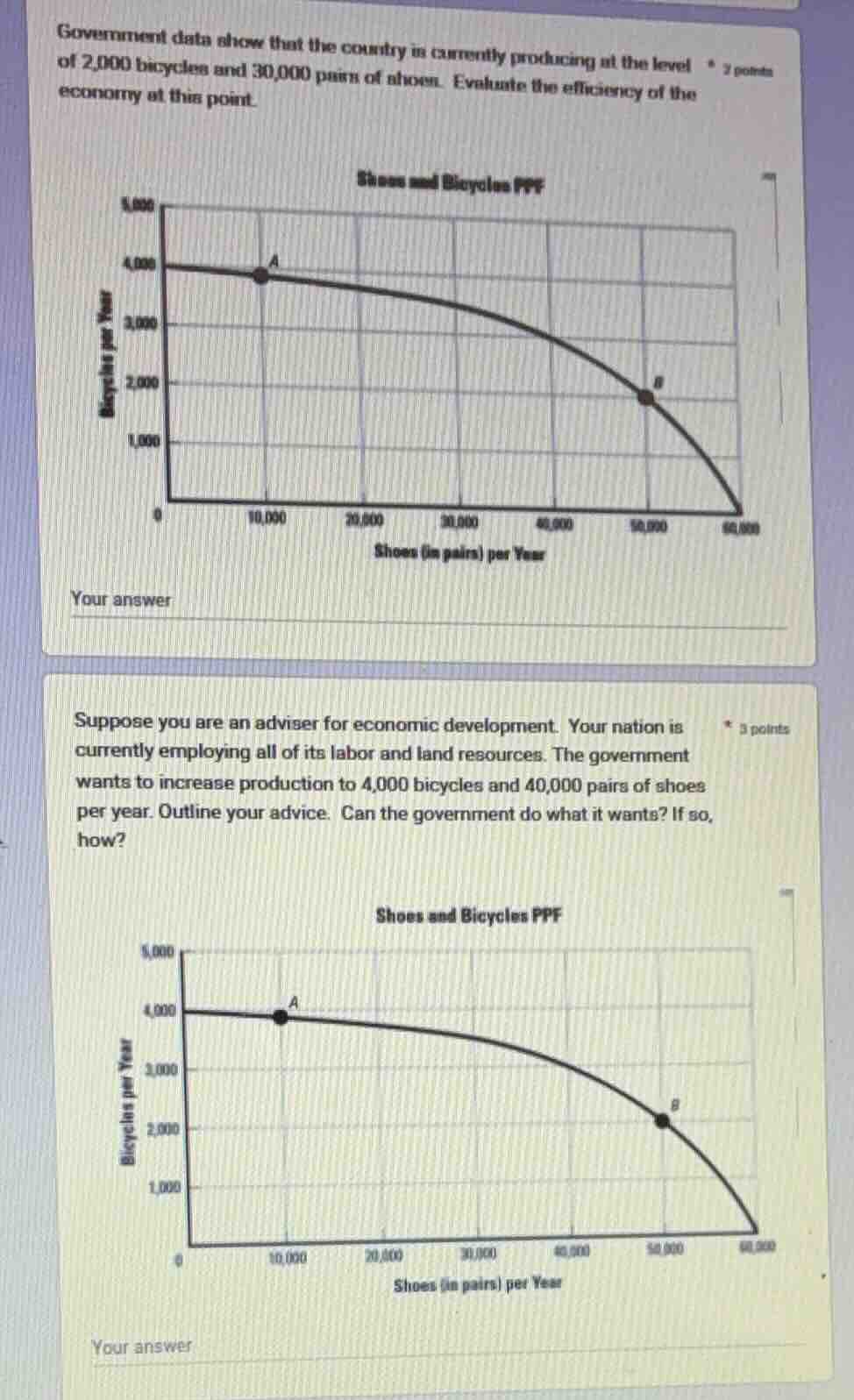
government data show that the country is currently producing at the level of 2,000 bicycles and 30,000 pairs of shoes. evaluate the efficiency of the economy at this point.
suppose you are an adviser for economic development. your nation is currently employing all of its labor and land resources. the government wants to increase production to 4,000 bicycles and 40,000 pairs of shoes per year. outline your advice. can the government do what it wants? if so, how?
For the first question:
A Production Possibilities Frontier (PPF) represents maximum efficient output combinations. The point (2,000 bicycles, 30,000 shoes) lies inside the PPF curve. Points inside the PPF indicate the economy is not using all its resources efficiently, with unused or underutilized resources available to increase output of either good without sacrificing the other.
For the second question:
The point (4,000 bicycles, 40,000 shoes) lies outside the current PPF, which represents the maximum output with existing resources and technology. To reach this point, the nation must expand its productive capacity: this can be done by increasing resources (like labor or land quality/quantity), improving technology to boost production efficiency, or enhancing worker skills through training.

Snap & solve any problem in the app
Get step-by-step solutions on Sovi AI
Photo-based solutions with guided steps
Explore more problems and detailed explanations
- The economy is operating inefficiently. The production point of 2,000 bicycles and 30,000 pairs of shoes falls inside the PPF, meaning resources are underutilized, and the economy could produce more of either or both goods without giving up production of the other.
- The government cannot reach the production level of 4,000 bicycles and 40,000 pairs of shoes with its current resources and technology, as this point lies outside the existing PPF. To achieve this, the nation needs to shift the PPF outward by:
- Increasing the quantity or quality of labor/land resources
- Adopting new, more efficient production technologies
- Investing in worker training to boost human capital