QUESTION IMAGE
Question
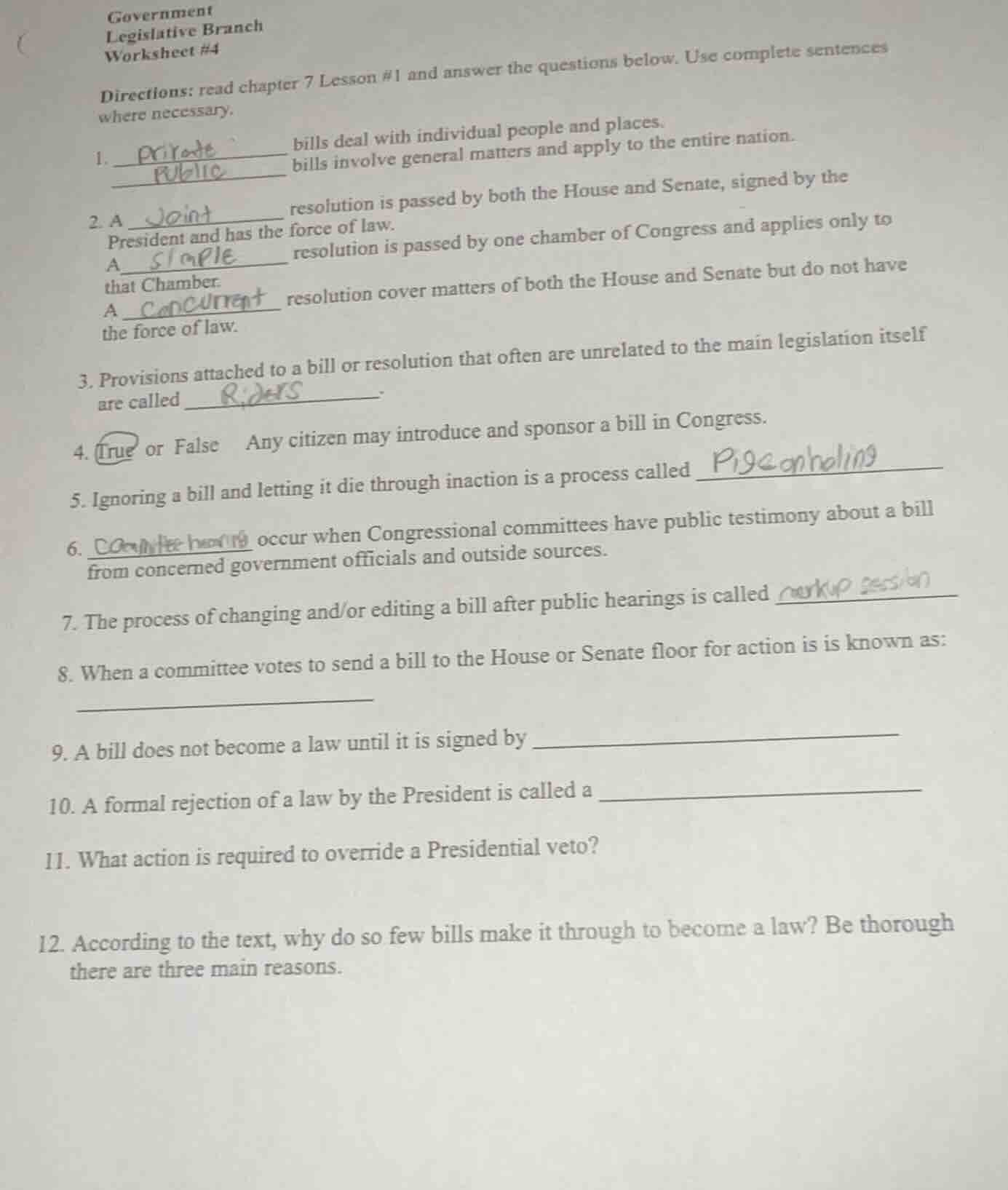
government legislative branch worksheet #4 directions: read chapter 7 lesson #1 and answer the questions below. use complete sentences where necessary. 1. ____ bills deal with individual people and places. __ bills involve general matters and apply to the entire nation. 2. a __ resolution is passed by both the house and senate, signed by the president and has the force of law. a __ resolution is passed by one chamber of congress and applies only to that chamber. a __ resolution cover matters of both the house and senate but do not have the force of law. 3. provisions attached to a bill or resolution that often are unrelated to the main legislation itself are called __. 4. true or false any citizen may introduce and sponsor a bill in congress. 5. ignoring a bill and letting it die through inaction is a process called __ 6. __ occur when congressional committees have public testimony about a bill from concerned government officials and outside sources. 7. the process of changing and/or editing a bill after public hearings is called __ 8. when a committee votes to send a bill to the house or senate floor for action is is known as: __ 9. a bill does not become a law until it is signed by __ 10. a formal rejection of a law by the president is called a ____ 11. what action is required to override a presidential veto? 12. according to the text, why do so few bills make it through to become a law? be thorough there are three main reasons.
Question 1
Private bills deal with individual people/places; public bills apply to the nation.
Joint resolution: passed by both, signed by Pres, has force of law. Simple resolution: passed by one chamber, applies to that chamber. Concurrent resolution: covers both chambers, no law force.
Riders are provisions attached to bills/resolutions, often unrelated to main legislation.

Snap & solve any problem in the app
Get step-by-step solutions on Sovi AI
Photo-based solutions with guided steps
Explore more problems and detailed explanations
- Private; Public