QUESTION IMAGE
Question
grammar passage
onion pests
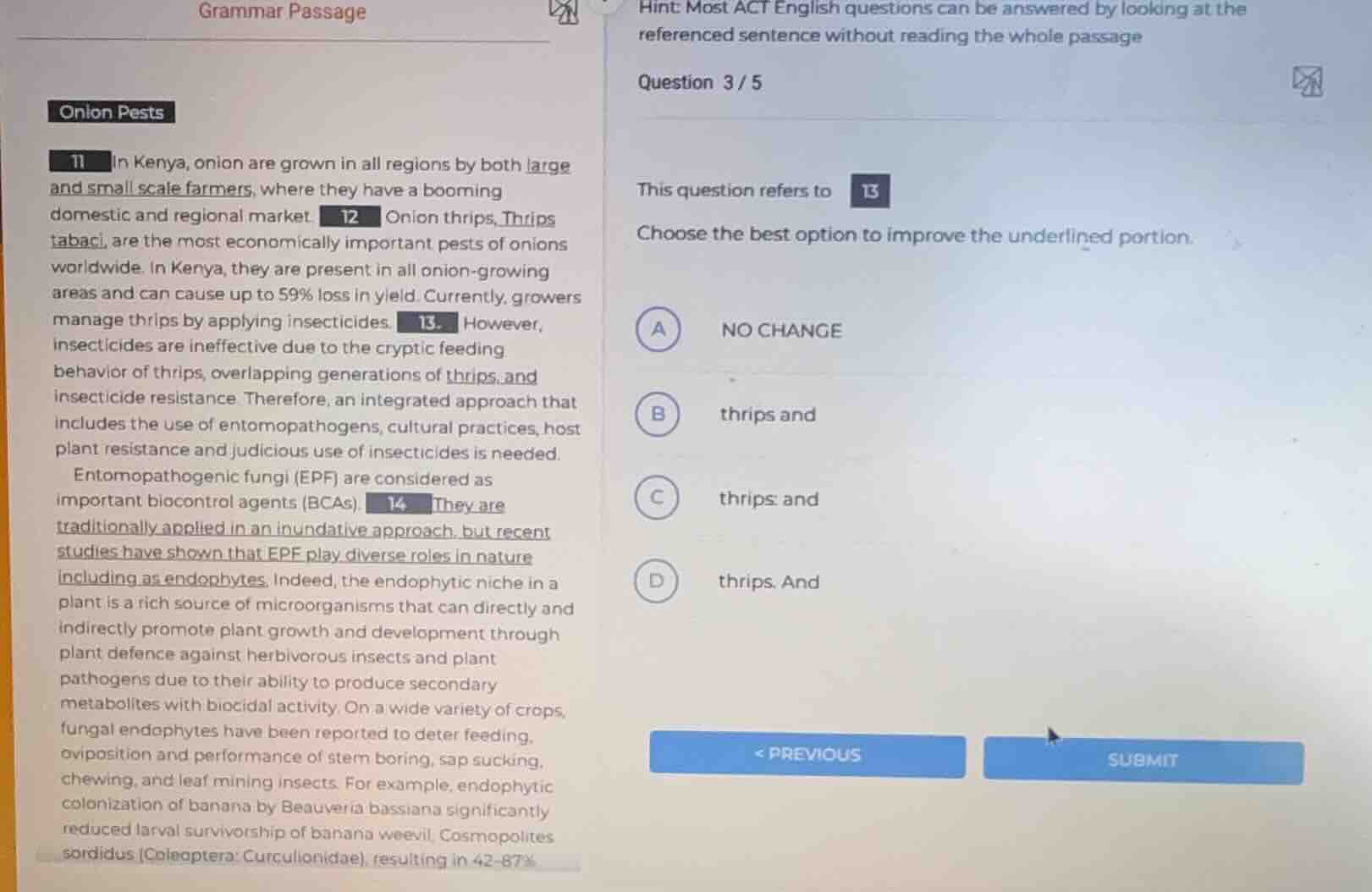
11 in kenya, onion are grown in all regions by both large and small scale farmers, where they have a booming domestic and regional market. 12 onion thrips, thrips tabaci, are the most economically important pests of onions worldwide. in kenya, they are present in all onion - growing areas and can cause up to 59% loss in yield. currently, growers manage thrips by applying insecticides. 13 however, insecticides are ineffective due to the cryptic feeding behavior of thrips, overlapping generations of thrips, and insecticide resistance. therefore, an integrated approach that includes the use of entomopathogens, cultural practices, host plant resistance and judicious use of insecticides is needed.
entomopathogenic fungi (epf) are considered as important biocontrol agents (bcas). 14 they are traditionally applied in an inundative approach, but recent studies have shown that epf play diverse roles in nature including as endophytes. indeed, the endophytic niche in a plant is a rich source of microorganisms that can directly and indirectly promote plant growth and development through plant defence against herbivorous insects and plant pathogens due to their ability to produce secondary metabolites with biocidal activity. on a wide variety of crops, fungal endophytes have been reported to deter feeding, oviposition and performance of stem boring, sap sucking, chewing, and leaf mining insects. for example, endophytic colonization of banana by beauveria bassiana significantly reduced larval survivorship of banana weevil, cosmopolites sordidus (coleoptera: curculionidae), resulting in 42 - 87%
hint: most act english questions can be answered by looking at the referenced sentence without reading the whole passage
question 3 / 5
this question refers to 13
choose the best option to improve the underlined portion.
a no change
b thrips and
c thrips: and
d thrips. and
< previous submit
To determine the correct option, we analyze the underlined portion "thrips, and". The list here is "the cryptic feeding behavior of thrips, overlapping generations of thrips, and insecticide resistance". The items in the list are parallel, and the punctuation before "and" should be consistent. Since the first two items are separated by commas, and we are adding the last item, we need to check the punctuation. The original "thrips, and" is part of a list where the items are "the cryptic feeding behavior of thrips", "overlapping generations of thrips", and "insecticide resistance". The correct punctuation for the list is to use a comma before "and" when it's the last item in a series (Oxford comma). However, let's check the structure: "due to the cryptic feeding behavior of thrips, overlapping generations of thrips, and insecticide resistance". The underlined part is "thrips, and" – wait, no, the original underlined is "thrips, and" in the sentence "due to the cryptic feeding behavior of thrips, overlapping generations of thrips, and insecticide resistance"? Wait, no, the sentence is "However, insecticides are ineffective due to the cryptic feeding behavior of thrips, overlapping generations of thrips, and insecticide resistance." Wait, the underlined portion is "thrips, and" – wait, looking at the passage, the sentence is "However, insecticides are ineffective due to the cryptic feeding behavior of thrips, overlapping generations of thrips, and insecticide resistance." Wait, the underlined part is "thrips, and" – no, maybe I misread. Wait, the question refers to sentence 13: "However, insecticides are ineffective due to the cryptic feeding behavior of thrips, overlapping generations of thrips, and insecticide resistance." Wait, the underlined portion is "thrips, and" – no, the options are about the underlined part. Wait, the original underlined is "thrips, and" – let's check the options. Option C is "thrips: and" – no, that's incorrect. Wait, no, the correct structure for a list is to use commas between items, and the "and" before the last item. Wait, the items are:
- the cryptic feeding behavior of thrips
- overlapping generations of thrips
- insecticide resistance
So the structure is "due to A, B, and C". So the underlined part is "thrips, and" – wait, the original sentence is "due to the cryptic feeding behavior of thrips, overlapping generations of thrips, and insecticide resistance". So the underlined portion is "thrips, and" – no, maybe the underlined is "thrips, and" in the context of "overlapping generations of thrips, and insecticide resistance". Wait, the options are:
A. NO CHANGE (thrips, and)
B. thrips and (no comma)
C. thrips: and (colon, which is incorrect)
D. thrips. And (period, which would create a new sentence, incorrect)
In a list of three items, the correct punctuation is to use commas between the first two and a comma before "and" (Oxford comma) for the last item. So "A, B, and C" is correct. So the original "thrips, and" is correct? Wait, no, wait the sentence is "due to the cryptic feeding behavior of thrips, overlapping generations of thrips, and insecticide resistance". So the underlined part is "thrips, and" – so the original is correct? Wait, no, maybe I made a mistake. Wait, the items are "the cryptic feeding behavior of thrips", "overlapping generations of thrips", and "insecticide resistance". So the structure is "due to [item1], [item2], and [item3]". So the comma before "and" is the Oxford comma, which is correct. So option A (NO CHANGE) is correct? Wait, but let's check the options again. W…

Snap & solve any problem in the app
Get step-by-step solutions on Sovi AI
Photo-based solutions with guided steps
Explore more problems and detailed explanations
A. NO CHANGE