QUESTION IMAGE
Question
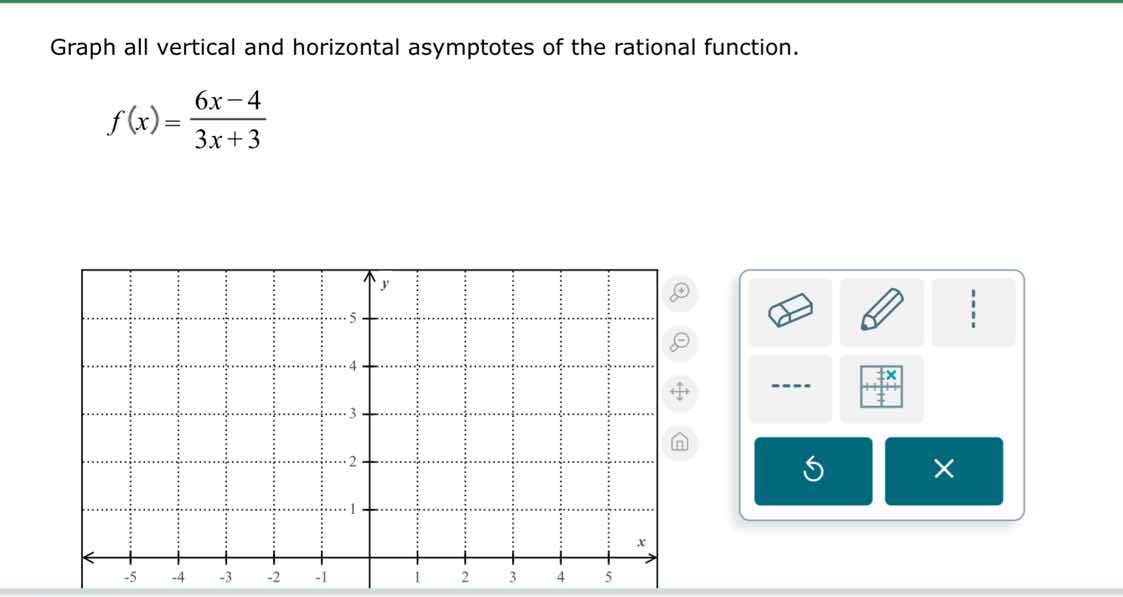
graph all vertical and horizontal asymptotes of the rational function. f(x) = (6x - 4)/(3x + 3)
Step1: Find Vertical Asymptote
To find the vertical asymptote of a rational function \( f(x)=\frac{N(x)}{D(x)} \), we set the denominator \( D(x) = 0 \) (provided the numerator and denominator have no common factors). For \( f(x)=\frac{6x - 4}{3x+3} \), the denominator is \( 3x + 3 \).
Set \( 3x+3=0 \).
Subtract 3 from both sides: \( 3x=- 3 \).
Divide both sides by 3: \( x=-1 \). So the vertical asymptote is \( x = - 1 \).
Step2: Find Horizontal Asymptote
For a rational function \( f(x)=\frac{N(x)}{D(x)} \), where the degree of \( N(x) \) (let's say \( n \)) and the degree of \( D(x) \) (let's say \( m \)):
- If \( n=m \), the horizontal asymptote is \( y=\frac{\text{leading coefficient of }N(x)}{\text{leading coefficient of }D(x)} \).
For \( f(x)=\frac{6x - 4}{3x+3} \), the degree of numerator \( 6x - 4 \) is 1 (since the highest power of \( x \) is 1) and the degree of denominator \( 3x + 3 \) is also 1. So \( n = m=1 \).
The leading coefficient of numerator is 6 and the leading coefficient of denominator is 3. So the horizontal asymptote is \( y=\frac{6}{3}=2 \).

Snap & solve any problem in the app
Get step-by-step solutions on Sovi AI
Photo-based solutions with guided steps
Explore more problems and detailed explanations
Vertical Asymptote: \( x=-1 \)
Horizontal Asymptote: \( y = 2 \)