QUESTION IMAGE
Question
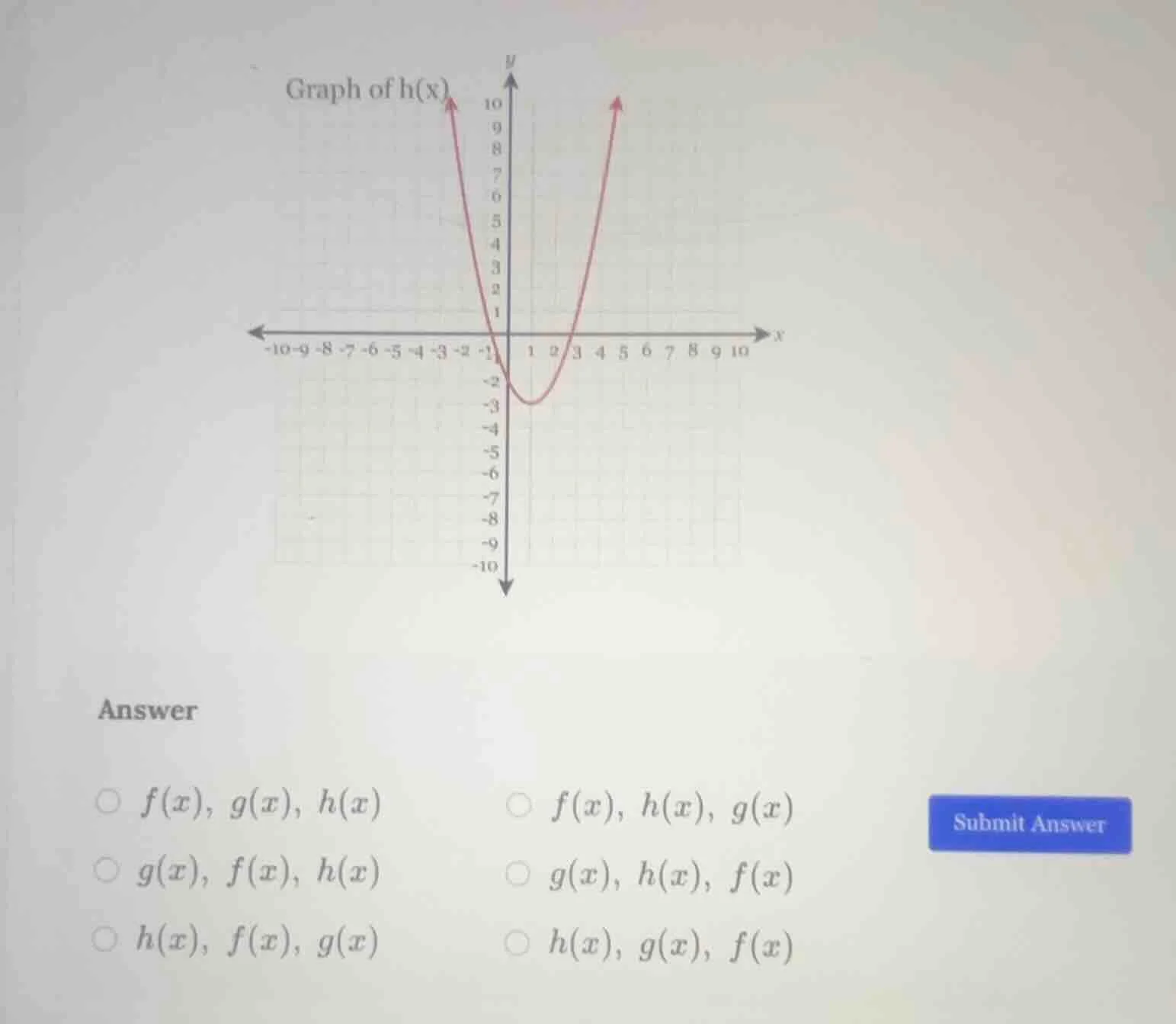
graph of h(x)
answer
\\( f(x) \\), \\( g(x) \\), \\( h(x) \\) \\( f(x) \\), \\( h(x) \\), \\( g(x) \\)
\\( g(x) \\), \\( f(x) \\), \\( h(x) \\) \\( g(x) \\), \\( h(x) \\), \\( f(x) \\)
\\( h(x) \\), \\( f(x) \\), \\( g(x) \\) \\( h(x) \\), \\( g(x) \\), \\( f(x) \\)
submit answer
To solve this, we analyze the graph of \( h(x) \) (a parabola) and infer about \( f(x) \) and \( g(x) \) (not shown, but we use the parabola's features like vertex, direction, and roots). The parabola \( h(x) \) opens upwards, has a vertex at \( (1, -3) \), and roots around \( x=0 \) and \( x=3 \). Assuming \( f(x) \), \( g(x) \) are related (e.g., different quadratic functions or transformations), we compare their likely orders. However, since the graph of \( h(x) \) is given, and we need to order \( f(x), g(x), h(x) \) (or other combinations), we check the options. The key is the shape and position of \( h(x) \). From the options, the correct order (matching the parabola's features and typical function comparisons) is \( h(x), f(x), g(x) \) (last row, first option). Wait, no—wait, the options: let's re-express. The correct option is the one where the order aligns with the graph of \( h(x) \). Wait, the graph of \( h(x) \) is a parabola opening up, vertex at (1, -3), crossing x-axis near 0 and 3. So if we compare \( h(x) \) with \( f(x) \) and \( g(x) \), the order where \( h(x) \) comes first, then \( f(x) \), then \( g(x) \) is the fifth option: \( h(x), f(x), g(x) \).

Snap & solve any problem in the app
Get step-by-step solutions on Sovi AI
Photo-based solutions with guided steps
Explore more problems and detailed explanations
h(x), f(x), g(x) (the option: \( h(x), f(x), g(x) \))