QUESTION IMAGE
Question
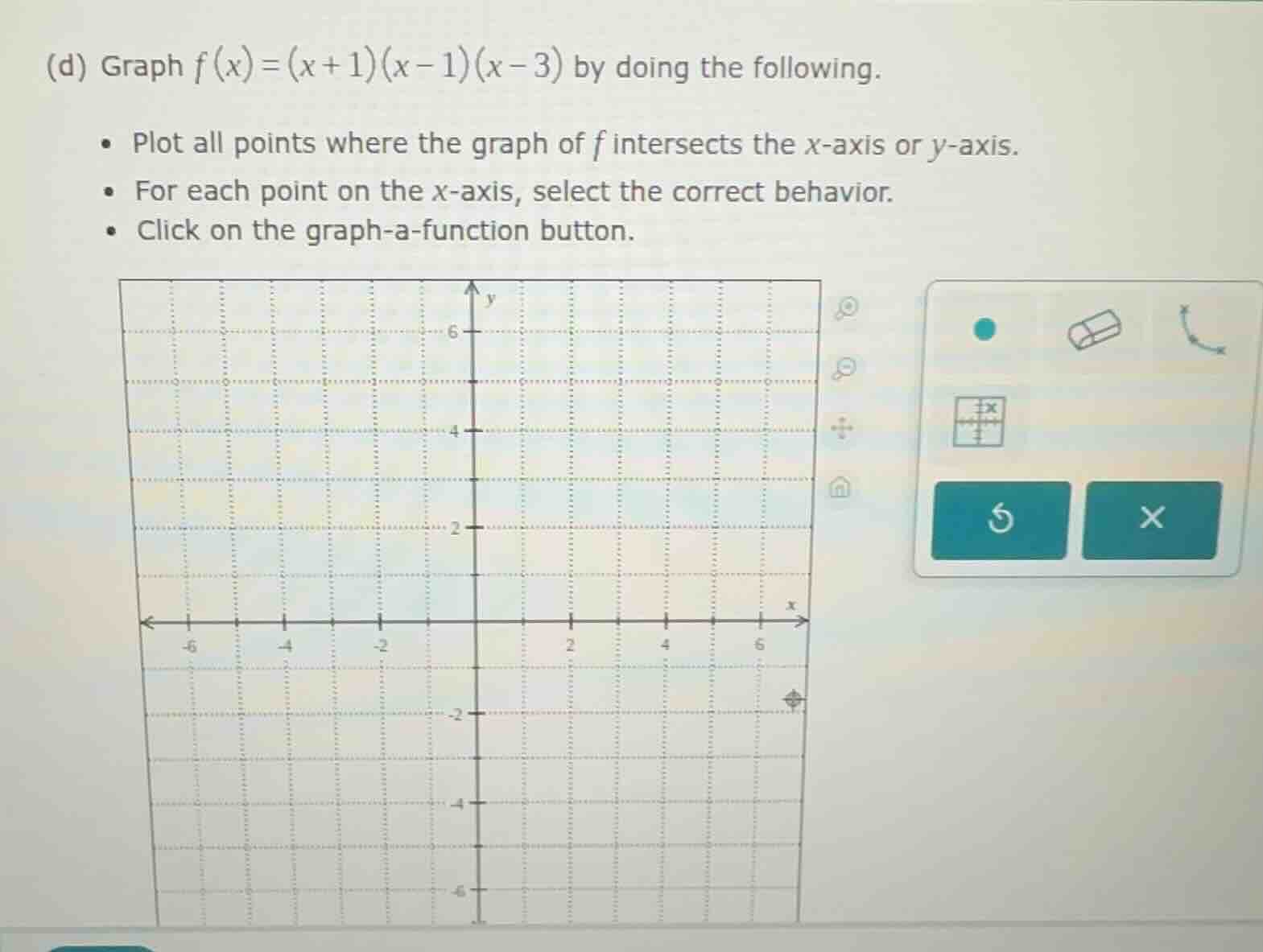
(d) graph $f(x)=(x + 1)(x - 1)(x - 3)$ by doing the following. - plot all points where the graph of $f$ intersects the $x$-axis or $y$-axis. - for each point on the $x$-axis, select the correct behavior. - click on the graph - a - function button.
Step1: Find x-intercepts (set f(x)=0)
Set $(x+1)(x-1)(x-3)=0$. Solve for $x$:
$x+1=0 \implies x=-1$; $x-1=0 \implies x=1$; $x-3=0 \implies x=3$
x-intercepts: $(-1,0)$, $(1,0)$, $(3,0)$
Step2: Find y-intercept (set x=0)
Calculate $f(0)=(0+1)(0-1)(0-3)=(1)(-1)(-3)=3$
y-intercept: $(0,3)$
Step3: Analyze x-axis point behavior
Each root has odd multiplicity (1), so the graph crosses the x-axis at each x-intercept.
Step4: Confirm end behavior
The leading term of $f(x)$ is $x^3$. As $x\to+\infty$, $f(x)\to+\infty$; as $x\to-\infty$, $f(x)\to-\infty$.

Snap & solve any problem in the app
Get step-by-step solutions on Sovi AI
Photo-based solutions with guided steps
Explore more problems and detailed explanations
- Intercept points to plot:
- x-intercepts: $(-1, 0)$, $(1, 0)$, $(3, 0)$
- y-intercept: $(0, 3)$
- Behavior at each x-intercept: The graph crosses the x-axis at $(-1,0)$, $(1,0)$, and $(3,0)$.
- The cubic graph will pass through all intercepts, rise to $+\infty$ as $x$ increases, and fall to $-\infty$ as $x$ decreases.