QUESTION IMAGE
Question
graph the equation shown below by transforming the given graph of the parent function.
$y = \sqrt3{-x} + 5$
Step1: Identify the parent function
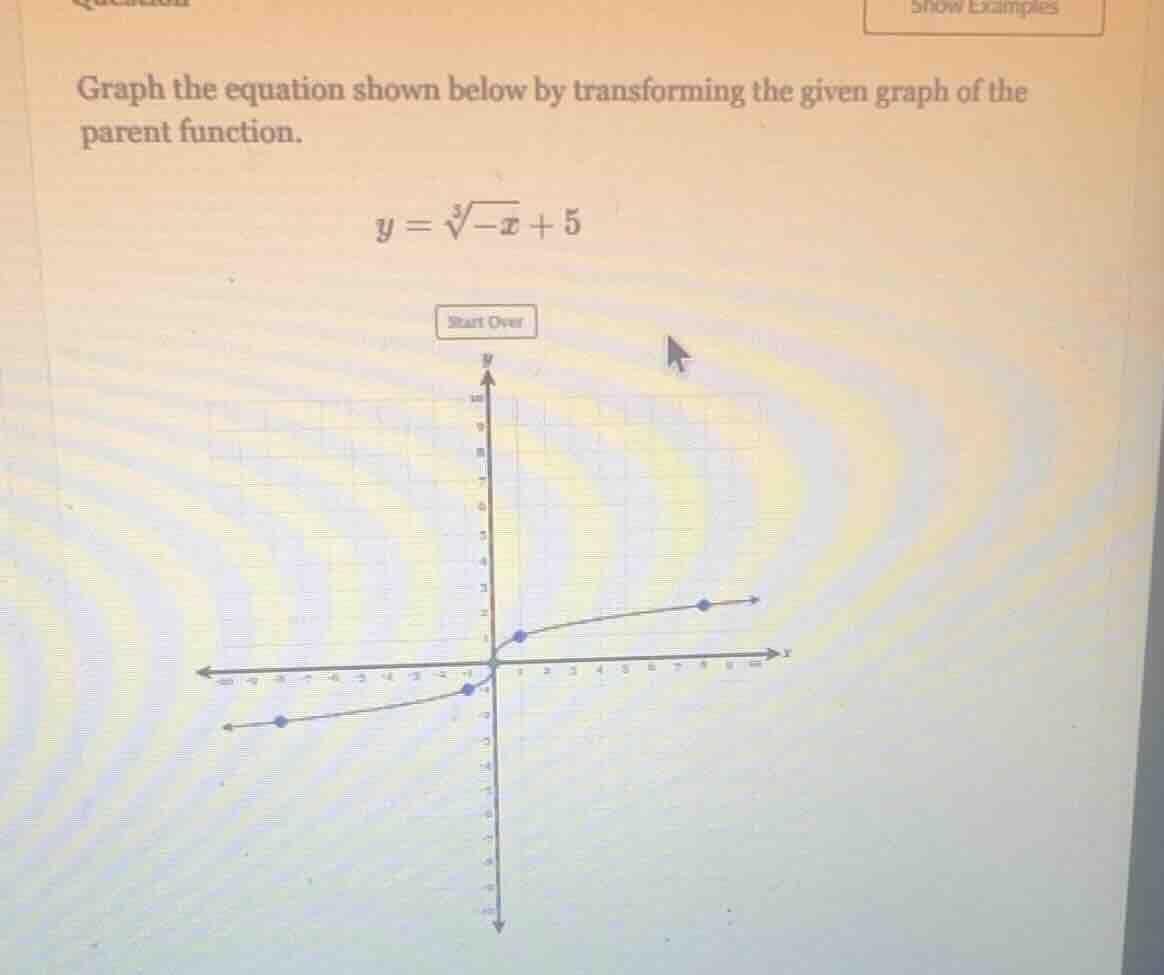
The parent function for the cube root function is \( y = \sqrt[3]{x} \). Its graph passes through the origin \((0,0)\), and has a point like \((1,1)\) and \((-1,-1)\).
Step2: Analyze the transformation \( y = \sqrt[3]{-x} \)
The negative sign inside the cube root, \( -x \), represents a reflection over the \( y \)-axis. For a function \( y = f(x) \), the function \( y = f(-x) \) is a reflection over the \( y \)-axis. So, \( y=\sqrt[3]{-x} \) is the parent function \( y = \sqrt[3]{x} \) reflected over the \( y \)-axis.
Step3: Analyze the vertical shift \( +5 \)
The \( +5 \) at the end of the function \( y=\sqrt[3]{-x}+5 \) represents a vertical shift upward by 5 units. For a function \( y = f(x) \), the function \( y = f(x)+k \) is a vertical shift of \( k \) units (upward if \( k>0 \), downward if \( k<0 \)).
Step4: Apply the transformations to key points
- Parent function key points: For \( y = \sqrt[3]{x} \), let's take three points: \((-1, -1)\), \((0, 0)\), \((1, 1)\).
- After reflection over \( y \)-axis (for \( y=\sqrt[3]{-x} \)):
- For \( x=-1 \), \( y=\sqrt[3]{-(-1)}=\sqrt[3]{1} = 1 \), so the point becomes \((-1,1)\).
- For \( x = 0 \), \( y=\sqrt[3]{-0}=0 \), so the point remains \((0,0)\).
- For \( x = 1 \), \( y=\sqrt[3]{-1}=-1 \), so the point becomes \((1,-1)\).
- After vertical shift upward by 5 units (for \( y=\sqrt[3]{-x}+5 \)):
- For the point \((-1,1)\), add 5 to the \( y \)-coordinate: \((-1,1 + 5)=(-1,6)\).
- For the point \((0,0)\), add 5 to the \( y \)-coordinate: \((0,0 + 5)=(0,5)\).
- For the point \((1,-1)\), add 5 to the \( y \)-coordinate: \((1,-1 + 5)=(1,4)\).
Step5: Graph the transformed function
Plot the transformed points \((-1,6)\), \((0,5)\), \((1,4)\) and draw the curve of the cube root function through these points, keeping in mind the shape of the cube root function (it has a point at the origin - now shifted, and increases/decreases without bound, with the reflection and shift applied). The graph of \( y=\sqrt[3]{-x}+5 \) will be the graph of \( y=\sqrt[3]{x} \) reflected over the \( y \)-axis and then shifted up 5 units.

Snap & solve any problem in the app
Get step-by-step solutions on Sovi AI
Photo-based solutions with guided steps
Explore more problems and detailed explanations
To graph \( y=\sqrt[3]{-x}+5 \):
- Start with the parent function \( y = \sqrt[3]{x} \).
- Reflect the graph of \( y = \sqrt[3]{x} \) over the \( y \)-axis (to get \( y=\sqrt[3]{-x} \)).
- Shift the graph upward by 5 units (to get \( y=\sqrt[3]{-x}+5 \)).
Key points after transformation: \((-1, 6)\), \((0, 5)\), \((1, 4)\) (and other points following the cube - root curve shape with the applied transformations).