QUESTION IMAGE
Question
graph the equation shown below by transforming the given graph of the parent function.
$y = 2^{3x}$
Step1: Identify the parent function
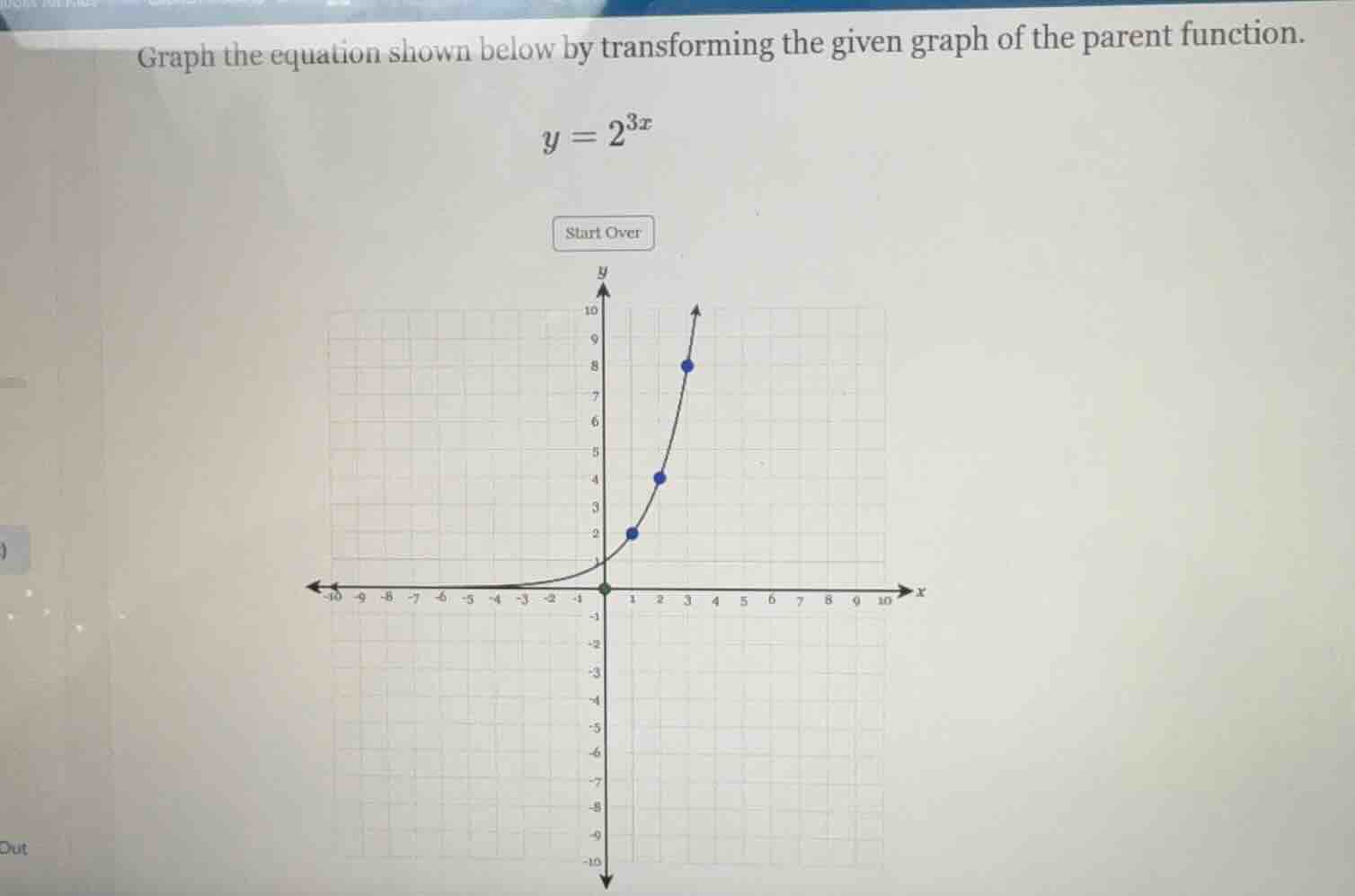
The parent function for exponential functions is \( y = 2^x \). The given function is \( y = 2^{3x} \), which is a horizontal compression of the parent function.
Step2: Recall the transformation rule
For a function \( y = f(bx) \), if \( |b|>1 \), it is a horizontal compression by a factor of \( \frac{1}{b} \) of the function \( y = f(x) \). Here, \( b = 3 \), so the graph of \( y = 2^{3x} \) is a horizontal compression of \( y = 2^x \) by a factor of \( \frac{1}{3} \).
Step3: Analyze key points
For the parent function \( y = 2^x \), some key points are: when \( x = 0 \), \( y = 1 \); \( x = 1 \), \( y = 2 \); \( x = 2 \), \( y = 4 \); \( x = 3 \), \( y = 8 \). For the transformed function \( y = 2^{3x} \), we solve for \( x \) when \( y \) is the same. Let's take \( y = 2 \): \( 2 = 2^{3x} \) implies \( 3x = 1 \) so \( x=\frac{1}{3} \). For \( y = 4 \): \( 4 = 2^{3x} \) implies \( 3x = 2 \) so \( x=\frac{2}{3} \). For \( y = 8 \): \( 8 = 2^{3x} \) implies \( 3x = 3 \) so \( x = 1 \). And when \( x = 0 \), \( y = 1 \) (same as parent function at \( x = 0 \)).
Step4: Graph the transformed function
To graph \( y = 2^{3x} \), we take the key points of the parent function \( y = 2^x \) (e.g., \( (0,1) \), \( (1,2) \), \( (2,4) \), \( (3,8) \)) and horizontally compress them by a factor of \( \frac{1}{3} \), so the new points are \( (0,1) \), \( (\frac{1}{3},2) \), \( (\frac{2}{3},4) \), \( (1,8) \). Then we plot these points and draw the curve, which will be steeper (compressed horizontally) compared to the parent function \( y = 2^x \).

Snap & solve any problem in the app
Get step-by-step solutions on Sovi AI
Photo-based solutions with guided steps
Explore more problems and detailed explanations
To graph \( y = 2^{3x} \), we horizontally compress the graph of the parent function \( y = 2^x \) by a factor of \( \frac{1}{3} \). Key points of \( y = 2^x \) (e.g., \( (0,1) \), \( (1,2) \), \( (2,4) \), \( (3,8) \)) transform to \( (0,1) \), \( (\frac{1}{3},2) \), \( (\frac{2}{3},4) \), \( (1,8) \) for \( y = 2^{3x} \). Plot these points and draw the exponential curve, which is steeper (compressed horizontally) than \( y = 2^x \).