QUESTION IMAGE
Question
graph the equation shown below by transforming the given graph of the parent function.
$y = |4x|$
Step1: Identify the parent function
The parent function of absolute value functions is \( y = |x| \). Its graph is a V - shaped graph with the vertex at the origin \((0,0)\), and the slope of the right - hand side (where \(x\geq0\)) is \(1\) and the slope of the left - hand side (where \(x < 0\)) is \(- 1\).
Step2: Analyze the transformation for \(y = |4x|\)
For a function of the form \(y=|ax|\) (where \(a\) is a non - zero constant), when \(|a|>1\), it is a horizontal compression of the parent function \(y = |x|\) by a factor of \(\frac{1}{|a|}\). In the equation \(y = |4x|\), \(a = 4\), so we have a horizontal compression by a factor of \(\frac{1}{4}\) of the parent function \(y=|x|\).
To understand the effect on the points: Let's take a point \((x,y)\) on the parent function \(y = |x|\). For the function \(y=|4x|\), we can rewrite it as \(y = 4|x|\) (since \(|4x|=4|x|\) when we consider the transformation of the graph's steepness, or we can think in terms of horizontal compression). Wait, actually, \(y = |4x|\) is equivalent to a horizontal compression. If we have \(y = f(kx)\) with \(k>1\), the graph of \(y = f(x)\) is compressed horizontally by a factor of \(\frac{1}{k}\).
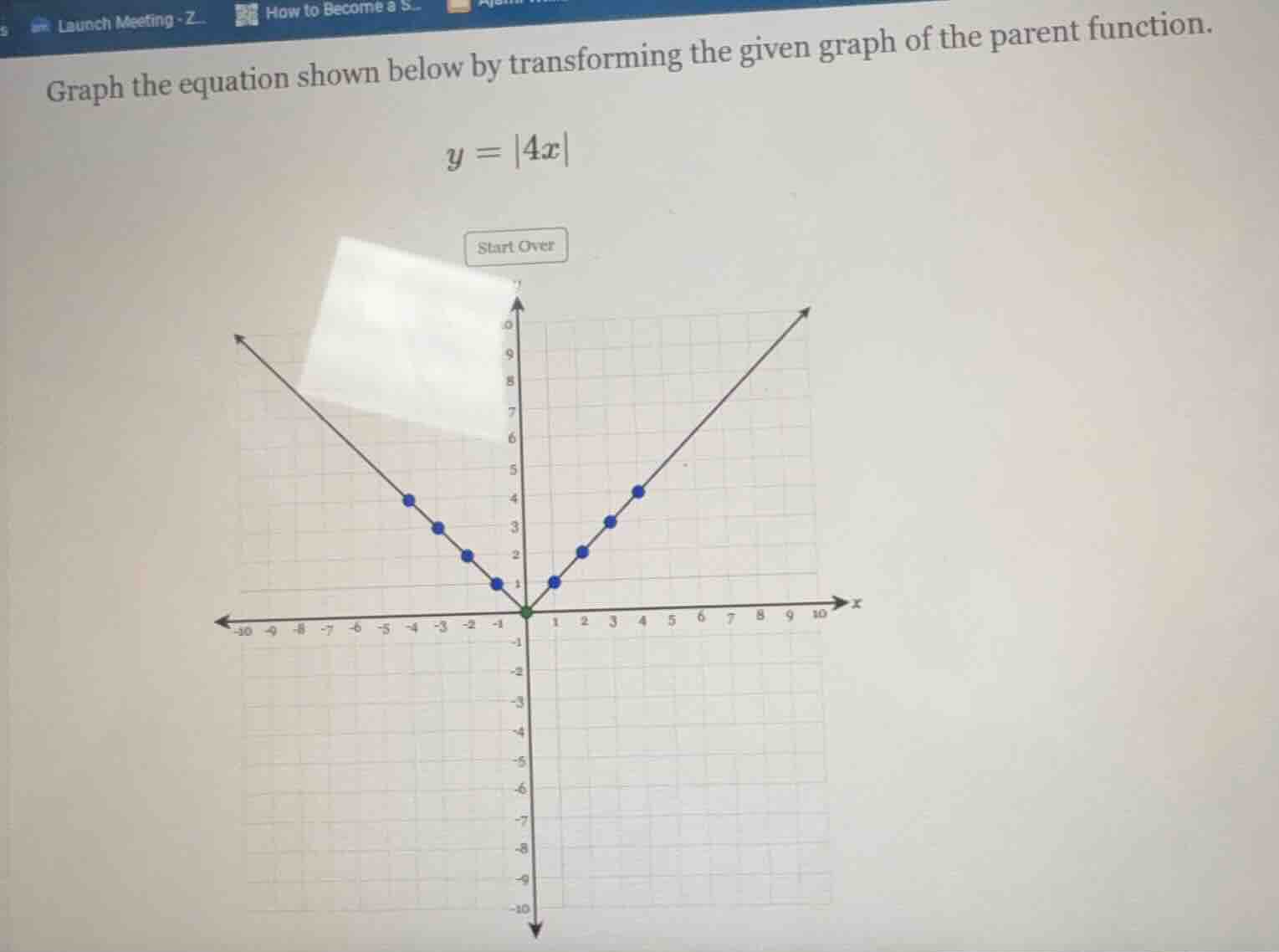
For the parent function \(y = |x|\), some key points are: when \(x = 0\), \(y = 0\); when \(x = 1\), \(y = 1\); when \(x=-1\), \(y = 1\); when \(x = 2\), \(y = 2\); when \(x=-2\), \(y = 2\) etc.
For the function \(y=|4x|\), we solve for \(x\) in terms of the input to the absolute value. Let \(u = 4x\), then \(x=\frac{u}{4}\). So the point \((u,y)\) on \(y = |u|\) corresponds to the point \((\frac{u}{4},y)\) on \(y = |4x|\).
For example, when \(y = 4\) in the parent function \(y = |x|\), \(x = 4\) or \(x=-4\). For \(y = |4x|\), when \(y = 4\), we have \(|4x|=4\), which gives \(4x = 4\) or \(4x=-4\), so \(x = 1\) or \(x=-1\).
When \(y = 3\) in the parent function \(y = |x|\), \(x = 3\) or \(x=-3\). For \(y = |4x|\), \(|4x|=3\) gives \(x=\frac{3}{4}\) or \(x =-\frac{3}{4}\).
When \(y = 2\) in the parent function \(y = |x|\), \(x = 2\) or \(x=-2\). For \(y = |4x|\), \(|4x|=2\) gives \(x=\frac{2}{4}=\frac{1}{2}\) or \(x =-\frac{1}{2}\).
When \(y = 1\) in the parent function \(y = |x|\), \(x = 1\) or \(x=-1\). For \(y = |4x|\), \(|4x|=1\) gives \(x=\frac{1}{4}\) or \(x =-\frac{1}{4}\).
To graph \(y = |4x|\), we can also think of it as a vertical stretch of \(y = |x|\) by a factor of \(4\) (since \(|4x| = 4|x|\)). The slope of the right - hand side (for \(x\geq0\)) of \(y = |4x|\) is \(4\) and the slope of the left - hand side (for \(x < 0\)) is \(-4\), which means the graph is steeper than the parent function \(y = |x|\).
So, to graph \(y = |4x|\) from the parent function \(y = |x|\):
- The vertex remains at \((0,0)\) because there is no vertical or horizontal shift (only a compression/stretch).
- For the right - hand side (\(x\geq0\)), the equation is \(y = 4x\) (since \(x\geq0\) implies \(4x\geq0\), so \(|4x| = 4x\)). We can find points: when \(x = 0\), \(y = 0\); when \(x=\frac{1}{4}\), \(y = 1\); when \(x=\frac{1}{2}\), \(y = 2\); when \(x = 1\), \(y = 4\) etc.
- For the left - hand side (\(x < 0\)), the equation is \(y=-4x\) (since \(x < 0\) implies \(4x < 0\), so \(|4x|=-4x\)). We can find points: when \(x = 0\), \(y = 0\); when \(x=-\frac{1}{4}\), \(y = 1\); when \(x =-\frac{1}{2}\), \(y = 2\); when \(x=-1\), \(y = 4\) etc.
Comparing with the given graph (which seems to be the graph of \(y = |x|\) with points like \((-4,4)\), \((-3,3)\), \((-2,2)\), \((-1,1)\), \((1,1)\), \((2,2)\), \((3,3)\), \((4,4)\) etc.), for the graph of \(y = |4x|\),…

Snap & solve any problem in the app
Get step-by-step solutions on Sovi AI
Photo-based solutions with guided steps
Explore more problems and detailed explanations
To graph \(y = |4x|\) from the parent function \(y=|x|\), we perform a horizontal compression by a factor of \(\frac{1}{4}\) (or a vertical stretch by a factor of \(4\)) of the parent absolute - value graph. The graph is a V - shaped graph with vertex at \((0,0)\), the right - hand branch (for \(x\geq0\)) has a slope of \(4\) (equation \(y = 4x\)) and the left - hand branch (for \(x < 0\)) has a slope of \(-4\) (equation \(y=-4x\)). Key points on the right branch: \((0,0)\), \((\frac{1}{4},1)\), \((\frac{1}{2},2)\), \((1,4)\) etc. Key points on the left branch: \((0,0)\), \((-\frac{1}{4},1)\), \((-\frac{1}{2},2)\), \((-1,4)\) etc. The graph is steeper than the parent function \(y = |x|\) and is compressed horizontally towards the \(y\) - axis.