QUESTION IMAGE
Question
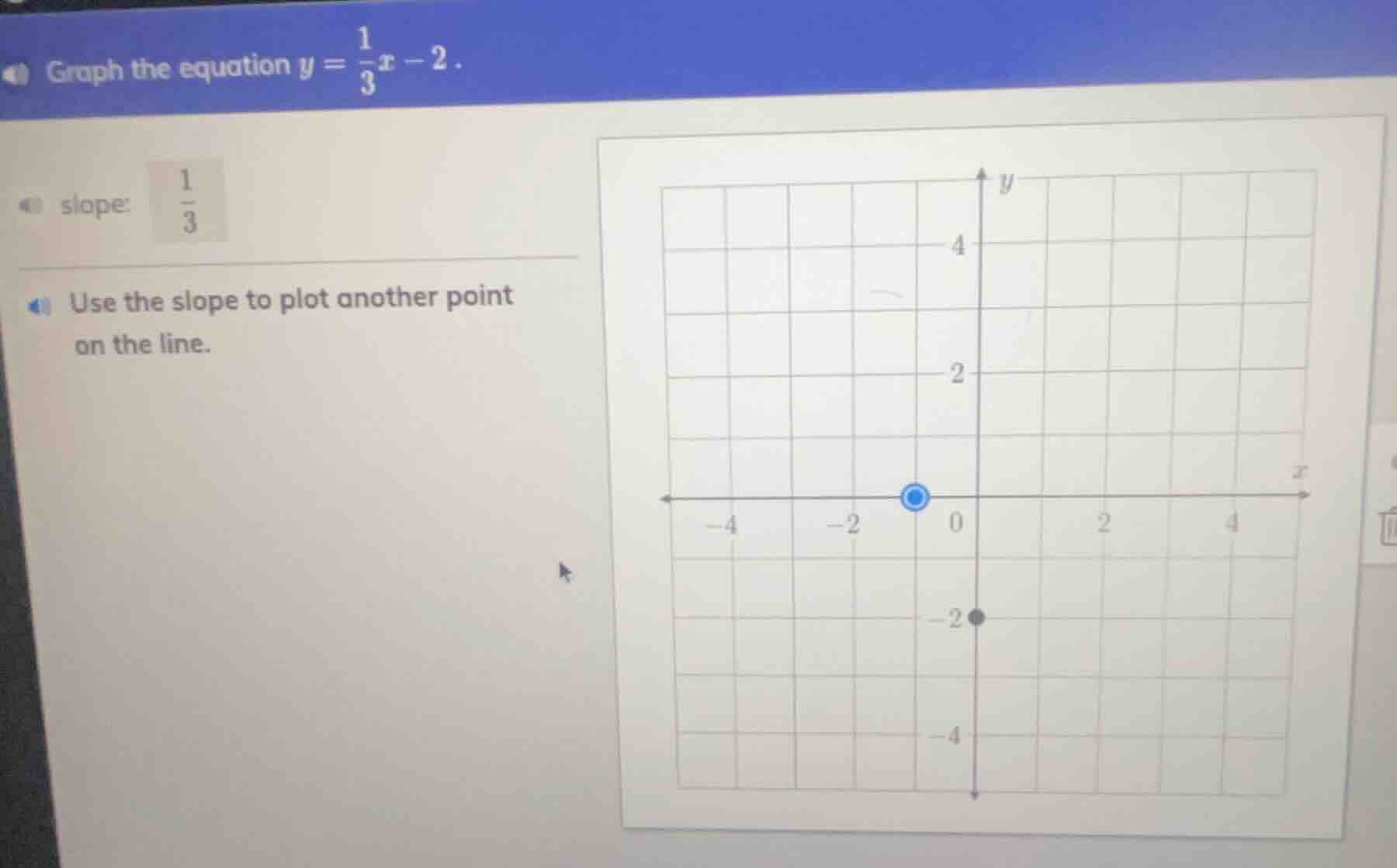
graph the equation $y = \frac{1}{3}x - 2$. slope: $\frac{1}{3}$ use the slope to plot another point on the line.
Step1: Identify the y - intercept point
The equation \( y=\frac{1}{3}x - 2 \) is in slope - intercept form \( y = mx + b \), where \( b=-2 \) and \( m = \frac{1}{3}\). The y - intercept is the point where \( x = 0 \), so the point is \( (0,-2) \) (the black dot on the graph). Also, there is a blue dot at \( (- 1,0) \)? Wait, no, let's re - examine. Wait, the slope \( m=\frac{1}{3}=\frac{\text{rise}}{\text{run}} \), which means for every 3 units we move to the right (run = 3) along the x - axis, we move up 1 unit (rise = 1) along the y - axis. Or for every 1 unit we move up, we move 3 units to the right.
Let's take the point \( (0,-2) \) (the y - intercept). To find another point, we use the slope. The slope \( m=\frac{1}{3}=\frac{\text{change in }y}{\text{change in }x} \). So if we start at \( (0,-2) \), and we increase \( x \) by 3 (run = 3), then we increase \( y \) by 1 (rise = 1). So the new \( x \) - coordinate is \( 0 + 3=3 \), and the new \( y \) - coordinate is \( - 2+1=-1 \). So the point is \( (3,-1) \). Alternatively, if we start at the blue dot (let's assume the blue dot is \( (-1,0) \)? Wait, no, looking at the graph, the blue dot is at \( x=-1,y = 0 \)? Wait, maybe the blue dot is a point on the line. Wait, the equation is \( y=\frac{1}{3}x-2 \). Let's check \( x = 3 \): \( y=\frac{1}{3}(3)-2=1 - 2=-1 \), so \( (3,-1) \) is on the line. Or if we start at \( (0,-2) \), using the slope \( \frac{1}{3} \), we can also go left 3 units (run=-3) and down 1 unit (rise = - 1). So from \( (0,-2) \), \( x=0 - 3=-3 \), \( y=-2-1=-3 \), so the point \( (-3,-3) \) is also on the line. But a more straightforward way is to use the slope from a given point. Let's take the point \( (0,-2) \).
Step2: Apply the slope
The slope \( m=\frac{1}{3} \) means \( \text{rise}=1 \) and \( \text{run}=3 \). So starting from the point \( (0,-2) \) (the y - intercept), we move 3 units to the right (in the positive x - direction) and 1 unit up (in the positive y - direction).
- New \( x \) - coordinate: \( 0+3 = 3 \)
- New \( y \) - coordinate: \( - 2 + 1=-1 \)
So the new point is \( (3,-1) \). We can also verify by plugging \( x = 3 \) into the equation \( y=\frac{1}{3}(3)-2=1 - 2=-1 \), which matches.

Snap & solve any problem in the app
Get step-by-step solutions on Sovi AI
Photo-based solutions with guided steps
Explore more problems and detailed explanations
To plot another point on the line \( y = \frac{1}{3}x-2 \) using the slope \( \frac{1}{3}=\frac{\text{rise}}{\text{run}} \):
- Start from the y - intercept point \( (0,-2) \).
- Move 3 units to the right (along the positive x - axis) and 1 unit up (along the positive y - axis). This gives the point \( (3,-1) \). (Other valid points can be found by using negative run and rise as well, for example, starting from \( (0,-2) \), moving 3 units to the left (run=-3) and 1 unit down (rise=-1) gives \( (-3,-3) \), but \( (3,-1) \) is a common choice.)