QUESTION IMAGE
Question
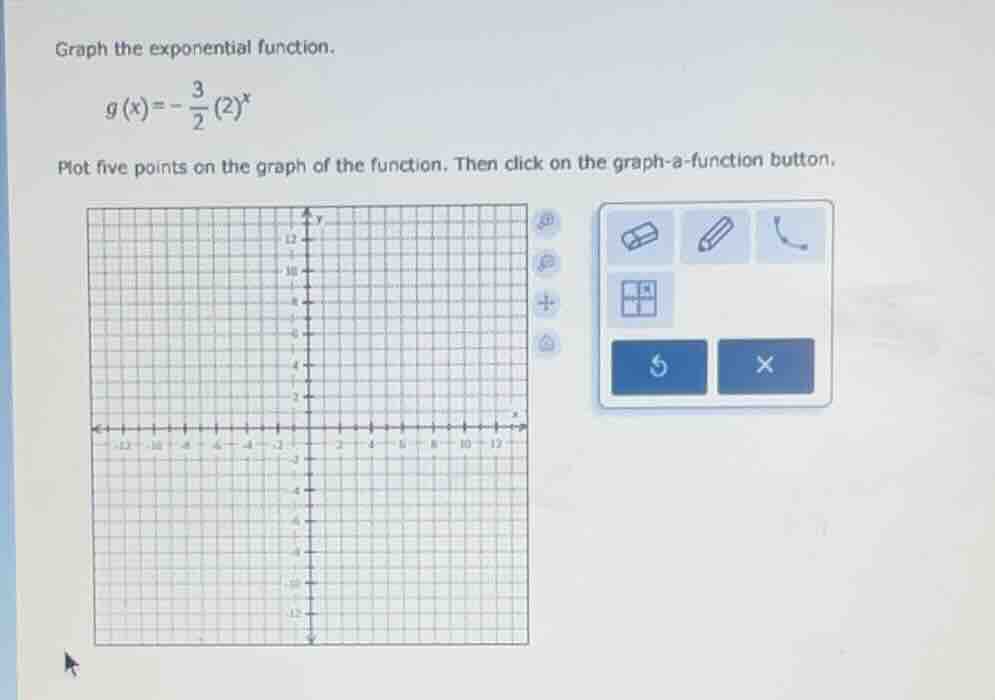
graph the exponential function.
\\( g(x) = -\frac{3}{2}(2)^x \\)
plot five points on the graph of the function. then click on the graph - a - function button.
Step1: Choose x-values
We can choose x - values such as \(x=-2, - 1,0,1,2\) to find corresponding y - values (since exponential functions are defined for all real numbers, these x - values will give us a good sense of the graph).
Step2: Calculate \(g(x)\) for \(x = - 2\)
Substitute \(x=-2\) into \(g(x)=-\frac{3}{2}(2)^{x}\).
We know that \(2^{-2}=\frac{1}{2^{2}}=\frac{1}{4}\).
So \(g(-2)=-\frac{3}{2}\times2^{-2}=-\frac{3}{2}\times\frac{1}{4}=-\frac{3}{8}=-0.375\)
Step3: Calculate \(g(x)\) for \(x=-1\)
Substitute \(x = - 1\) into \(g(x)=-\frac{3}{2}(2)^{x}\).
We know that \(2^{-1}=\frac{1}{2}\).
So \(g(-1)=-\frac{3}{2}\times2^{-1}=-\frac{3}{2}\times\frac{1}{2}=-\frac{3}{4}=-0.75\)
Step4: Calculate \(g(x)\) for \(x = 0\)
Substitute \(x = 0\) into \(g(x)=-\frac{3}{2}(2)^{x}\).
We know that \(2^{0}=1\).
So \(g(0)=-\frac{3}{2}\times2^{0}=-\frac{3}{2}\times1 = -\frac{3}{2}=-1.5\)
Step5: Calculate \(g(x)\) for \(x = 1\)
Substitute \(x = 1\) into \(g(x)=-\frac{3}{2}(2)^{x}\).
We know that \(2^{1}=2\).
So \(g(1)=-\frac{3}{2}\times2^{1}=-\frac{3}{2}\times2=-3\)
Step6: Calculate \(g(x)\) for \(x = 2\)
Substitute \(x = 2\) into \(g(x)=-\frac{3}{2}(2)^{x}\).
We know that \(2^{2}=4\).
So \(g(2)=-\frac{3}{2}\times2^{2}=-\frac{3}{2}\times4=-6\)
The five points are \((-2,-0.375)\), \((-1, - 0.75)\), \((0,-1.5)\), \((1,-3)\), \((2,-6)\). To graph the function, we plot these points and draw a smooth curve through them (since it's an exponential function, the curve will have the characteristic shape of an exponential function, reflected over the x - axis (because of the negative sign) and vertically stretched by a factor of \(\frac{3}{2}\)).

Snap & solve any problem in the app
Get step-by-step solutions on Sovi AI
Photo-based solutions with guided steps
Explore more problems and detailed explanations
The five points to plot are \((-2,-\frac{3}{8})\), \((-1,-\frac{3}{4})\), \((0,-\frac{3}{2})\), \((1, - 3)\), \((2,-6)\) (or in decimal form \((-2,-0.375)\), \((-1,-0.75)\), \((0,-1.5)\), \((1,-3)\), \((2,-6)\)) and the graph is a smooth curve passing through these points with the general shape of an exponential function, reflected over the x - axis and vertically stretched.