QUESTION IMAGE
Question
graph the exponential function.
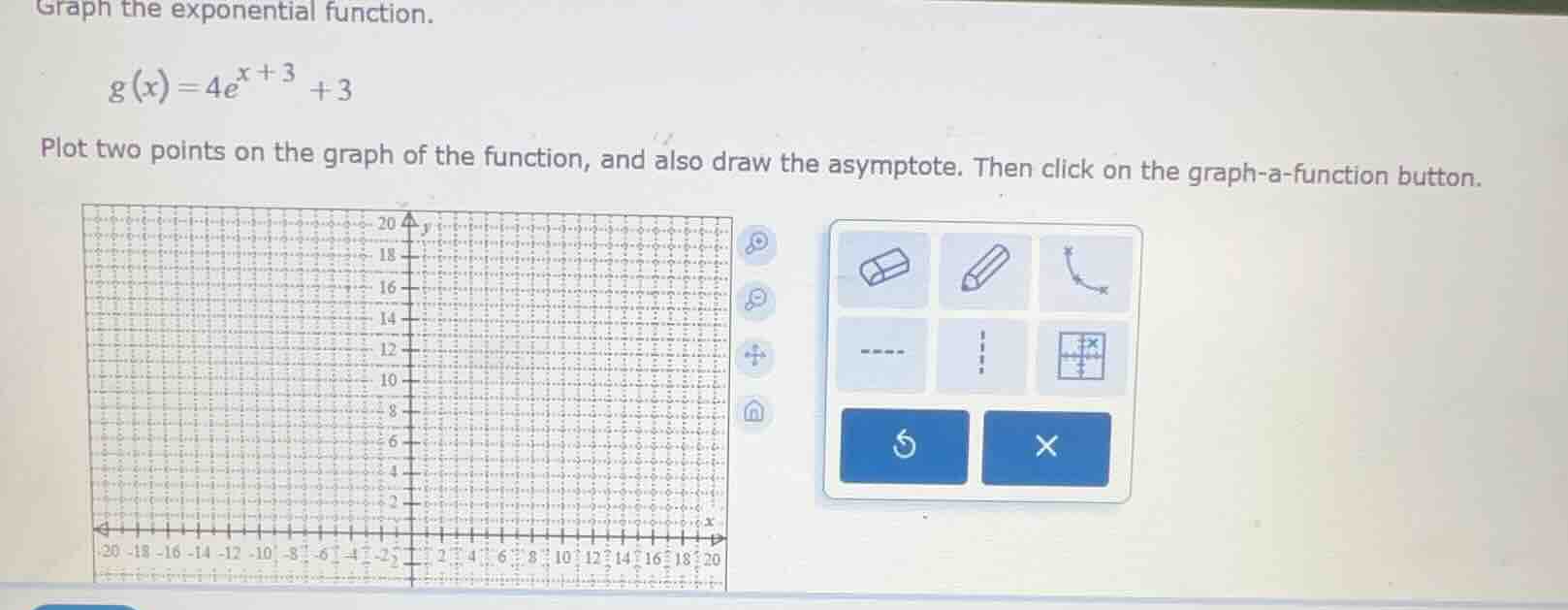
$g(x)=4e^{x + 3}+3$
plot two points on the graph of the function, and also draw the asymptote. then click on the graph - a - function button.
Step1: Find the horizontal asymptote
For an exponential function of the form \( y = ae^{x - h}+k \), the horizontal asymptote is \( y = k \). In \( g(x)=4e^{x + 3}+3 \), \( k = 3 \), so the horizontal asymptote is \( y = 3 \) (dashed line).
Step2: Find the first point (when \( x=-3 \))
Substitute \( x=-3 \) into \( g(x) \):
\( g(-3)=4e^{-3 + 3}+3=4e^{0}+3=4(1)+3 = 7 \).
So the point is \( (-3,7) \).
Step3: Find the second point (when \( x = 0 \))
Substitute \( x = 0 \) into \( g(x) \):
\( g(0)=4e^{0 + 3}+3=4e^{3}+3\approx4(20.0855)+3\approx80.342 + 3=83.342 \) (but for simplicity, we can also use \( x=-2 \)):
\( g(-2)=4e^{-2 + 3}+3=4e^{1}+3\approx4(2.7183)+3\approx10.873 + 3 = 13.873 \), so point \( (-2,13.87) \) or using \( x=-3, x = -2 \) etc. (we use \( x=-3, y = 7 \) and \( x=-2, y\approx13.87 \) or another simple \( x \) like \( x = -4 \)):
\( g(-4)=4e^{-4 + 3}+3=4e^{-1}+3\approx4(0.3679)+3\approx1.4716+3 = 4.4716 \), so point \( (-4,4.47) \) (but the asymptote is \( y = 3 \), and the function increases as \( x \) increases since the exponent has a positive coefficient for \( x \)).

Snap & solve any problem in the app
Get step-by-step solutions on Sovi AI
Photo-based solutions with guided steps
Explore more problems and detailed explanations
Horizontal asymptote: \( y = 3 \) (dashed line).
Two points: \( (-3,7) \) and \( (-2, 4e + 3)\approx(-2,13.87) \) (or other valid points from substituting \( x \)-values into \( g(x) \)). To graph, draw the dashed line \( y = 3 \), plot \( (-3,7) \) and another point (e.g., \( (-2,13.87) \)) and sketch the curve rising from near \( y = 3 \) (as \( x\to-\infty \)) and increasing rapidly as \( x \) increases.