QUESTION IMAGE
Question
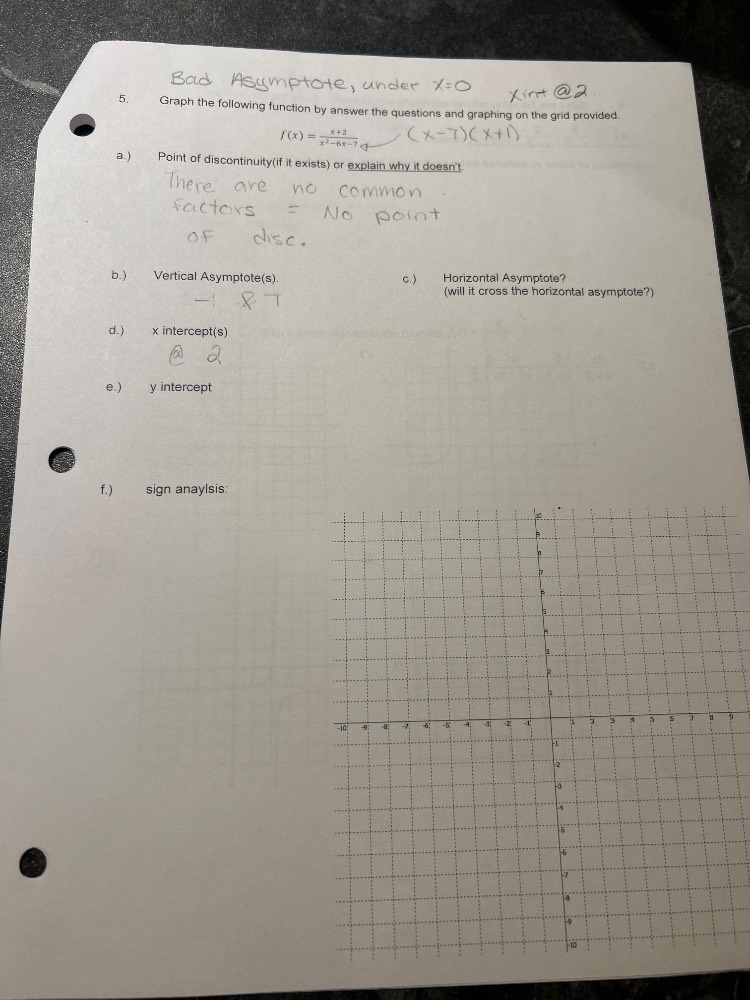
- graph the following function by answer the questions and graphing on the grid provided. \\( f(x) = \frac{x + 2}{x^2 + 6x - 7} \\) \\( (x - 1)(x + 1) \\) \\( \text{a) point of discontinuity(if it exists) or explain why it doesnt} \\) \\( \text{there are no common factors = no point of disc.} \\) \\( \text{b) vertical asymptote(s).} \\) \\( \text{c) horizontal asymptote?} \\) \\( \text{(will it cross the horizontal asymptote?)} \\) \\( \text{d) x intercept(s)} \\) \\( \text{@ 2} \\) \\( \text{e) y intercept} \\) \\( \text{f) sign analysis:} \\)
Part (a)
Step1: Factor denominator
First, factor the denominator \(x^{2}+6x - 7\). We need two numbers that multiply to \(-7\) and add to \(6\). Those numbers are \(7\) and \(-1\), so \(x^{2}+6x - 7=(x + 7)(x - 1)\). The numerator is \(x + 2\).
Step2: Check common factors
Now, check if the numerator (\(x + 2\)) and the factored denominator (\((x + 7)(x - 1)\)) have any common factors. Since \(x+2\) is not equal to \(x + 7\) or \(x - 1\) for all \(x\), there are no common factors.
Step3: Conclusion on discontinuity
A point of discontinuity (hole) occurs when there is a common factor in the numerator and denominator (which gets canceled). Since there are no common factors, there is no point of discontinuity.
Step1: Recall vertical asymptote rule
Vertical asymptotes of a rational function \(f(x)=\frac{N(x)}{D(x)}\) occur where \(D(x)=0\) and \(N(x)
eq0\) (since we already checked for holes).
Step2: Solve denominator for zero
We have the denominator factored as \((x + 7)(x - 1)\). Set each factor equal to zero:
- For \(x+7 = 0\), we get \(x=-7\).
- For \(x - 1=0\), we get \(x = 1\).
Step3: Check numerator at these x - values
Now, check the numerator at \(x=-7\) and \(x = 1\):
- When \(x=-7\), the numerator \(x + 2=-7 + 2=-5
eq0\).
- When \(x = 1\), the numerator \(x + 2=1+2 = 3
eq0\).
So, the vertical asymptotes occur at these \(x\)-values.
Step1: Recall horizontal asymptote rules
For a rational function \(f(x)=\frac{N(x)}{D(x)}\), where the degree of \(N(x)\) is \(n\) and the degree of \(D(x)\) is \(m\):
- If \(n\lt m\), the horizontal asymptote is \(y = 0\).
- If \(n=m\), the horizontal asymptote is \(y=\frac{\text{leading coefficient of }N(x)}{\text{leading coefficient of }D(x)}\).
- If \(n>m\), there is no horizontal asymptote (but there may be an oblique asymptote).
Step2: Determine degrees
The degree of the numerator \(N(x)=x + 2\) is \(n = 1\) (since the highest power of \(x\) is \(1\)). The degree of the denominator \(D(x)=x^{2}+6x - 7\) is \(m = 2\) (highest power of \(x\) is \(2\)). Since \(n=1\lt m = 2\), the horizontal asymptote is \(y = 0\).
Step3: Check if it crosses the asymptote
To check if the graph crosses the horizontal asymptote \(y = 0\), we set \(f(x)=0\) (since \(y = f(x)\)) and solve for \(x\). So, \(\frac{x + 2}{(x + 7)(x - 1)}=0\). A fraction is zero when the numerator is zero (and the denominator is not zero). Set \(x+2=0\), we get \(x=-2\). Now, check if \(x=-2\) makes the denominator zero: \((-2 + 7)(-2 - 1)=(5)(-3)=-15
eq0\). So, when \(x=-2\), \(y = 0\), which means the graph crosses the horizontal asymptote \(y = 0\) at the point \((-2,0)\).

Snap & solve any problem in the app
Get step-by-step solutions on Sovi AI
Photo-based solutions with guided steps
Explore more problems and detailed explanations
There is no point of discontinuity because the numerator \(x + 2\) and the factored denominator \((x + 7)(x - 1)\) have no common factors.