QUESTION IMAGE
Question
graph the following function. state the domain and range. is the function increasing or decreasing?
$f(x) = \sqrt3{x} - 4$
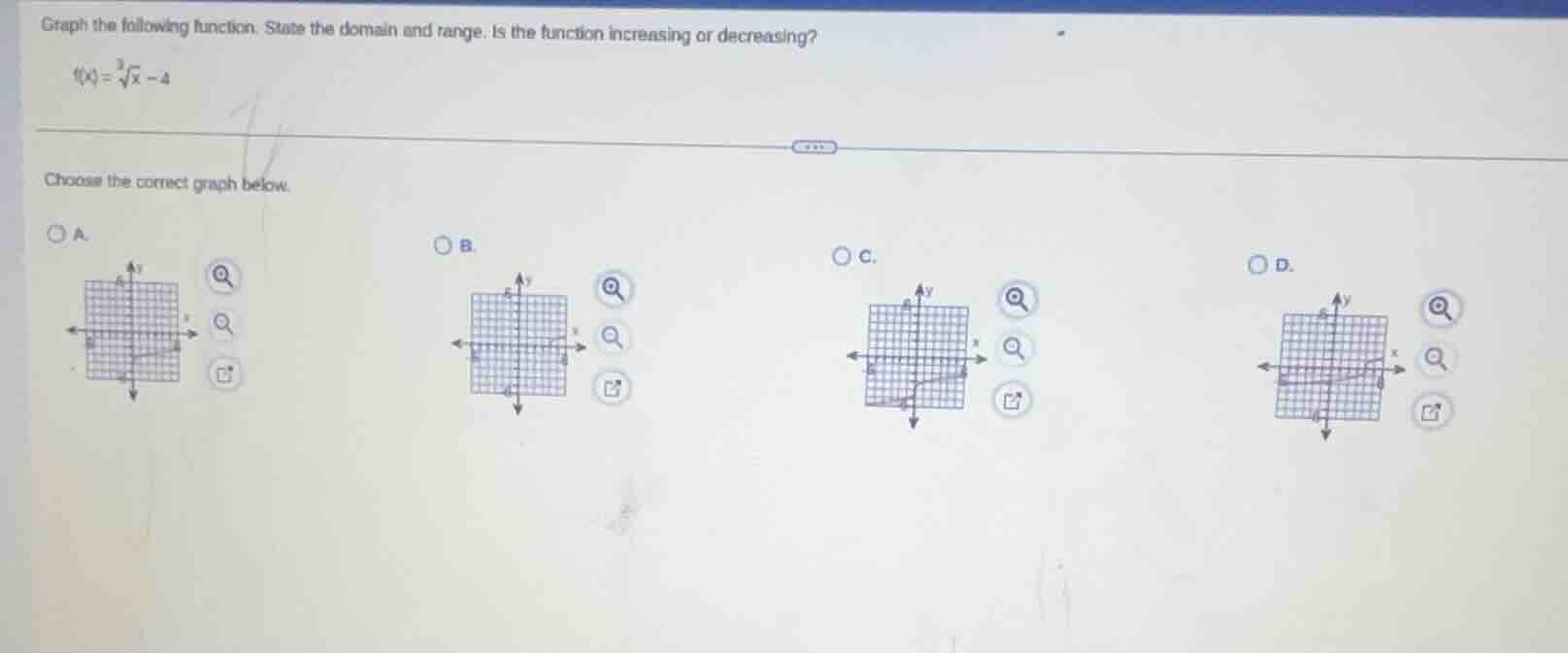
choose the correct graph below.
\\(\bigcirc\\) a.
\\(\bigcirc\\) b.
\\(\bigcirc\\) c.
\\(\bigcirc\\) d.
Step1: Analyze the parent function
The parent function is \( y = \sqrt[3]{x} \), which has a domain of all real numbers (\( (-\infty, \infty) \)) and a range of all real numbers (\( (-\infty, \infty) \)). It is an increasing function, passing through the origin \((0,0)\), and has a point - symmetric graph about the origin.
Step2: Analyze the transformation
The given function is \( f(x)=\sqrt[3]{x}-4 \). This is a vertical shift of the parent function \( y = \sqrt[3]{x} \) down by 4 units.
Domain:
For the cube - root function \( y=\sqrt[3]{x}\), we can take the cube - root of any real number. When we shift the graph vertically (by subtracting 4), the domain does not change. So the domain of \( f(x)=\sqrt[3]{x}-4 \) is all real numbers, or in interval notation, \( (-\infty,\infty) \).
Range:
The range of the parent function \( y = \sqrt[3]{x} \) is all real numbers. A vertical shift down by 4 units does not change the set of all possible \( y \) - values (because we are just moving the graph up or down, not restricting or expanding the set of \( y \) - values in terms of their possible range). So the range of \( f(x)=\sqrt[3]{x}-4 \) is also all real numbers, or \( (-\infty,\infty) \) in interval notation.
Increasing/Decreasing:
The derivative of the parent function \( y = \sqrt[3]{x}=x^{\frac{1}{3}} \) is \( y^\prime=\frac{1}{3}x^{-\frac{2}{3}}=\frac{1}{3\sqrt[3]{x^{2}}} \). The derivative is non - negative for all \( x
eq0 \) (and at \( x = 0 \), the function has a vertical tangent, but the function is still increasing through \( x = 0 \)). When we shift the function vertically, the slope of the function (the rate of change) does not change. So the function \( f(x)=\sqrt[3]{x}-4 \) is an increasing function.
Graph:
The parent function \( y=\sqrt[3]{x} \) passes through \((0,0)\), \((1,1)\), and \(( - 1,-1)\). For the function \( f(x)=\sqrt[3]{x}-4 \), when \( x = 0 \), \( f(0)=\sqrt[3]{0}-4=-4 \); when \( x = 1 \), \( f(1)=\sqrt[3]{1}-4=1 - 4=-3 \); when \( x=-1 \), \( f(-1)=\sqrt[3]{-1}-4=-1 - 4=-5 \). So the graph of \( f(x) \) should be the graph of \( y = \sqrt[3]{x} \) shifted down 4 units. Looking at the options, we need to find the graph that has the shape of a cube - root function (increasing, passing through points like \((0, - 4)\), \((1,-3)\), \((-1,-5)\))

Snap & solve any problem in the app
Get step-by-step solutions on Sovi AI
Photo-based solutions with guided steps
Explore more problems and detailed explanations
- Domain: \( (-\infty,\infty) \)
- Range: \( (-\infty,\infty) \)
- Increasing/Decreasing: The function is increasing.
- Graph: (Assuming the correct graph is the one that represents a vertically shifted (down 4 units) cube - root function. If we assume the options are such that the correct graph has the key points and the increasing nature as we analyzed, for example, if option B (or the appropriate option) shows a graph that is an increasing curve shifted down 4 units, then the correct graph is the one with the shape of \( y = \sqrt[3]{x} \) shifted down 4 units. )