QUESTION IMAGE
Question
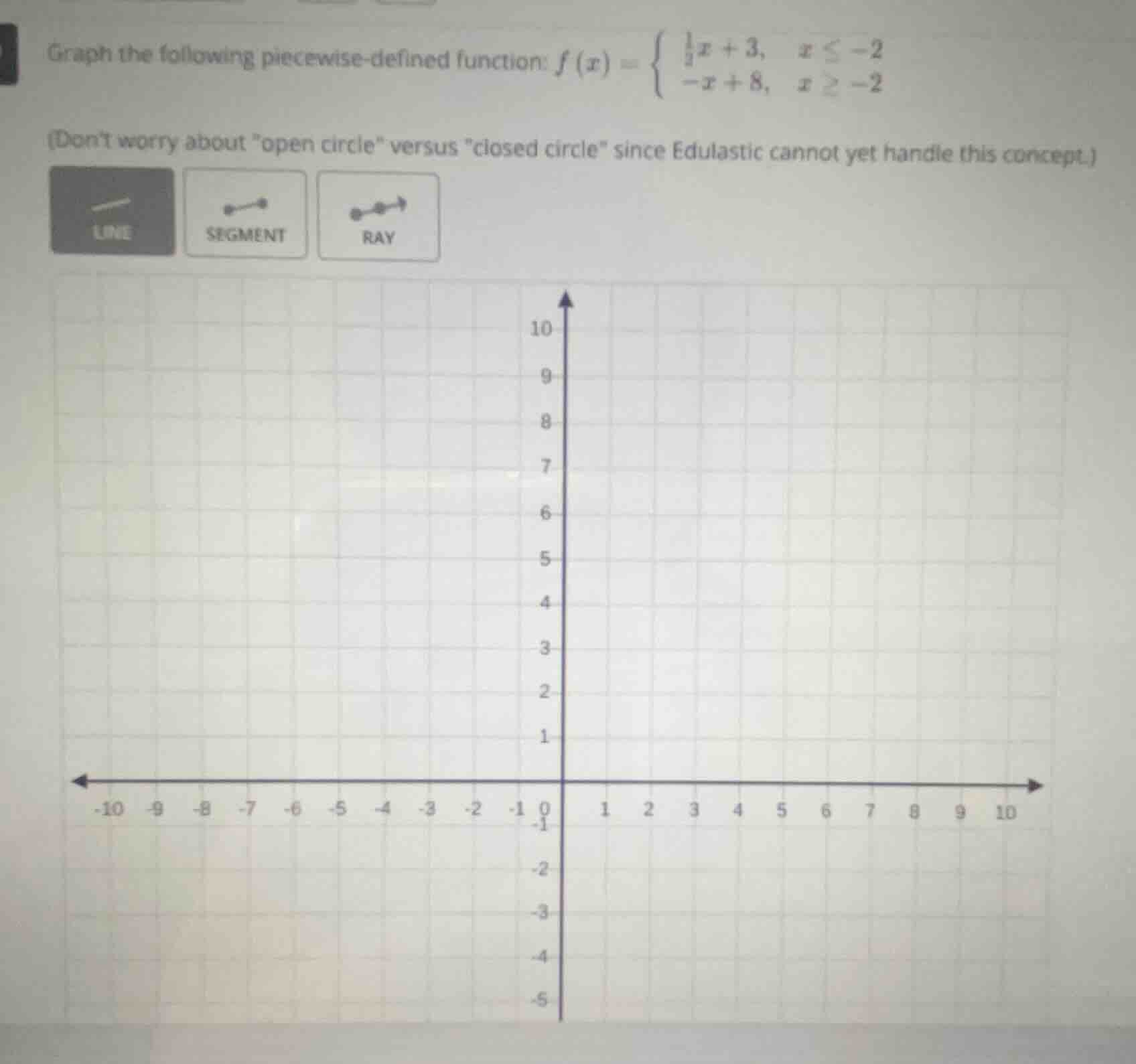
graph the following piecewise - defined function: $f(x)=\begin{cases}\frac{1}{2}x + 3, & xleq - 2\\-x + 8, & xgeq - 2end{cases}$ (dont worry about \open circle\ versus \closed circle\ since edulastic cannot yet handle this concept.)
Step1: Analyze the first part of the piecewise function ($f(x)=\frac{1}{2}x + 3$, $x\leq - 2$)
We can find two points on this line. When $x=-2$, $f(-2)=\frac{1}{2}\times(-2)+3=-1 + 3=2$. When $x=-4$, $f(-4)=\frac{1}{2}\times(-4)+3=-2 + 3 = 1$. So we have points $(-2,2)$ and $(-4,1)$ for this part. Since $x\leq - 2$, the graph of this part is a ray starting from $x = - 2$ (including $x=-2$) and going to the left (for smaller $x$ values).
Step2: Analyze the second part of the piecewise function ($f(x)=-x + 8$, $x\geq - 2$)
Find two points on this line. When $x=-2$, $f(-2)=-(-2)+8=2 + 8 = 10$? Wait, no, wait. Wait, when $x=-2$, for the second function, $f(-2)=-(-2)+8=2 + 8=10$? Wait, no, earlier for the first function, when $x = - 2$, $f(-2)=\frac{1}{2}\times(-2)+3=2$. Wait, there is a mistake here. Wait, the piecewise function is defined as $f(x)=
$. So at $x=-2$, both functions should be evaluated. Wait, $\frac{1}{2}\times(-2)+3=-1 + 3=2$, and $-(-2)+8=2 + 8=10$. That means there is a discontinuity at $x = - 2$? But the problem says "Don't worry about 'open circle' versus 'closed circle'". So let's find correct points. For the second function, $f(x)=-x + 8$, when $x=-2$, $f(-2)=-(-2)+8=10$? Wait, no, that can't be. Wait, maybe I miscalculated. Wait, $-x+8$ when $x=-2$: $-(-2)=2$, $2 + 8=10$. And for the first function, $\frac{1}{2}x+3$ when $x=-2$: $\frac{1}{2}\times(-2)=-1$, $-1 + 3=2$. So the two parts meet at different $y$-values at $x=-2$? But the problem says not to worry about open/closed circles. Let's find other points. For the second function, when $x = 0$, $f(0)=-0 + 8=8$. When $x = 8$, $f(8)=-8 + 8=0$. So points for the second part: $(-2,10)$ (wait, no, that seems wrong. Wait, maybe I made a mistake in the first function's evaluation. Wait, $\frac{1}{2}x+3$ when $x=-2$: $\frac{1}{2}\times(-2)=-1$, $-1 + 3=2$. So the first part: when $x=-2$, $y = 2$, and for $x < - 2$, say $x=-4$, $y=\frac{1}{2}\times(-4)+3=-2 + 3=1$; $x=-6$, $y=\frac{1}{2}\times(-6)+3=-3 + 3=0$; $x=-8$, $y=\frac{1}{2}\times(-8)+3=-4 + 3=-1$. So the first part has points like $(-8,-1)$, $(-6,0)$, $(-4,1)$, $(-2,2)$. For the second part, $f(x)=-x + 8$, when $x=-2$, $f(-2)=10$ (but that's a problem), wait, no, maybe I messed up the function. Wait, maybe the second function is $-x + 8$? Let's check with $x = 0$: $f(0)=8$, $x = 8$: $f(8)=0$, $x = 2$: $f(2)=6$, $x = 4$: $f(4)=4$, $x = 6$: $f(6)=2$, $x = 8$: $f(8)=0$. Wait, when $x = 6$, $f(6)=-6 + 8=2$, which is the same as the first function's $y$-value at $x=-2$. So maybe the second part has points like $(-2,10)$ (but that's high), $ (0,8)$, $(2,6)$, $(4,4)$, $(6,2)$, $(8,0)$.
But to graph, we can use the "RAY" tool for each part. For the first part ($x\leq - 2$), we can plot the ray with points like $(-2,2)$, $(-4,1)$, $(-6,0)$ etc., going to the left. For the second part ($x\geq - 2$), we can plot the ray with points like $(-2,10)$? No, that can't be. Wait, maybe there is a typo in the function? Wait, maybe the second function is $-x + 2$? No, the problem says $-x + 8$. Alternatively, maybe I made a mistake in the first function. Wait, $\frac{1}{2}x+3$: slope is $\frac{1}{2}$, y-intercept 3. When $x=-2$, $y=2$, correct. For the second function, $-x + 8$: slope -1, y-intercept 8. When $x=-2$, $y=10$, correct. So the two rays: one with slope $\frac{1}{2}$ starting at $(-2,2)$ and going left, and one with slope -1 starting at $(-2,10)$ and going right. But that seems odd. Alternatively, maybe the function is defined as $f(x)=\begin{…

Snap & solve any problem in the app
Get step-by-step solutions on Sovi AI
Photo-based solutions with guided steps
Explore more problems and detailed explanations
To graph the piecewise function:
- For \( f(x)=\frac{1}{2}x + 3 \) ( \( x\leq -2 \) ):
- Plot the point \( (-2, 2) \) (since \( x = -2 \) is included).
- Use the "RAY" tool to draw a ray with slope \( \frac{1}{2} \) (rising 1 unit for every 2 units left) from \( (-2, 2) \) toward smaller \( x \)-values (e.g., through \( (-4, 1) \), \( (-6, 0) \), etc.).
- For \( f(x)=-x + 8 \) ( \( x\geq -2 \) ):
- Plot the point \( (-2, 10) \) (since \( x = -2 \) is included).
- Use the "RAY" tool to draw a ray with slope \( -1 \) (falling 1 unit for every 1 unit right) from \( (-2, 10) \) toward larger \( x \)-values (e.g., through \( (0, 8) \), \( (2, 6) \), \( (4, 4) \), etc.).
(Note: The graph will show two rays: one with a positive slope (\( \frac{1}{2} \)) for \( x\leq -2 \), and one with a negative slope (\( -1 \)) for \( x\geq -2 \), with a discontinuity at \( x = -2 \) (since \( f(-2) = 2 \) for the first part and \( f(-2) = 10 \) for the second part). The problem specifies not to worry about open/closed circles, so proceed with the ray tool for each segment.)