QUESTION IMAGE
Question
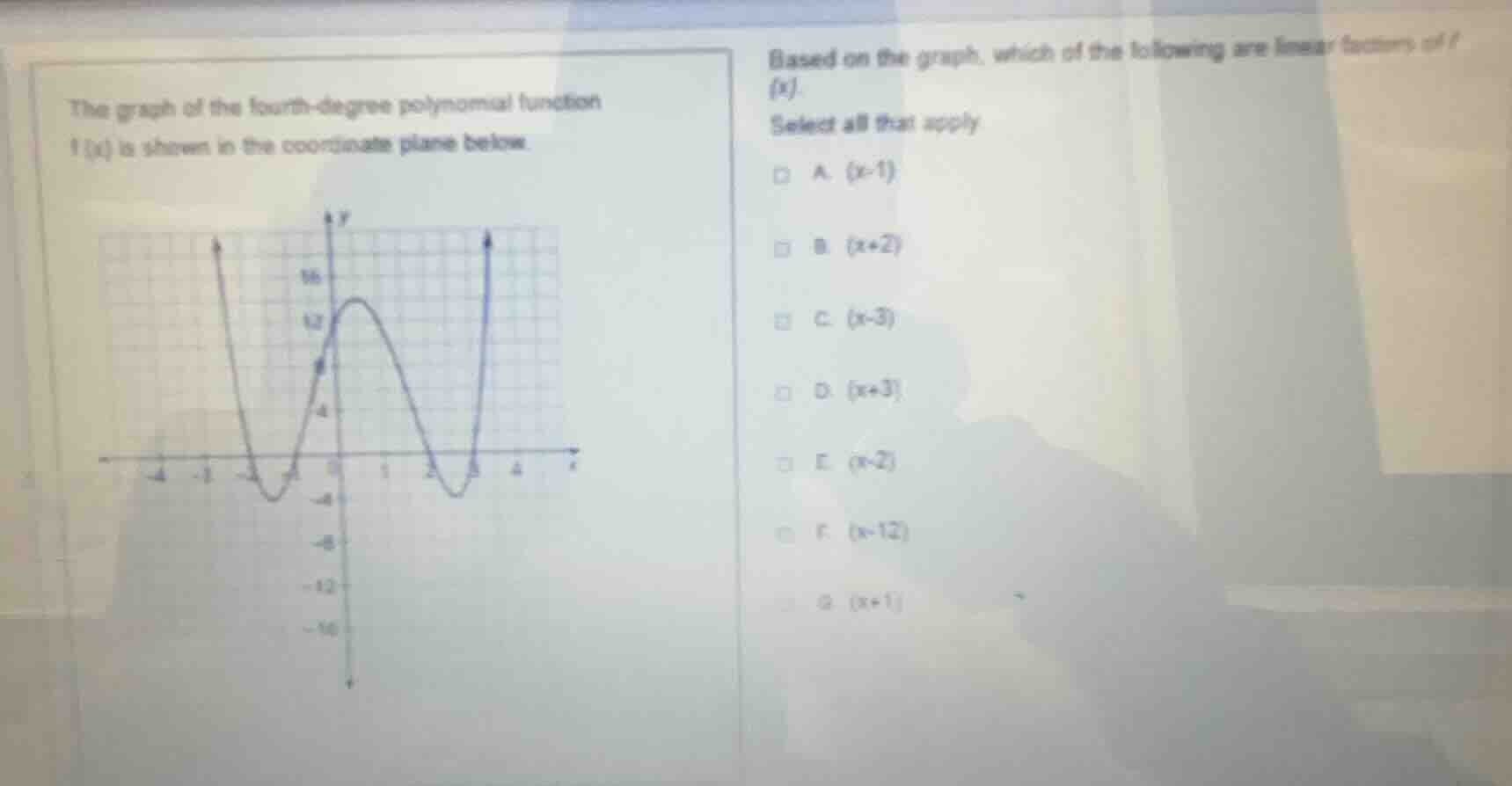
the graph of the fourth - degree polynomial function f(x) is shown in the coordinate plane below. based on the graph, which of the following are linear factors of f(x). select all that apply
a. (x - 1)
b. (x + 2)
c. (x - 3)
d. (x + 3)
e. (x - 2)
f. (x - 12)
g. (x + 1)
Step1: Recall root - factor relationship
If a polynomial function \(y = f(x)\) has a root (x - intercept) at \(x = a\), then \((x - a)\) is a linear factor of \(f(x)\). This is from the Factor Theorem, which states that if \(f(a)=0\), then \((x - a)\) is a factor of \(f(x)\).
Step2: Identify x - intercepts from the graph
From the given graph of the fourth - degree polynomial function \(f(x)\), we can see that the graph intersects the x - axis at \(x=- 2\), \(x = - 1\), \(x = 2\) and \(x=3\)? Wait, no, looking at the x - axis labels: the x - intercepts are at \(x=-2\), \(x=-1\)? Wait, no, let's re - examine the graph. Wait, the x - axis has marks at - 4, - 3, - 2, - 1, 0, 1, 2, 3, 4. The graph crosses the x - axis at \(x=-2\), \(x=-1\)? Wait, no, looking at the graph: the left - most x - intercept is at \(x=-2\), then another at \(x=-1\)? Wait, no, the graph: let's see the x - intercepts. Wait, the graph touches or crosses the x - axis at \(x=-2\), \(x=-1\), \(x = 2\), \(x = 3\)? Wait, no, the correct x - intercepts from the graph (by looking at where the graph intersects the x - axis) are \(x=-2\), \(x=-1\), \(x = 2\), \(x = 3\)? Wait, no, let's check the options. The options are \((x - 1)\), \((x + 2)=(x-(-2))\), \((x - 3)\), \((x + 3)=(x-(-3))\), \((x - 2)=(x - 2)\), \((x - 12)\), \((x + 1)=(x-(-1))\).
Wait, from the graph, the x - intercepts (where the graph crosses the x - axis) are at \(x=-2\), \(x=-1\), \(x = 2\), \(x = 3\). Wait, no, let's look again. The graph: when \(x=-2\), the graph crosses the x - axis, so for \(x=-2\), the factor is \((x-(-2))=(x + 2)\). When \(x=-1\), the graph crosses the x - axis, so the factor is \((x-(-1))=(x + 1)\). When \(x = 2\), the graph crosses the x - axis, so the factor is \((x - 2)\). When \(x = 3\), the graph crosses the x - axis, so the factor is \((x - 3)\). Wait, but the options are:
A. \((x - 1)\): For \(x = 1\), is \(x = 1\) an x - intercept? No, the graph does not cross the x - axis at \(x = 1\).
B. \((x + 2)=(x-(-2))\): Since the graph has an x - intercept at \(x=-2\), by the Factor Theorem, \((x + 2)\) is a factor.
C. \((x - 3)\): Since the graph has an x - intercept at \(x = 3\), by the Factor Theorem, \((x - 3)\) is a factor.
D. \((x + 3)=(x-(-3))\): The graph does not have an x - intercept at \(x=-3\), so \((x + 3)\) is not a factor.
E. \((x - 2)\): Since the graph has an x - intercept at \(x = 2\), by the Factor Theorem, \((x - 2)\) is a factor.
F. \((x - 12)\): The graph does not have an x - intercept at \(x = 12\), so this is not a factor.
G. \((x + 1)=(x-(-1))\): Since the graph has an x - intercept at \(x=-1\), by the Factor Theorem, \((x + 1)\) is a factor. Wait, but the options given: A is \((x - 1)\), B is \((x + 2)\), C is \((x - 3)\), D is \((x + 3)\), E is \((x - 2)\), F is \((x - 12)\), G is \((x + 1)\). Wait, maybe I misread the x - intercepts. Wait, let's look at the graph again. The x - axis: the graph crosses the x - axis at \(x=-2\), \(x=-1\), \(x = 2\), \(x = 3\)? Wait, no, the original graph: the left x - intercept is at \(x=-2\), then another at \(x=-1\), then at \(x = 2\) and \(x = 3\). But the options are A: \((x - 1)\), B: \((x + 2)\), C: \((x - 3)\), D: \((x + 3)\), E: \((x - 2)\), F: \((x - 12)\), G: \((x + 1)\).
Wait, maybe the x - intercepts are at \(x=-2\), \(x=-1\), \(x = 2\), \(x = 3\). So the factors are \((x + 2)\) (because \(x=-2\) is a root, so factor is \(x-(-2)=x + 2\)), \((x + 1)\) (because \(x=-1\) is a root, factor is \(x-(-1)=x + 1\)), \((x - 2)\) (because \(x = 2\) is a root, factor is \(x - 2\)), \((x - 3)\) (because \(x…

Snap & solve any problem in the app
Get step-by-step solutions on Sovi AI
Photo-based solutions with guided steps
Explore more problems and detailed explanations
B. \((x + 2)\), C. \((x - 3)\), E. \((x - 2)\)