QUESTION IMAGE
Question
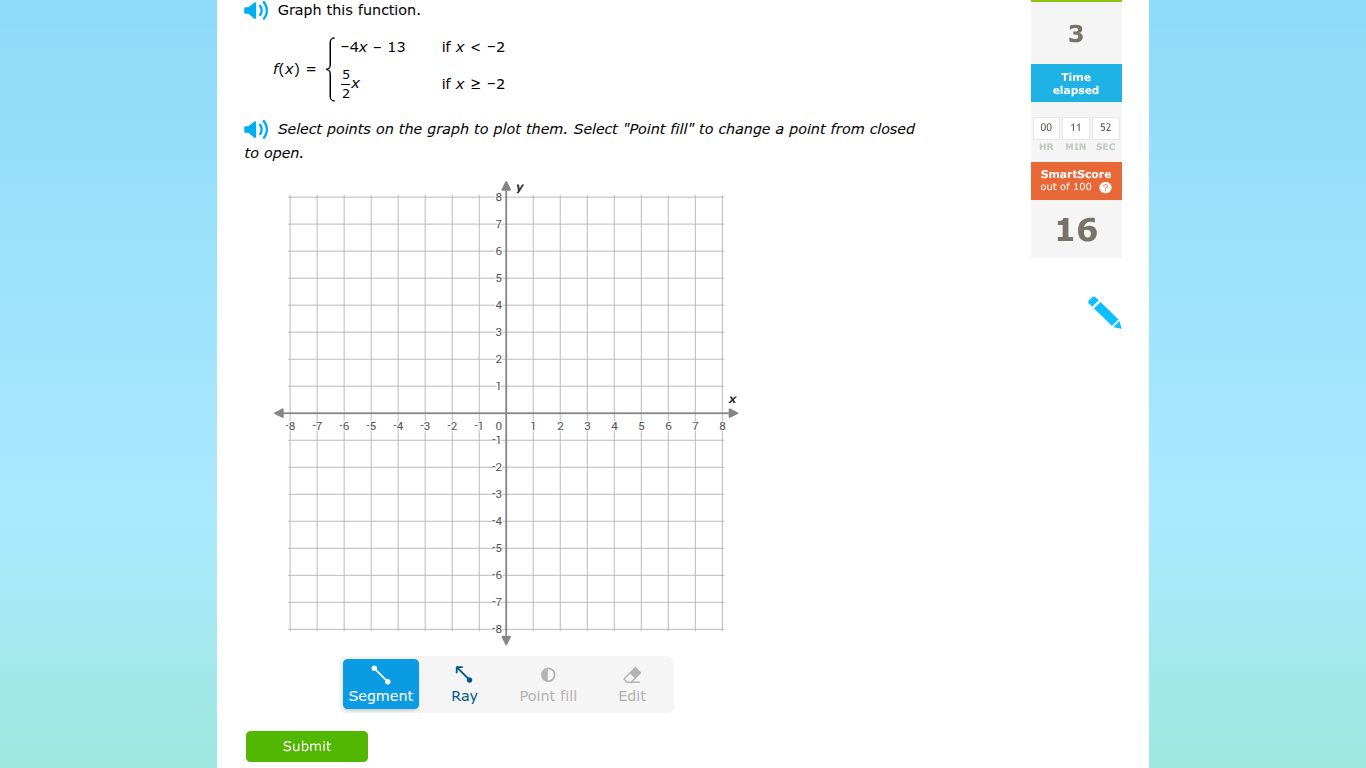
graph this function.
$f(x) = \
$
select points on the graph to plot them. select \point fill\ to change a point from closed to open.
Step1: Analyze the piecewise function
The function is \( f(x) =
\)
Step2: Plot the first part (\(x < -2\))
Let's choose \(x = -3\) (since \( -3 < -2 \)):
\( f(-3) = -4(-3) - 13 = 12 - 13 = -1 \)
So the point is \((-3, -1)\)
Choose \(x = -4\):
\( f(-4) = -4(-4) - 13 = 16 - 13 = 3 \)
Point: \((-4, 3)\)
This part is a line with slope \(-4\), so we can draw a ray (open circle at \(x = -2\) for this part).
Step3: Plot the second part (\(x \geq -2\))
Let's choose \(x = -2\):
\( f(-2) = \frac{5}{2}(-2) = -5 \)
Wait, no, wait: Wait, \(\frac{5}{2}x\) when \(x = -2\): \(\frac{5}{2}(-2) = -5\)? Wait, no, wait, maybe I made a mistake. Wait, \(\frac{5}{2}x\) when \(x = -2\): \(\frac{5}{2} \times (-2) = -5\)? Wait, but let's check the first part at \(x = -2\): \( -4(-2) - 13 = 8 - 13 = -5 \). Oh! So at \(x = -2\), both parts give \( -5 \). So the point at \(x = -2\) is \((-2, -5)\) (closed circle for the second part).
Now choose \(x = 0\):
\( f(0) = \frac{5}{2}(0) = 0 \)
Point: \((0, 0)\)
Choose \(x = 2\):
\( f(2) = \frac{5}{2}(2) = 5 \)
Point: \((2, 5)\)
This part is a line with slope \(\frac{5}{2}\), so we can draw a ray starting at \((-2, -5)\) (closed circle) and going through \((0, 0)\), \((2, 5)\), etc.
Step4: Draw the graph
For \(x < -2\), draw a ray with open circle at \(x = -2\) (but since at \(x = -2\) both parts meet, actually, since \(f(-2)\) from the second part is equal to the first part at \(x = -2\), the open circle from the first part and closed circle from the second part coincide, so it's a closed circle at \((-2, -5)\).
Wait, let's recalculate \(f(-2)\) for the first part: \( -4(-2) - 13 = 8 - 13 = -5 \). And for the second part: \(\frac{5}{2}(-2) = -5\). So the function is continuous at \(x = -2\). So the first part is a line from \(x < -2\) (ray with open circle at \(x = -2\) but since the second part has a closed circle there and the value is the same, it's a closed circle).
Now, let's plot the points:
For \(x < -2\):
- \(x = -3\): \(f(-3) = -4(-3) -13 = 12 -13 = -1\) → \((-3, -1)\)
- \(x = -4\): \(f(-4) = -4(-4) -13 = 16 -13 = 3\) → \((-4, 3)\)
For \(x \geq -2\):
- \(x = -2\): \(f(-2) = \frac{5}{2}(-2) = -5\) → \((-2, -5)\)
- \(x = 0\): \(f(0) = 0\) → \((0, 0)\)
- \(x = 2\): \(f(2) = 5\) → \((2, 5)\)
Now, draw the first line (for \(x < -2\)) through \((-4, 3)\) and \((-3, -1)\) (and extend to the left, with an open circle at \(x = -2\) but since the value at \(x = -2\) is the same, it's a closed circle). Then draw the second line (for \(x \geq -2\)) through \((-2, -5)\), \((0, 0)\), \((2, 5)\) (and extend to the right).

Snap & solve any problem in the app
Get step-by-step solutions on Sovi AI
Photo-based solutions with guided steps
Explore more problems and detailed explanations
To graph the piecewise function:
- For \( \boldsymbol{x < -2} \) (function \( -4x - 13 \)):
- Plot points like \( (-4, 3) \) (when \( x = -4 \), \( f(-4) = -4(-4) - 13 = 3 \)) and \( (-3, -1) \) (when \( x = -3 \), \( f(-3) = -4(-3) - 13 = -1 \)). Draw a ray (open circle at \( x = -2 \), but since the function is continuous there, it becomes a closed circle).
- For \( \boldsymbol{x \geq -2} \) (function \( \frac{5}{2}x \)):
- Plot points like \( (-2, -5) \) (when \( x = -2 \), \( f(-2) = \frac{5}{2}(-2) = -5 \)), \( (0, 0) \) (when \( x = 0 \), \( f(0) = 0 \)), and \( (2, 5) \) (when \( x = 2 \), \( f(2) = 5 \)). Draw a line through these points (closed circle at \( x = -2 \)).
The graph consists of two linear segments: a line with slope \( -4 \) (for \( x < -2 \)) and a line with slope \( \frac{5}{2} \) (for \( x \geq -2 \)), meeting at \( (-2, -5) \) (closed circle).