QUESTION IMAGE
Question
graph the function.
$y = 4\sqrt3{x}$
To graph \( y = 4\sqrt[3]{x} \), we can analyze key points and the shape of the cube - root function:
Step 1: Recall the parent function
The parent function of a cube - root function is \( y=\sqrt[3]{x} \). The graph of \( y = \sqrt[3]{x} \) passes through the origin \((0,0)\), and for \( x = 1\), \( y=\sqrt[3]{1}=1\); for \( x=- 1\), \( y=\sqrt[3]{-1}=-1\); for \( x = 8\), \( y=\sqrt[3]{8}=2\); for \( x=-8\), \( y=\sqrt[3]{-8}=-2\)
Step 2: Analyze the transformation
The function \( y = 4\sqrt[3]{x} \) is a vertical stretch of the parent function \( y=\sqrt[3]{x} \) by a factor of 4. This means that for any given \( x \)-value, the \( y \)-value of \( y = 4\sqrt[3]{x} \) is 4 times the \( y \)-value of \( y=\sqrt[3]{x} \)
Step 3: Find key points
- When \( x = 0\):
Substitute \( x = 0\) into \( y = 4\sqrt[3]{x} \), we get \( y=4\sqrt[3]{0}=0\). So the point \((0,0)\) is on the graph.
- When \( x = 1\):
Substitute \( x = 1\) into \( y = 4\sqrt[3]{x} \), we have \( y = 4\sqrt[3]{1}=4\times1 = 4\). So the point \((1,4)\) is on the graph.
- When \( x=-1\):
Substitute \( x=-1\) into \( y = 4\sqrt[3]{x} \), we get \( y = 4\sqrt[3]{-1}=4\times(- 1)=-4\). So the point \((-1,-4)\) is on the graph.
- When \( x = 8\):
Substitute \( x = 8\) into \( y = 4\sqrt[3]{x} \), we have \( y=4\sqrt[3]{8}=4\times2 = 8\). So the point \((8,8)\) is on the graph.
- When \( x=-8\):
Substitute \( x = - 8\) into \( y = 4\sqrt[3]{x} \), we get \( y=4\sqrt[3]{-8}=4\times(-2)=-8\). So the point \((-8,-8)\) is on the graph.
Step 4: Sketch the graph
- The domain of the function \( y = 4\sqrt[3]{x} \) is all real numbers (\( (-\infty,\infty) \)) because we can take the cube - root of any real number.
- The range of the function is also all real numbers (\( (-\infty,\infty) \)) since the cube - root function can output any real number and we are just stretching it vertically.
- The graph is symmetric about the origin (it is an odd function, since \( f(-x)=4\sqrt[3]{-x}=-4\sqrt[3]{x}=-f(x) \))
- As \( x\to\infty\), \( y = 4\sqrt[3]{x}\to\infty\) and as \( x\to-\infty\), \( y = 4\sqrt[3]{x}\to-\infty\)
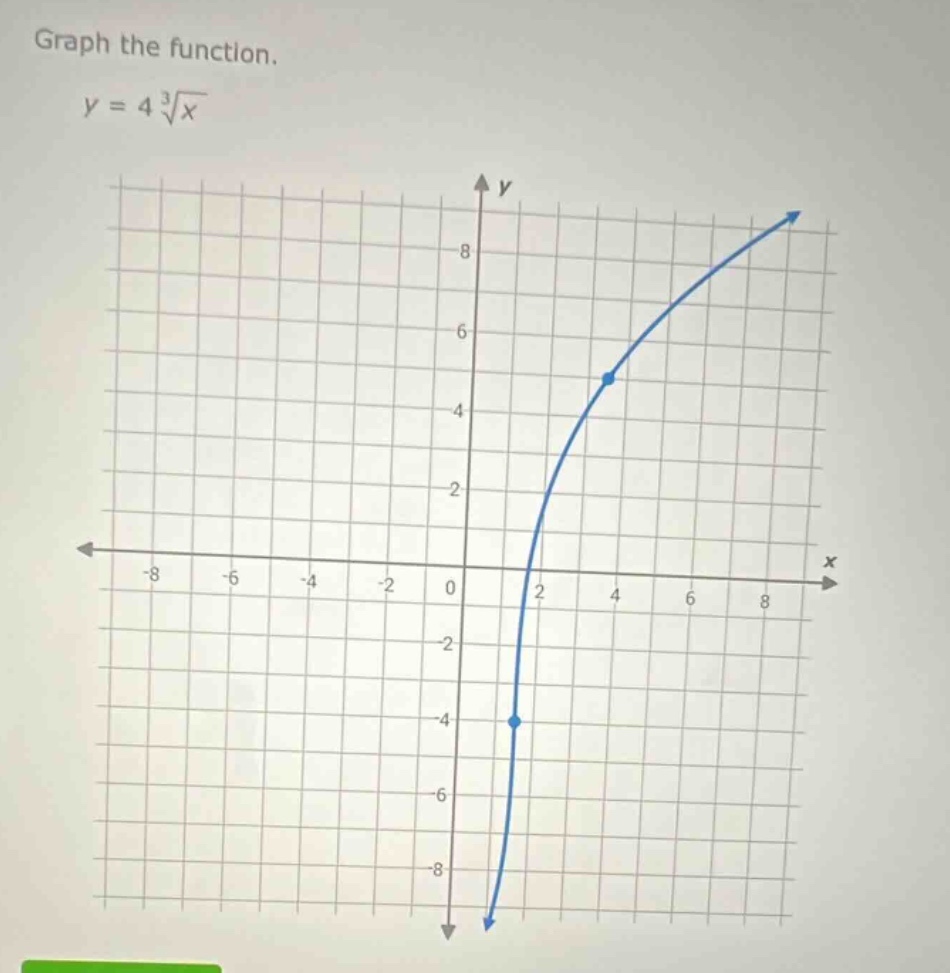
To graph the function, plot the key points \((-8,-8)\), \((-1,-4)\), \((0,0)\), \((1,4)\), \((8,8)\) and draw a smooth curve through them. The curve should pass through the origin, increase from left to right (since the cube - root function with a positive coefficient of the cube - root term is an increasing function), and have a shape similar to the cube - root curve but stretched vertically.
If we want to check the points on the given grid:
- For \( x = 1\), \( y = 4\), so the point \((1,4)\) should be on the graph.
- For \( x=-1\), \( y=-4\), so the point \((-1,-4)\) should be on the graph.
The graph of \( y = 4\sqrt[3]{x} \) is a vertically stretched (by a factor of 4) version of the cube - root function \( y=\sqrt[3]{x} \), passing through the origin, increasing, and symmetric about the origin.

Snap & solve any problem in the app
Get step-by-step solutions on Sovi AI
Photo-based solutions with guided steps
Explore more problems and detailed explanations
To graph \( y = 4\sqrt[3]{x} \), we can analyze key points and the shape of the cube - root function:
Step 1: Recall the parent function
The parent function of a cube - root function is \( y=\sqrt[3]{x} \). The graph of \( y = \sqrt[3]{x} \) passes through the origin \((0,0)\), and for \( x = 1\), \( y=\sqrt[3]{1}=1\); for \( x=- 1\), \( y=\sqrt[3]{-1}=-1\); for \( x = 8\), \( y=\sqrt[3]{8}=2\); for \( x=-8\), \( y=\sqrt[3]{-8}=-2\)
Step 2: Analyze the transformation
The function \( y = 4\sqrt[3]{x} \) is a vertical stretch of the parent function \( y=\sqrt[3]{x} \) by a factor of 4. This means that for any given \( x \)-value, the \( y \)-value of \( y = 4\sqrt[3]{x} \) is 4 times the \( y \)-value of \( y=\sqrt[3]{x} \)
Step 3: Find key points
- When \( x = 0\):
Substitute \( x = 0\) into \( y = 4\sqrt[3]{x} \), we get \( y=4\sqrt[3]{0}=0\). So the point \((0,0)\) is on the graph.
- When \( x = 1\):
Substitute \( x = 1\) into \( y = 4\sqrt[3]{x} \), we have \( y = 4\sqrt[3]{1}=4\times1 = 4\). So the point \((1,4)\) is on the graph.
- When \( x=-1\):
Substitute \( x=-1\) into \( y = 4\sqrt[3]{x} \), we get \( y = 4\sqrt[3]{-1}=4\times(- 1)=-4\). So the point \((-1,-4)\) is on the graph.
- When \( x = 8\):
Substitute \( x = 8\) into \( y = 4\sqrt[3]{x} \), we have \( y=4\sqrt[3]{8}=4\times2 = 8\). So the point \((8,8)\) is on the graph.
- When \( x=-8\):
Substitute \( x = - 8\) into \( y = 4\sqrt[3]{x} \), we get \( y=4\sqrt[3]{-8}=4\times(-2)=-8\). So the point \((-8,-8)\) is on the graph.
Step 4: Sketch the graph
- The domain of the function \( y = 4\sqrt[3]{x} \) is all real numbers (\( (-\infty,\infty) \)) because we can take the cube - root of any real number.
- The range of the function is also all real numbers (\( (-\infty,\infty) \)) since the cube - root function can output any real number and we are just stretching it vertically.
- The graph is symmetric about the origin (it is an odd function, since \( f(-x)=4\sqrt[3]{-x}=-4\sqrt[3]{x}=-f(x) \))
- As \( x\to\infty\), \( y = 4\sqrt[3]{x}\to\infty\) and as \( x\to-\infty\), \( y = 4\sqrt[3]{x}\to-\infty\)
To graph the function, plot the key points \((-8,-8)\), \((-1,-4)\), \((0,0)\), \((1,4)\), \((8,8)\) and draw a smooth curve through them. The curve should pass through the origin, increase from left to right (since the cube - root function with a positive coefficient of the cube - root term is an increasing function), and have a shape similar to the cube - root curve but stretched vertically.
If we want to check the points on the given grid:
- For \( x = 1\), \( y = 4\), so the point \((1,4)\) should be on the graph.
- For \( x=-1\), \( y=-4\), so the point \((-1,-4)\) should be on the graph.
The graph of \( y = 4\sqrt[3]{x} \) is a vertically stretched (by a factor of 4) version of the cube - root function \( y=\sqrt[3]{x} \), passing through the origin, increasing, and symmetric about the origin.