QUESTION IMAGE
Question
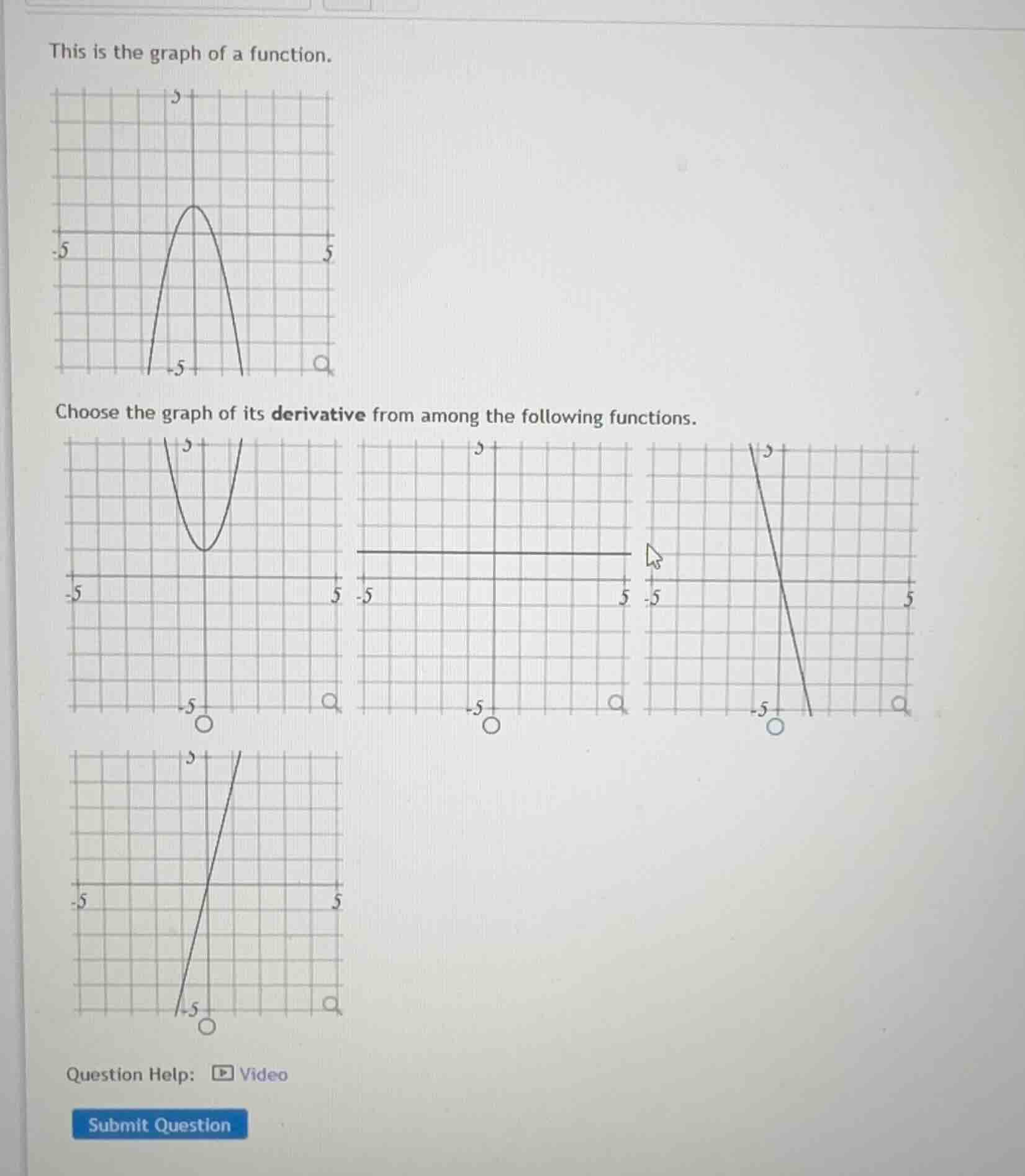
this is the graph of a function.
choose the graph of its derivative from among the following functions.
question help: ▶ video
submit question
Step1: Analyze the original function's graph
The original function is a downward - opening parabola (a quadratic function of the form \(y = -ax^{2}+b\), \(a>0\)) with vertex at \(x = 0\). For a function \(y = f(x)\), the derivative \(f^{\prime}(x)\) gives the slope of the tangent line at any point \(x\).
For a quadratic function \(y=ax^{2}+bx + c\), the derivative is \(y^{\prime}=2ax + b\). In our case, the original function is symmetric about the \(y\) - axis, so \(b = 0\), and since it opens downward, \(a<0\). So the derivative function will be of the form \(y^{\prime}=2ax\) (a linear function with a negative slope, because \(a < 0\)).
Step2: Analyze the derivative's properties
- The derivative of a downward - opening parabola \(y=-ax^{2}+k\) (\(a > 0\)) is \(y^{\prime}=-2ax\). This is a linear function with a negative slope (since \(a>0\)) that passes through the origin \((0,0)\).
- Let's check the options:
- The first option is an upward - opening parabola, which is the graph of a quadratic function, not a linear function, so it can't be the derivative of a quadratic function.
- The second option is a horizontal line (constant function), which would be the derivative of a linear function, not a quadratic function, so it's incorrect.
- The third option is a line with a negative slope passing through the origin (or near the origin, considering the grid), which matches the form of the derivative of our original downward - opening parabola.
- The fourth option is a line with a positive slope, but our derivative should have a negative slope, so it's incorrect.

Snap & solve any problem in the app
Get step-by-step solutions on Sovi AI
Photo-based solutions with guided steps
Explore more problems and detailed explanations
The third graph (the one with the line having a negative slope passing through the origin - like point on the grid)