QUESTION IMAGE
Question
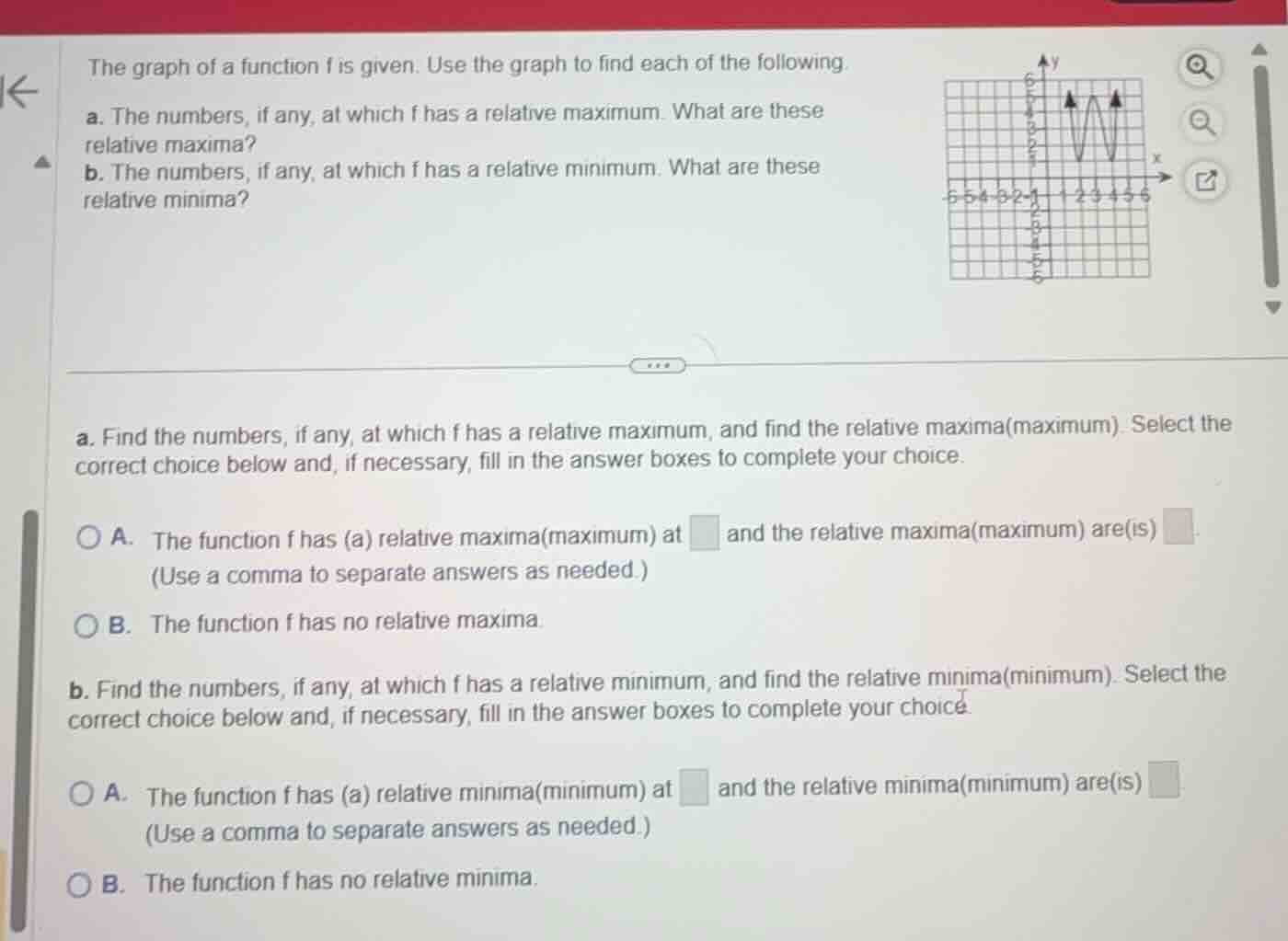
the graph of a function f is given. use the graph to find each of the following.
a. the numbers, if any, at which f has a relative maximum. what are these relative maxima?
b. the numbers, if any, at which f has a relative minimum. what are these relative minima?
a. find the numbers, if any, at which f has a relative maximum, and find the relative maxima(maximum). select the correct choice below and, if necessary, fill in the answer boxes to complete your choice.
a. the function f has (a) relative maxima(maximum) at and the relative maxima(maximum) are(is) . (use a comma to separate answers as needed.)
b. the function f has no relative maxima.
b. find the numbers, if any, at which f has a relative minimum, and find the relative minima(minimum). select the correct choice below and, if necessary, fill in the answer boxes to complete your choice.
a. the function f has (a) relative minima(minimum) at and the relative minima(minimum) are(is) . (use a comma to separate answers as needed.)
b. the function f has no relative minima.
Step1: Identify relative maxima
From the graph, the function peaks (relative maxima) at $x=1$ and $x=5$, with the $y$-value (relative maximum) equal to $5$ at both points.
Step2: Identify relative minima
From the graph, the function dips (relative minima) at $x=2$ and $x=4$, with the $y$-value (relative minimum) equal to $1$ at both points.

Snap & solve any problem in the app
Get step-by-step solutions on Sovi AI
Photo-based solutions with guided steps
Explore more problems and detailed explanations
Part a:
A. The function f has (a) relative maxima(maximum) at $\boldsymbol{1, 5}$ and the relative maxima(maximum) are(is) $\boldsymbol{5}$.
Part b:
A. The function f has (a) relative minima(minimum) at $\boldsymbol{2, 4}$ and the relative minima(minimum) are(is) $\boldsymbol{1}$.