QUESTION IMAGE
Question
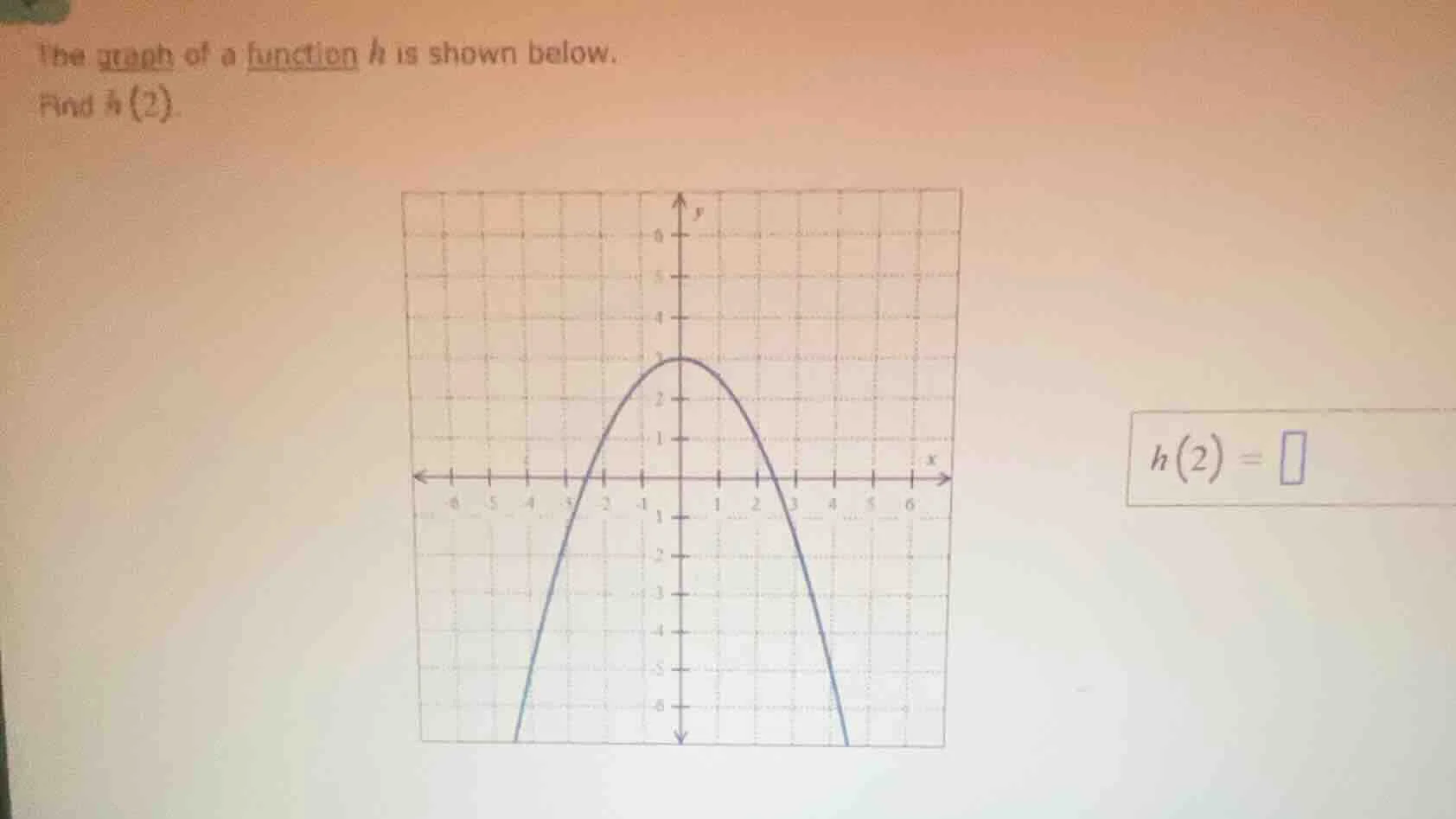
the graph of a function ( h ) is shown below. find ( h(2) ). ( h(2)=square )
Step1: Understand the problem
We need to find the value of the function \( h \) at \( x = 2 \), which means we look at the graph of the function \( h \) and find the \( y \)-coordinate when \( x = 2 \).
Step2: Locate \( x = 2 \) on the graph
On the \( x \)-axis, find the point where \( x = 2 \). Then, move vertically until we intersect the graph of the function \( h \).
Step3: Determine the \( y \)-coordinate
From the graph, when \( x = 2 \), the corresponding \( y \)-coordinate (the value of the function at \( x = 2 \)) is 0? Wait, no, wait. Wait, let's check the graph again. Wait, the graph is a parabola opening downward. Let's check the coordinates. Wait, the grid: each square is 1 unit. Let's see, when \( x = 2 \), the point on the graph: let's look at the \( x \)-axis, \( x = 2 \) is two units to the right of the origin. Then, the graph at \( x = 2 \): looking at the \( y \)-axis, when \( x = 2 \), the \( y \)-value is 0? Wait, no, wait, maybe I made a mistake. Wait, let's check again. Wait, the graph: when \( x = 0 \), the \( y \)-value is 3 (the vertex). Then, when \( x = 1 \), what's the \( y \)-value? Then \( x = 2 \): let's see the grid. Wait, the \( x \)-axis: from -6 to 6, \( y \)-axis from -6 to 6. Wait, the graph at \( x = 2 \): let's see, the points. Wait, maybe I misread. Wait, the graph crosses the \( x \)-axis at \( x = -2 \) and \( x = 2 \)? Wait, no, wait, the vertex is at (0, 3), and it crosses the \( x \)-axis at \( x = -2 \) and \( x = 2 \)? Wait, no, let's check the grid. Wait, the \( x \)-axis: the tick marks are at -6, -5, -4, -3, -2, -1, 0, 1, 2, 3, 4, 5, 6. The \( y \)-axis: -6, -5, -4, -3, -2, -1, 0, 1, 2, 3, 4, 5, 6. So when \( x = 2 \), the graph is on the \( x \)-axis, so \( y = 0 \). Wait, but that seems right. Wait, so \( h(2) = 0 \)? Wait, no, wait, maybe I made a mistake. Wait, let's confirm. The function is a parabola with vertex at (0, 3) and roots at \( x = -2 \) and \( x = 2 \). So when \( x = 2 \), \( h(2) = 0 \).
Wait, but let's check again. The graph: at \( x = 2 \), the point is on the \( x \)-axis, so \( y = 0 \). So \( h(2) = 0 \).
Wait, no, wait, maybe I messed up. Wait, the \( y \)-axis: the positive \( y \) is up, negative down. Wait, when \( x = 2 \), the graph is at \( y = 0 \). So \( h(2) = 0 \).
Wait, but let's check again. Let's see the graph: the vertex is at (0, 3). Then, the parabola opens downward, so it symmetric about the \( y \)-axis. So the roots are at \( x = -2 \) and \( x = 2 \), because the distance from the vertex (0,3) to the roots is 2 units? Wait, no, the vertex form of a parabola is \( y = a(x - h)^2 + k \), where (h, k) is the vertex. Here, vertex is (0, 3), so \( y = ax^2 + 3 \). Then, when \( x = 2 \), \( y = 0 \), so \( 0 = a(2)^2 + 3 \), so \( 4a = -3 \), \( a = -3/4 \). So the equation is \( y = -3/4 x^2 + 3 \). Then, when \( x = 2 \), \( y = -3/4*(4) + 3 = -3 + 3 = 0 \). So yes, \( h(2) = 0 \).

Snap & solve any problem in the app
Get step-by-step solutions on Sovi AI
Photo-based solutions with guided steps
Explore more problems and detailed explanations
\( \boxed{0} \)