QUESTION IMAGE
Question
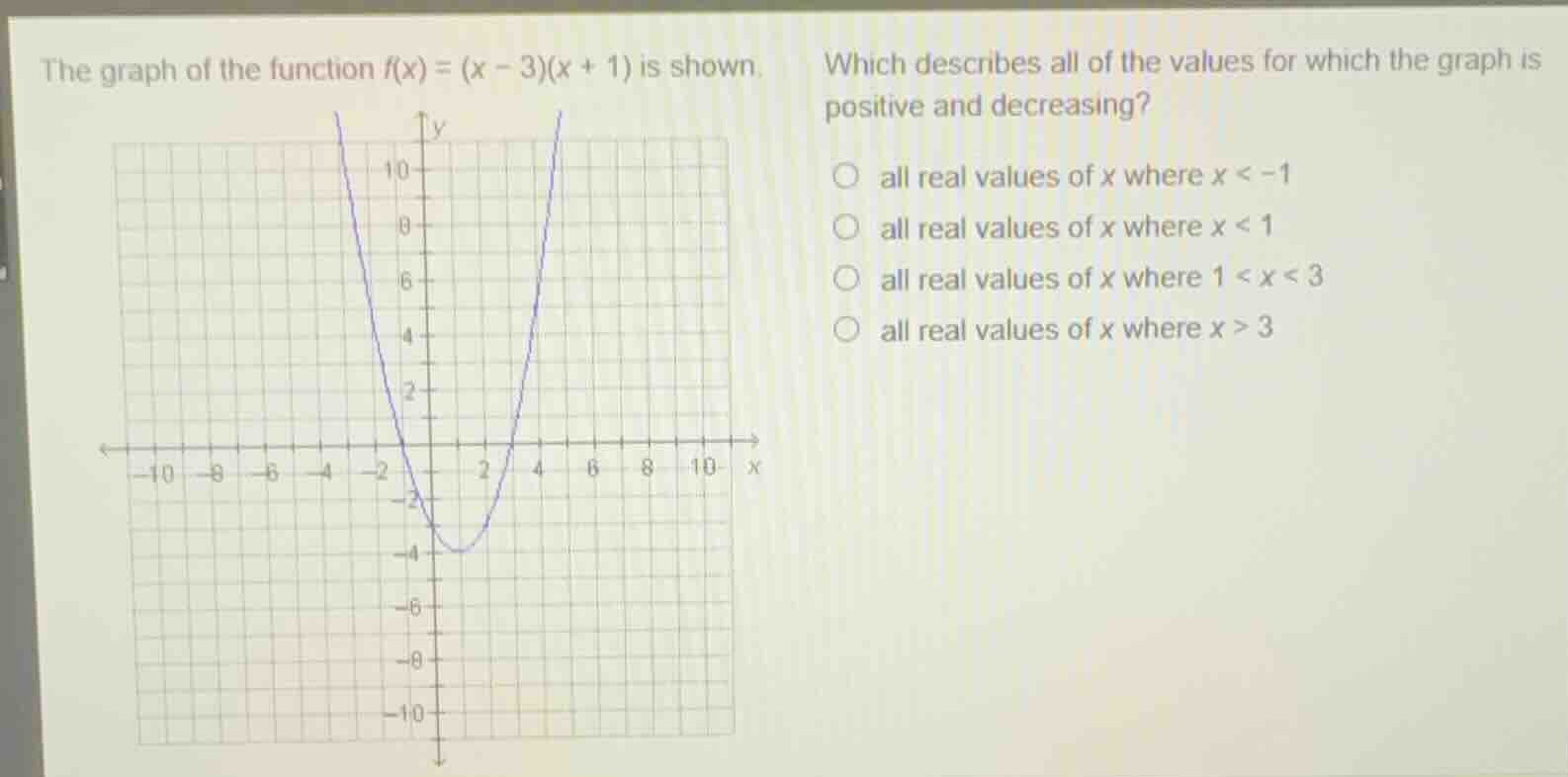
the graph of the function $f(x) = (x - 3)(x + 1)$ is shown. which describes all of the values for which the graph is positive and decreasing? \bigcirc all real values of $x$ where $x < -1$ \bigcirc all real values of $x$ where $x < 1$ \bigcirc all real values of $x$ where $1 < x < 3$ \bigcirc all real values of $x$ where $x > 3$
Step1: Analyze the function's roots and sign
The function \( f(x) = (x - 3)(x + 1) \) is a quadratic function. Its roots are at \( x = 3 \) and \( x = -1 \) (since \( f(x)=0 \) when \( x - 3 = 0 \) or \( x + 1 = 0 \)). The parabola opens upwards (because the coefficient of \( x^2 \) when expanded is positive: \( f(x)=x^2 - 2x - 3 \), so the leading coefficient is 1 > 0). For a parabola opening upwards, the function is positive when \( x < -1 \) or \( x > 3 \) (outside the roots) and negative between the roots (\( -1 < x < 3 \)).
Step2: Analyze the function's decreasing interval
The vertex of a parabola \( f(x)=ax^2+bx+c \) is at \( x = -\frac{b}{2a} \). For \( f(x)=x^2 - 2x - 3 \), \( a = 1 \), \( b = -2 \), so the x - coordinate of the vertex is \( x = -\frac{-2}{2\times1}=1 \). Since the parabola opens upwards, the function is decreasing on the interval \( (-\infty, 1) \) and increasing on \( (1, \infty) \).
Step3: Find the intersection of positive and decreasing intervals
We need the values of \( x \) where \( f(x) \) is positive and decreasing. From Step1, \( f(x) \) is positive when \( x < -1 \) or \( x > 3 \). From Step2, \( f(x) \) is decreasing when \( x < 1 \). The intersection of \( x < -1 \) (positive) and \( x < 1 \) (decreasing) is \( x < -1 \), and the intersection of \( x > 3 \) (positive) and \( x < 1 \) (decreasing) is empty. Also, we check the other options:
- Option "all real values of \( x \) where \( x < 1 \)": \( f(x) \) is negative between \( -1 \) and \( 3 \), so this is incorrect.
- Option "all real values of \( x \) where \( 1 < x < 3 \)": \( f(x) \) is negative here, incorrect.
- Option "all real values of \( x \) where \( x > 3 \)": \( f(x) \) is increasing here (since \( x > 1 \)), incorrect.

Snap & solve any problem in the app
Get step-by-step solutions on Sovi AI
Photo-based solutions with guided steps
Explore more problems and detailed explanations
all real values of \( x \) where \( x < -1 \)