QUESTION IMAGE
Question
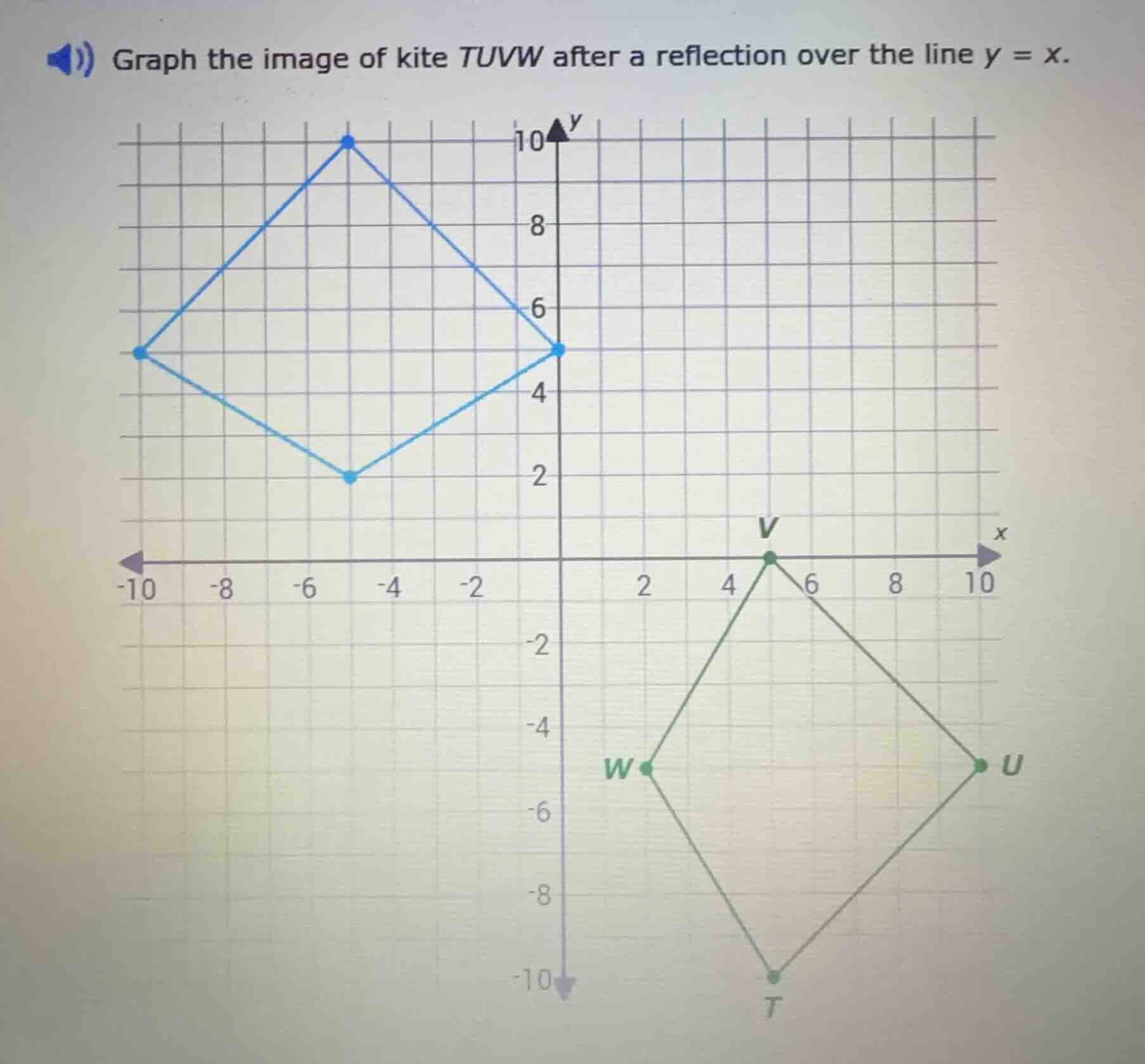
graph the image of kite tuvw after a reflection over the line y = x.
Step1: Identify coordinates of TUVW
First, find the coordinates of the vertices of kite \( TUVW \). From the graph:
- \( T \): Let's assume the coordinates. Wait, looking at the green kite: \( T \) is at \( (5, -10) \)? Wait no, let's re - examine. Wait, the green kite: \( V \) is at \( (5, 0) \)? Wait, no, the grid: each square is 1 unit. Let's look at the green kite (TUVW):
- \( T \): (5, - 10)? Wait, no, the bottom vertex \( T \) is at \( (5, - 10) \)? Wait, no, the y - axis: the bottom of the green kite is at \( y=-10 \), x = 5? Wait, maybe I made a mistake. Wait, the blue kite is on the left, green on the right. Wait, the problem is to reflect the blue kite? Wait, no, the question is "Graph the image of kite TUVW after a reflection over the line \( y = x \)". Wait, TUVW is the green kite? Wait, let's get the coordinates of T, U, V, W:
- \( V \): (5, 0) (since it's on the x - axis, x = 5, y = 0)
- \( U \): (9, - 5) (looking at the grid, x = 9, y=-5)
- \( T \): (5, - 10) (x = 5, y=-10)
- \( W \): (1, - 5) (x = 1, y=-5)
Step2: Apply reflection over \( y = x \)
The rule for reflection over the line \( y=x \) is \( (x,y)\to(y,x) \).
- For point \( V=(5,0) \): After reflection, \( V'=(0,5) \)
- For point \( U=(9, - 5) \): After reflection, \( U'=(-5,9) \)
- For point \( T=(5, - 10) \): After reflection, \( T'=(-10,5) \)
- For point \( W=(1, - 5) \): After reflection, \( W'=(-5,1) \)
Step3: Plot the reflected points
Now, plot the points \( V'=(0,5) \), \( U'=(-5,9) \), \( T'=(-10,5) \), \( W'=(-5,1) \) on the coordinate plane and connect them to form the reflected kite.
(Note: If the original kite TUVW was misidentified, let's re - check. Wait, maybe the blue kite is TUVW? Let's assume the blue kite:
- Let's find the coordinates of the blue kite (assuming TUVW is the blue kite):
- Let's say the top vertex of the blue kite: \( ( - 5,10) \), right vertex: \( (0,5) \), bottom vertex: \( ( - 5,2) \), left vertex: \( ( - 10,5) \)
- Then applying reflection over \( y = x \):
- \( (-5,10)\to(10, - 5) \)
- \( (0,5)\to(5,0) \)
- \( (-5,2)\to(2, - 5) \)
- \( (-10,5)\to(5, - 10) \)
- Then plot these points.
The key steps are:
- Find the coordinates of each vertex of the kite.
- Apply the reflection rule \( (x,y)\to(y,x) \) to each vertex.
- Plot the new vertices and connect them to get the reflected image.

Snap & solve any problem in the app
Get step-by-step solutions on Sovi AI
Photo-based solutions with guided steps
Explore more problems and detailed explanations
To graph the image of kite \( TUVW \) after reflection over \( y = x \):
- Find Vertex Coordinates: Determine the coordinates of \( T \), \( U \), \( V \), \( W \) from the graph.
- Apply Reflection Rule: For a point \( (x,y) \), its image after reflection over \( y = x \) is \( (y,x) \).
- Plot Reflected Points: Plot the new points \( (y,x) \) for each vertex and connect them to form the reflected kite.
(The actual graphing involves plotting the reflected vertices. For example, if \( T=(x_1,y_1) \), \( U=(x_2,y_2) \), \( V=(x_3,y_3) \), \( W=(x_4,y_4) \), the reflected vertices are \( (y_1,x_1) \), \( (y_2,x_2) \), \( (y_3,x_3) \), \( (y_4,x_4) \) and then drawing the kite through these points.)