QUESTION IMAGE
Question
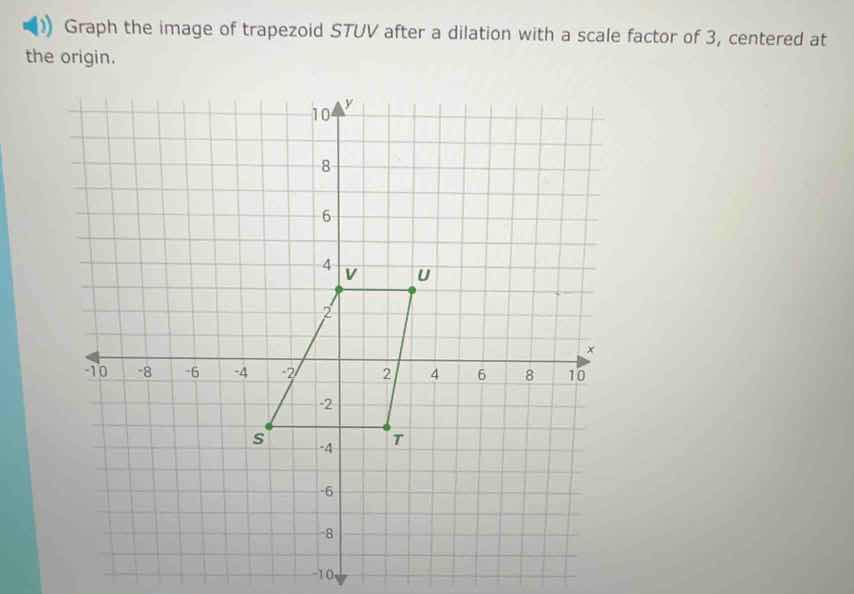
graph the image of trapezoid stuv after a dilation with a scale factor of 3, centered at the origin.
Step1: Identify coordinates of vertices
First, find the coordinates of each vertex of trapezoid \( STUV \):
- \( S \): From the graph, \( S(-3, -3) \) (wait, looking again: S is at (-3, -3)? Wait, no, let's check the grid. The x-axis: S is at x=-3, y=-3? Wait, the original graph: S is at (-3, -3)? Wait, no, let's see: the points:
- \( V \): (0, 3) [wait, the green dot at (0,3)? Wait, the y-axis: V is at (0, 3)? Wait, the graph shows V at (0, 3)? Wait, the user's graph: V is at (0, 3), U is at (3, 3)? Wait, no, the x-axis: from -10 to 10, y from -10 to 10. Let's re-express:
Looking at the graph:
- \( S \): (-3, -3)? Wait, no, S is at (-3, -3)? Wait, the grid lines: each square is 1 unit. So:
- \( S \): x=-3, y=-3? Wait, no, the point S is at (-3, -3)? Wait, the T is at (3, -3)? Wait, no, let's check again:
Wait, the original trapezoid:
- \( V \): (0, 3) (since it's on the y-axis, x=0, y=3)
- \( U \): (3, 3) (x=3, y=3)
- \( T \): (3, -3) (x=3, y=-3)
- \( S \): (-3, -3) (x=-3, y=-3)
Wait, that makes sense: ST is horizontal from (-3, -3) to (3, -3), VU is horizontal from (0, 3) to (3, 3), and VS is from (-3, -3) to (0, 3), UT is from (3, 3) to (3, -3). Wait, no, maybe I misread. Wait, the user's graph: S is at (-3, -3)? Wait, the green dots: S is at (-3, -3), T at (3, -3), V at (0, 3), U at (3, 3). Wait, no, let's check the coordinates again. Let's list each point:
Looking at the graph:
- \( S \): x=-3, y=-3 (since it's 3 units left on x, 3 units down on y)
- \( T \): x=3, y=-3 (3 units right on x, 3 units down on y)
- \( U \): x=3, y=3 (3 units right on x, 3 units up on y)
- \( V \): x=0, y=3 (on y-axis, 3 units up)
Wait, that's a trapezoid with bases ST (length 6) and VU (length 3), and legs VS and UT.
Step2: Apply dilation with scale factor 3, centered at origin
The rule for dilation centered at the origin with scale factor \( k \) is \( (x, y) \to (k \cdot x, k \cdot y) \).
So for each vertex:
- For \( S(-3, -3) \):
New coordinates \( S' = (3 \cdot (-3), 3 \cdot (-3)) = (-9, -9) \)
- For \( T(3, -3) \):
New coordinates \( T' = (3 \cdot 3, 3 \cdot (-3)) = (9, -9) \)
- For \( U(3, 3) \):
New coordinates \( U' = (3 \cdot 3, 3 \cdot 3) = (9, 9) \)
- For \( V(0, 3) \):
New coordinates \( V' = (3 \cdot 0, 3 \cdot 3) = (0, 9) \)
Step3: Plot the new vertices
Now, plot the points \( S'(-9, -9) \), \( T'(9, -9) \), \( U'(9, 9) \), \( V'(0, 9) \) and connect them to form the dilated trapezoid.

Snap & solve any problem in the app
Get step-by-step solutions on Sovi AI
Photo-based solutions with guided steps
Explore more problems and detailed explanations
The dilated trapezoid \( S'T'U'V' \) has vertices at \( S'(-9, -9) \), \( T'(9, -9) \), \( U'(9, 9) \), and \( V'(0, 9) \). To graph it, plot these points and connect \( S' \) to \( T' \), \( T' \) to \( U' \), \( U' \) to \( V' \), and \( V' \) to \( S' \).