QUESTION IMAGE
Question
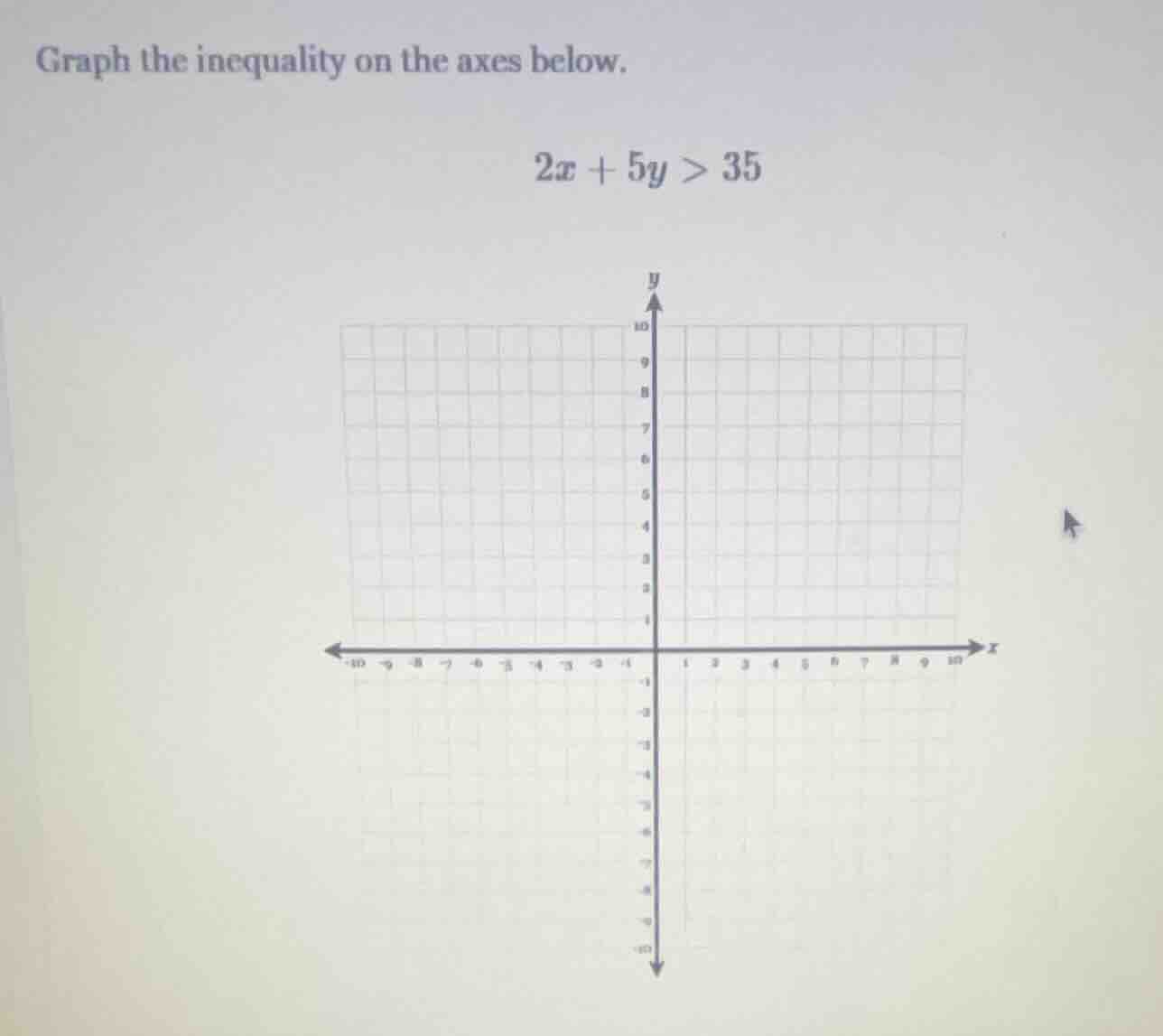
graph the inequality on the axes below.
2x + 5y > 35
Step1: Rewrite the inequality in slope - intercept form
We start with the inequality \(2x + 5y>35\). To get it in the form \(y = mx + b\) (slope - intercept form), we solve for \(y\).
Subtract \(2x\) from both sides: \(5y>- 2x + 35\).
Then divide each term by 5: \(y>-\frac{2}{5}x + 7\).
Step2: Graph the boundary line
The boundary line is the equation \(y =-\frac{2}{5}x + 7\). Since the inequality is \(y>-\frac{2}{5}x + 7\) (not \(y\geq-\frac{2}{5}x + 7\)), the boundary line should be a dashed line.
- To find the \(y\) - intercept, when \(x = 0\), \(y=7\). So the line passes through the point \((0,7)\).
- To find another point, we can use the slope. The slope \(m =-\frac{2}{5}\), which means for every 5 units we move to the right (increase \(x\) by 5), we move down 2 units (decrease \(y\) by 2). Starting from \((0,7)\), if we move \(x = 5\), then \(y=7 - 2=5\). So the line also passes through the point \((5,5)\). We can plot these two points \((0,7)\) and \((5,5)\) (and more if needed) and draw a dashed line through them.
Step3: Shade the region
We need to determine which side of the line to shade. We can use a test point that is not on the line. A common test point is the origin \((0,0)\).
Substitute \(x = 0\) and \(y = 0\) into the inequality \(y>-\frac{2}{5}x + 7\):
Left - hand side: \(y=0\)
Right - hand side: \(-\frac{2}{5}(0)+7 = 7\)
Since \(0>7\) is false, we do not shade the region containing the origin. So we shade the region above the dashed line \(y =-\frac{2}{5}x + 7\).
(Note: Since this is a graphing problem, the final answer is the graph with a dashed line \(y =-\frac{2}{5}x + 7\) and the region above the line shaded. If we were to describe it in text, the key elements are the dashed boundary line and the correct shaded region.)

Snap & solve any problem in the app
Get step-by-step solutions on Sovi AI
Photo-based solutions with guided steps
Explore more problems and detailed explanations
The graph has a dashed line with slope \(-\frac{2}{5}\) and \(y\) - intercept 7 (passing through \((0,7)\) and \((5,5)\) etc.), and the region above the dashed line is shaded.