QUESTION IMAGE
Question
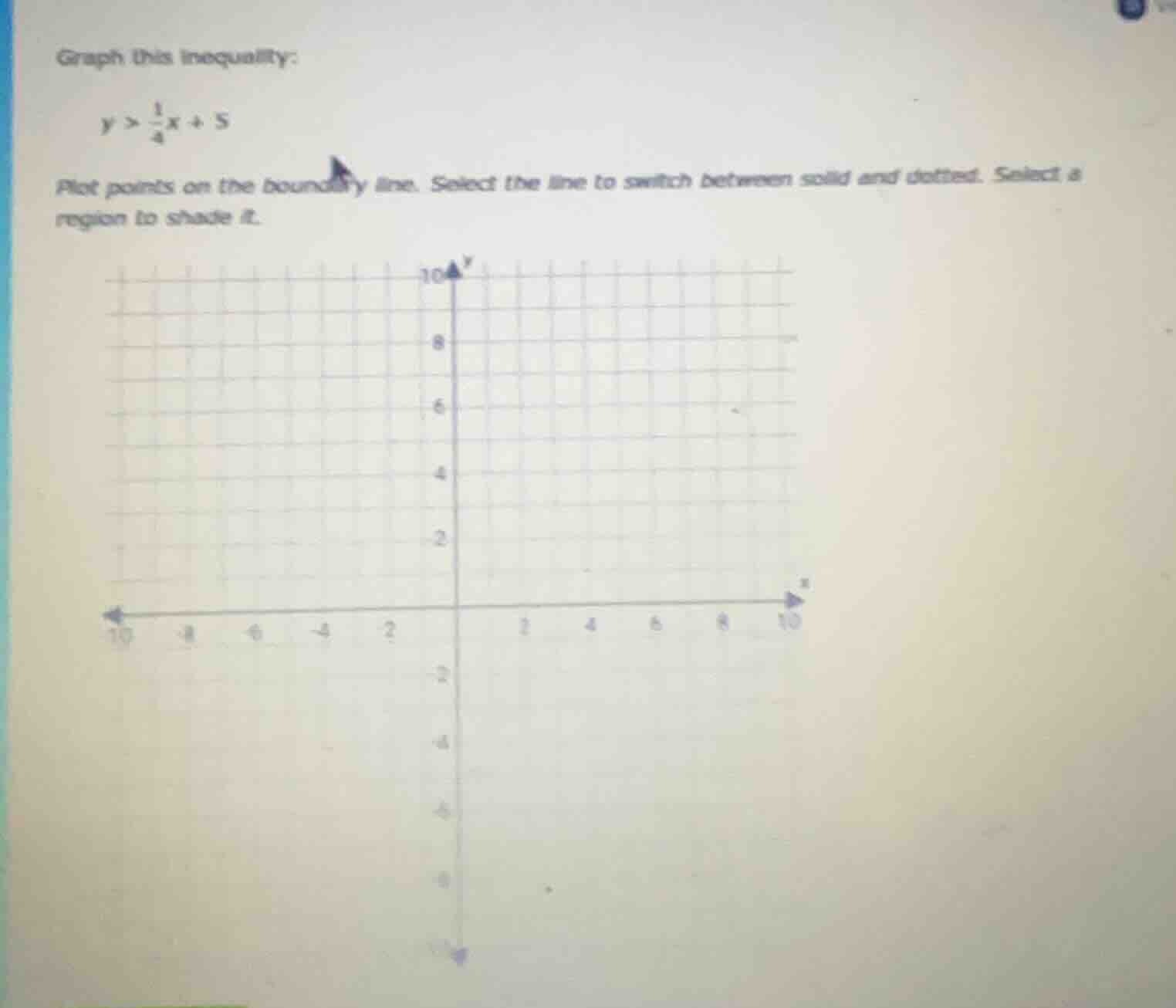
graph this inequality:
$y > \frac{1}{4}x + 5$
plot points on the boundary line. select the line to switch between solid and dotted. select a region to shade it.
Step1: Identify the boundary line type
The inequality is \( y > \frac{1}{4}x + 5 \), so the boundary line \( y=\frac{1}{4}x + 5 \) should be dashed (since the inequality is strict, \(>\) not \(\geq\)).
Step2: Find two points on the boundary line
- When \( x = 0 \), \( y=\frac{1}{4}(0)+5 = 5 \). So one point is \((0, 5)\).
- When \( x = 4 \), \( y=\frac{1}{4}(4)+5=1 + 5=6 \). So another point is \((4, 6)\). Plot these two points and draw a dashed line through them.
Step3: Determine the region to shade
Pick a test point not on the line, e.g., \((0, 0)\). Substitute into the inequality: \( 0>\frac{1}{4}(0)+5 \) → \( 0 > 5 \), which is false. So we shade the region that does NOT include \((0, 0)\), i.e., above the dashed line \( y=\frac{1}{4}x + 5 \).
(Note: Since the question is about graphing, the final answer involves the graphical steps as above. If a textual description of the graph is needed: The boundary line is dashed, passes through \((0, 5)\) and \((4, 6)\), and the region above the line is shaded.)

Snap & solve any problem in the app
Get step-by-step solutions on Sovi AI
Photo-based solutions with guided steps
Explore more problems and detailed explanations
Step1: Identify the boundary line type
The inequality is \( y > \frac{1}{4}x + 5 \), so the boundary line \( y=\frac{1}{4}x + 5 \) should be dashed (since the inequality is strict, \(>\) not \(\geq\)).
Step2: Find two points on the boundary line
- When \( x = 0 \), \( y=\frac{1}{4}(0)+5 = 5 \). So one point is \((0, 5)\).
- When \( x = 4 \), \( y=\frac{1}{4}(4)+5=1 + 5=6 \). So another point is \((4, 6)\). Plot these two points and draw a dashed line through them.
Step3: Determine the region to shade
Pick a test point not on the line, e.g., \((0, 0)\). Substitute into the inequality: \( 0>\frac{1}{4}(0)+5 \) → \( 0 > 5 \), which is false. So we shade the region that does NOT include \((0, 0)\), i.e., above the dashed line \( y=\frac{1}{4}x + 5 \).
(Note: Since the question is about graphing, the final answer involves the graphical steps as above. If a textual description of the graph is needed: The boundary line is dashed, passes through \((0, 5)\) and \((4, 6)\), and the region above the line is shaded.)