QUESTION IMAGE
Question
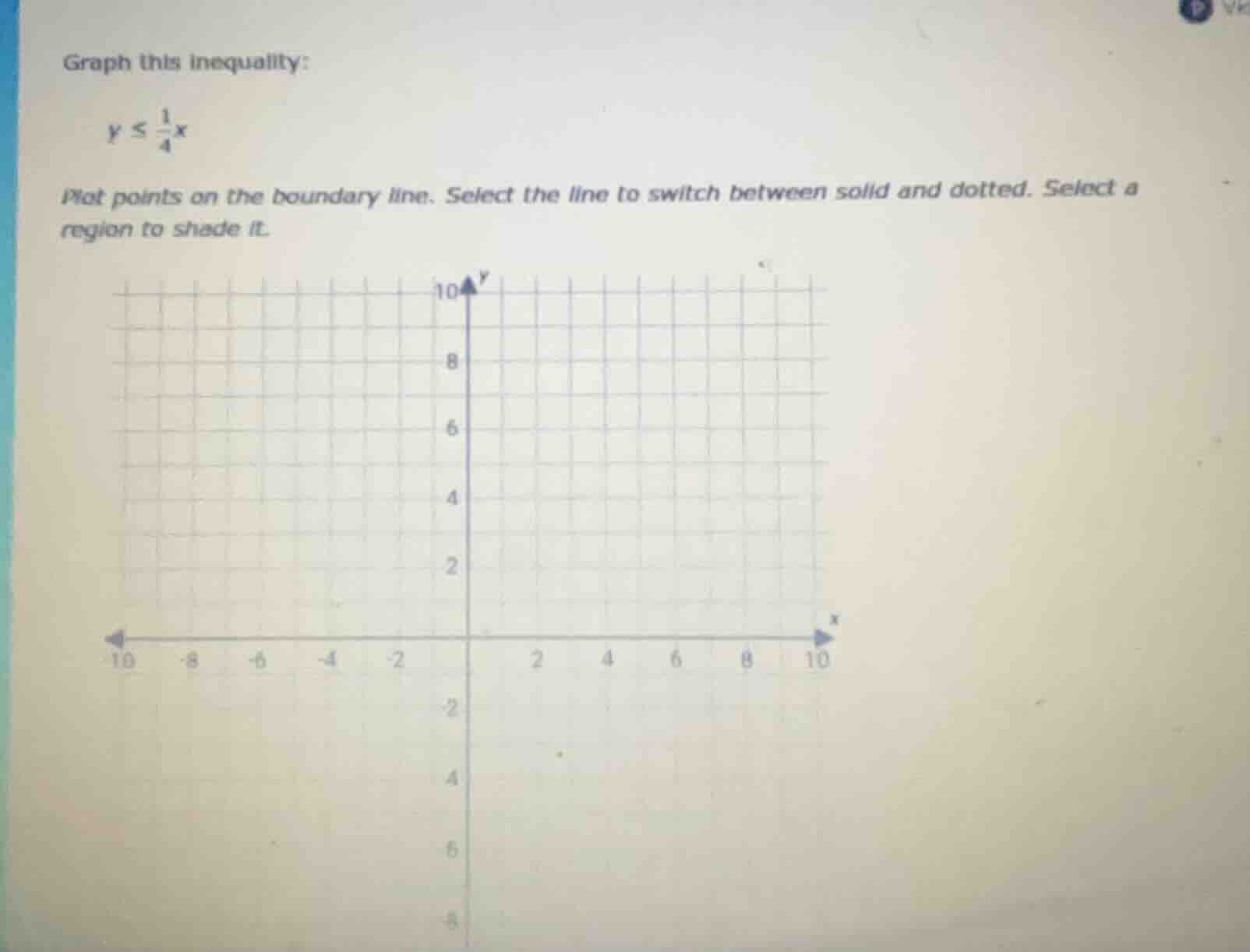
graph this inequality:
\\( y \leq \frac{1}{4}x \\)
plot points on the boundary line. select the line to switch between solid and dotted. select a region to shade it.
Step1: Identify the boundary line
The inequality is \( y \leq \frac{1}{4}x \). First, consider the equation of the boundary line, which is \( y = \frac{1}{4}x \). This is a linear equation in slope - intercept form (\(y = mx + b\)) where the slope \(m=\frac{1}{4}\) and the y - intercept \(b = 0\). So, the line passes through the origin \((0,0)\). We can find another point on the line. Let's take \(x = 4\), then \(y=\frac{1}{4}\times4 = 1\), so the point \((4,1)\) is also on the line. Since the inequality is \(y\leq\frac{1}{4}x\) (the inequality sign is \(\leq\)), the boundary line should be solid (because the inequality includes equality).
Step2: Determine the region to shade
To determine which side of the line to shade, we can use a test point. A common test point is \((0,0)\) (which is on the line, so we need to choose another point, say \((0,1)\)). Substitute \(x = 0\) and \(y = 1\) into the inequality \(y\leq\frac{1}{4}x\): \(1\leq\frac{1}{4}(0)\) which simplifies to \(1\leq0\), this is false. So we shade the region that does not contain the point \((0,1)\). In other words, we shade the region below the line \(y=\frac{1}{4}x\) (since for a line \(y = mx + b\), when \(y\leq mx + b\), we shade below the line when \(m>0\) in this case).
To graph:
- Plot the points \((0,0)\) and \((4,1)\) (and other points if needed) on the coordinate plane.
- Draw a solid line through these points (because the inequality is \(\leq\)).
- Shade the region below the line (the region where the inequality \(y\leq\frac{1}{4}x\) holds true).

Snap & solve any problem in the app
Get step-by-step solutions on Sovi AI
Photo-based solutions with guided steps
Explore more problems and detailed explanations
- Plot the boundary line \(y = \frac{1}{4}x\) as a solid line (passing through \((0,0)\), \((4,1)\), etc.).
- Shade the region below the line \(y=\frac{1}{4}x\).