QUESTION IMAGE
Question
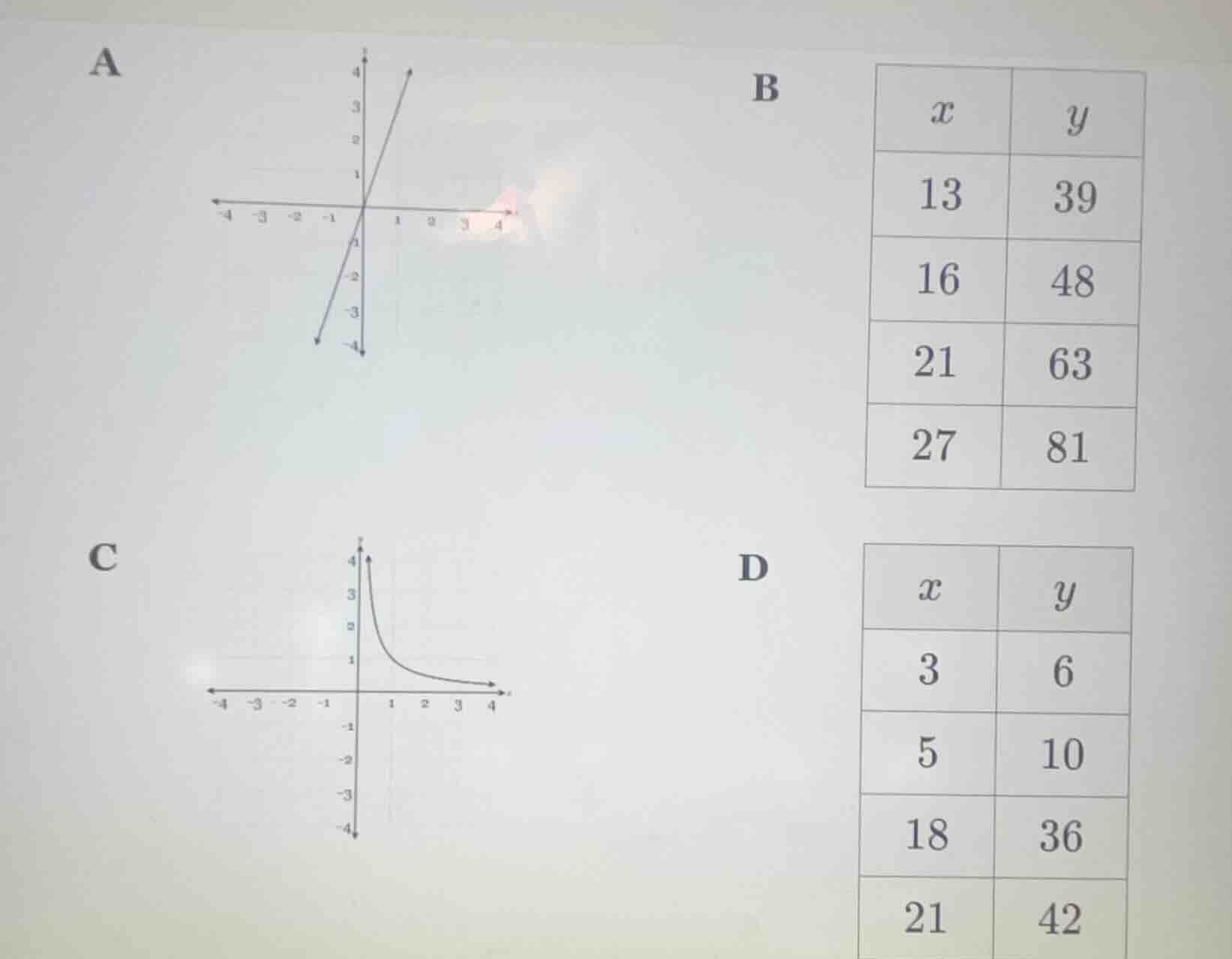
a (graph of a line through the origin), b (table with x: 13,16,21,27 and y:39,48,63,81), c (graph of a curve in the first quadrant), d (table with x:3,5,18,21 and y:6,10,36,42)
Assuming the question is to identify which of A, B, C, D represents a proportional relationship (direct variation, \( y = kx \) where \( k \) is constant). Let's analyze each:
Option A (Graph):
The graph is a straight line through the origin, but it has two segments? Wait, no—wait, the line passes through (0,0), but the left segment goes from (-2, -4) to (0,0)? Wait, slope: from (0,0) to (1, 4)? Wait, no, maybe I misread. Wait, if it's a straight line through the origin, but does it have a constant slope? Wait, no—wait, the left part: from x=-2, y=-4? Wait, no, the graph in A: let's check points. If x=1, y=4? Wait, maybe the slope is 4? But wait, the left segment: when x=-1, y=-4? No, maybe the graph is two lines? Wait, no, maybe it's a single line. Wait, no—actually, a proportional relationship must be a straight line through the origin with constant slope. But wait, the graph in A: does it pass through (0,0) and have constant slope? Wait, maybe the left part is a different line? Wait, no, maybe the graph is not a function? Wait, no, maybe I made a mistake. Let's check others.
Option B (Table):
Calculate \( \frac{y}{x} \):
- \( \frac{39}{13} = 3 \)
- \( \frac{48}{16} = 3 \)
- \( \frac{63}{21} = 3 \)
- \( \frac{81}{27} = 3 \)
All ratios are 3 (constant). So \( y = 3x \), proportional.
Option C (Graph):
The graph is a curve (hyperbola-like), so it's not a straight line. Not proportional (proportional is linear, straight line through origin).
Option D (Table):
Calculate \( \frac{y}{x} \):
- \( \frac{6}{3} = 2 \)
- \( \frac{10}{5} = 2 \)
- \( \frac{36}{18} = 2 \)
- \( \frac{42}{21} = 2 \)
Wait, all ratios are 2? Wait, but the graph in A: wait, maybe I misanalyzed A. Wait, D's table: \( y = 2x \), so proportional. But wait, the graph in A: is it a straight line through origin? Wait, maybe the graph in A is not a function (fails vertical line test)? Because at x=0, it has two points? Wait, the graph in A: the left segment goes down to (-2, -4) and the right goes up to (2, 4)? Wait, no, the vertical line at x=0 would intersect twice (once from the left, once from the right), so it's not a function. So A is not a function, hence not a proportional relationship (which requires a function \( y = kx \)).
Wait, but D's table: \( y = 2x \), proportional. B's table: \( y = 3x \), proportional. Wait, but maybe the graph in A is a function? Wait, no—if the graph has two lines crossing at the origin, it's not a function (fails vertical line test). So A is invalid (not a function). C is a curve (not linear). Now, B and D: both have constant \( \frac{y}{x} \). Wait, but maybe the question is which is NOT proportional? Wait, no, maybe I misread. Wait, let's recheck:
Wait, the graph in A: is it a single line? Wait, maybe the left part is a different line, but actually, the graph in A: if you look at the axes, the left segment is from (-2, -4) to (0,0), and the right from (0,0) to (2, 4). So it's two lines, but together they form a straight line? Wait, no—from (-2, -4) to (0,0): slope is \( \frac{0 - (-4)}{0 - (-2)} = 2 \). From (0,0) to (2, 4): slope is \( \frac{4 - 0}{2 - 0} = 2 \). Wait, so slope is 2? Then why does the right part look steeper? Maybe the graph is scaled. Wait, but if the slope is 2, then \( y = 2x \). But the table in D is \( y = 2x \), and B is \( y = 3x \). Wait, but the graph in A: if it's a straight line with slope 2, passing through origin, then it is proportional. But the table in D is also proportional. Wait, maybe the graph in A is not a function (two lines, so vertical line test fails). Because at x=0, i…
- A: Straight line through origin (proportional).
- B: \( \frac{y}{x} = 3 \) (constant, proportional).
- C: Curve (not linear, non - proportional).
- D: \( \frac{y}{x} = 2 \) (constant, proportional).

Snap & solve any problem in the app
Get step-by-step solutions on Sovi AI
Photo-based solutions with guided steps
Explore more problems and detailed explanations
C