QUESTION IMAGE
Question
the graph of the parent function $f(x) = x^3$ is translated such that the resulting graph can be represented by the function $g(x) = (x - 1)^3 + 1$. which is the graph of $g(x)$?
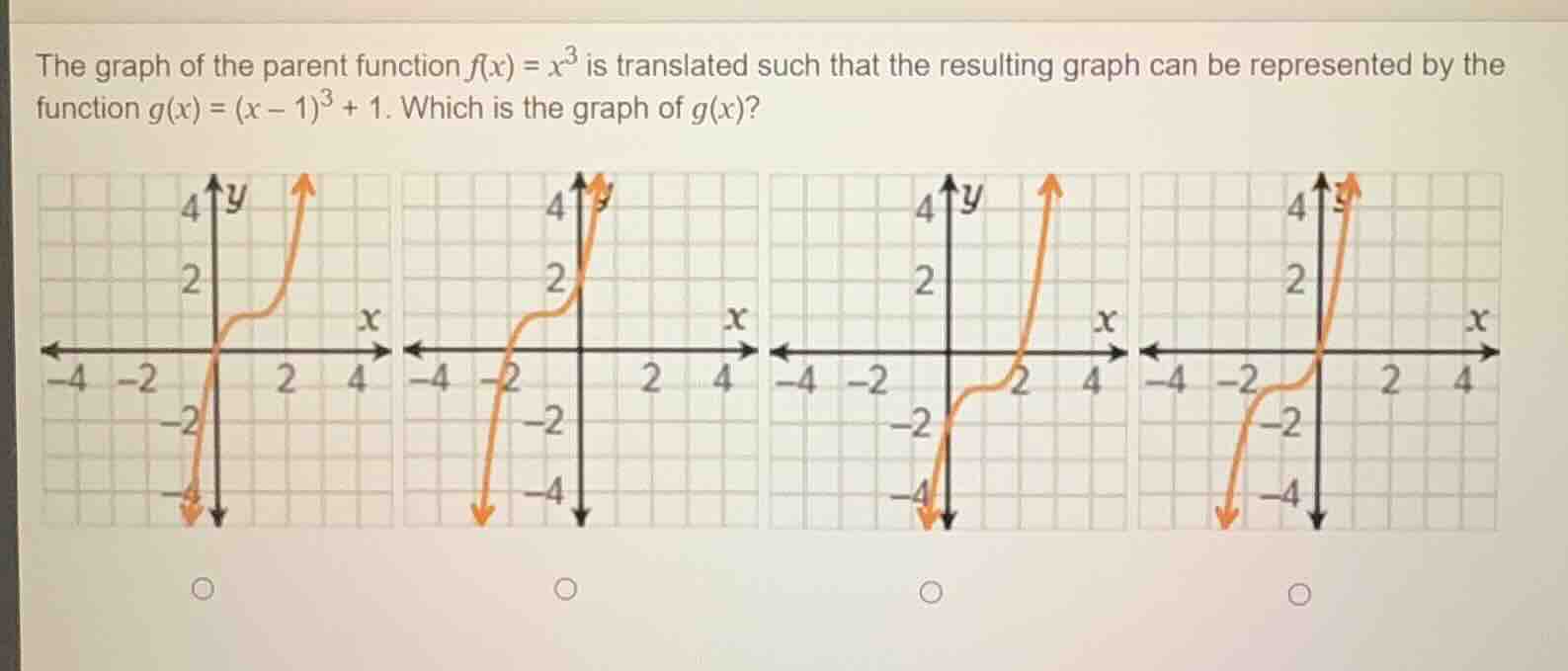
four graphs are shown here, each with a coordinate grid and a cubic - like curve. the first graph has a curve passing through the origin, the second has a curve crossing the y - axis at (0,2), the third has a curve crossing the x - axis at (2,0), and the fourth has a curve crossing the origin. each graph has x - axis from - 4 to 4 and y - axis from - 4 to 4, with grid lines.
Step1: Recall transformation rules
For a function \( y = f(x - h)+k \), the graph of \( f(x) \) is shifted \( h \) units horizontally (right if \( h>0 \), left if \( h < 0 \)) and \( k \) units vertically (up if \( k>0 \), down if \( k < 0 \)). For \( f(x)=x^{3} \) and \( g(x)=(x - 1)^{3}+1 \), \( h = 1 \) and \( k=1 \). So the parent graph \( y = x^{3} \) (which has a point at \( (0,0) \)) is shifted 1 unit right and 1 unit up. The new point should be \( (0 + 1,0+1)=(1,1) \). Also, we can check the shape: the cubic function \( y=(x - 1)^{3}+1 \) has the same shape as \( y = x^{3} \) (since there's no reflection or vertical/horizontal stretch/compression), just translated. Let's analyze the options:
- First option: The point near the origin is around (0,0) shifted? No, let's check the key point. The parent \( y=x^{3} \) passes through (0,0), (1,1), (-1,-1). For \( g(x)=(x - 1)^{3}+1 \), when \( x = 1 \), \( g(1)=1 \); when \( x=0 \), \( g(0)=( - 1)^{3}+1=-1 + 1=0 \); when \( x = 2 \), \( g(2)=(1)^{3}+1=2 \). Wait, maybe better to find the inflection point (the point where the curve changes concavity, which for \( y=x^{3} \) is at (0,0)). For \( g(x)=(x - 1)^{3}+1 \), the inflection point is at \( (1,1) \). Let's check the graphs:
- First graph: The curve has a point around (0,0) - no, inflection at (0,0) shifted? No.
- Second graph: Inflection at (-1,2)? No.
- Third graph: Let's see, when \( x = 1 \), what's the value? Wait, maybe check the x - intercept or y - intercept. Wait, maybe another approach: the parent function \( y=x^{3} \) is increasing, passes through (0,0), (1,1), (-1,-1). The function \( g(x)=(x - 1)^{3}+1 \) can be expanded as \( g(x)=x^{3}-3x^{2}+3x - 1 + 1=x^{3}-3x^{2}+3x=x(x^{2}-3x + 3) \). The discriminant of \( x^{2}-3x + 3 \) is \( 9-12=-3<0 \), so only real root at \( x = 0 \) (since \( g(0)=0 \)). Wait, no: \( g(x)=(x - 1)^{3}+1 \), set \( g(x)=0 \): \( (x - 1)^{3}=-1\implies x - 1=-1\implies x = 0 \). So x - intercept at (0,0). When \( x = 1 \), \( g(1)=1 \); when \( x=2 \), \( g(2)=2 \); when \( x=-1 \), \( g(-1)=(-2)^{3}+1=-8 + 1=-7 \). Now let's look at the graphs:
- First option: The curve passes through (0,0), and when x increases, it goes up. Let's check the inflection point. The inflection point of \( y=(x - 1)^{3}+1 \) is at \( x = 1 \), \( y = 1 \). Wait, maybe I made a mistake earlier. The inflection point of \( y = x^{3} \) is at (0,0). For \( y=(x - h)^{3}+k \), the inflection point is at (h,k). So for \( g(x)=(x - 1)^{3}+1 \), inflection point is (1,1). Let's check the graphs:
- First graph: The curve has a "bend" around (0,0) - no.
- Second graph: Bend around (-1,2) - no.
- Third graph: Let's see, when x = 1, the y - value: looking at the third graph, when x = 1, y is around 1? Wait, maybe the first graph: wait, no, let's re - evaluate the transformation. The parent function \( f(x)=x^{3} \) is shifted 1 unit to the right (because of \( x-1 \)) and 1 unit up (because of +1). So the point (0,0) on \( f(x) \) moves to (1,1) on \( g(x) \). The point (1,1) on \( f(x) \) moves to (2,2) on \( g(x) \), and (-1,-1) on \( f(x) \) moves to (0,0) on \( g(x) \). Ah! So when x = 0, \( g(0)=(-1)^{3}+1 = 0 \), so (0,0) is on \( g(x) \). When x = 1, \( g(1)=1 \), so (1,1) is on \( g(x) \). Now let's look at the graphs:
- First graph: The curve passes through (0,0), and as x increases, it goes up, with the bend (inflection) around (0,0)? No, wait the inflection point for \( g(x) \) is (1,1). Wait, maybe I confused the inflection point. The derivative of \( g(x) \) is \( g'(x)=3(x - 1)^{2} \), second derivativ…

Snap & solve any problem in the app
Get step-by-step solutions on Sovi AI
Photo-based solutions with guided steps
Explore more problems and detailed explanations
The first graph (the one with the curve passing through (0,0), rising with the inflection point around (1,1)) is the graph of \( g(x)=(x - 1)^{3}+1 \). (Assuming the first option is the one with the circle at the bottom left, the curve through (0,0), and rising to the right.)