QUESTION IMAGE
Question
graph the piecewise - defined function.
$f(x)=\begin{cases}-1 - x& \text{if } xleq2\\-4 + 2x& \text{if } x>2end{cases}$
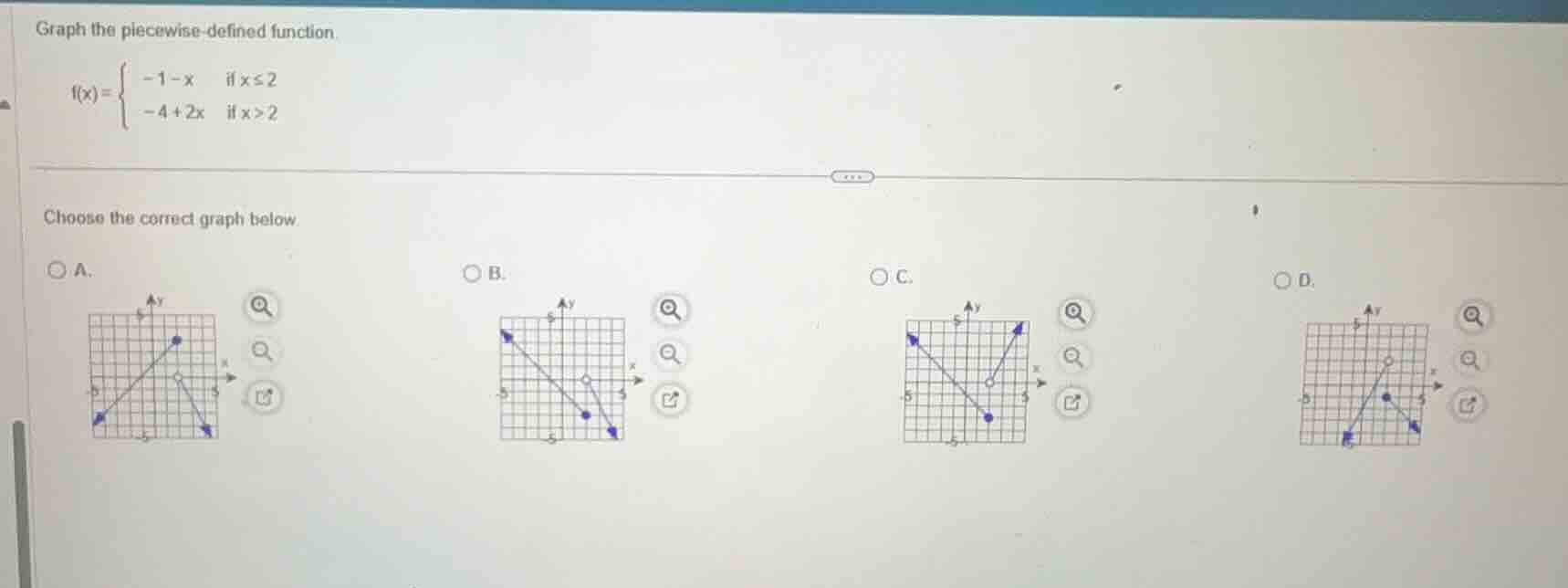
choose the correct graph below.
\\(\bigcirc\\) a.
\\(\bigcirc\\) b.
\\(\bigcirc\\) c.
\\(\bigcirc\\) d.
Step1: Analyze the first piece \( f(x) = -1 - x \) for \( x \leq 2 \)
This is a linear function with slope \( -1 \) and y-intercept \( -1 \). When \( x = 2 \), \( f(2) = -1 - 2 = -3 \). So at \( x = 2 \), there is a closed dot (since \( x \leq 2 \)) at \( (2, -3) \). As \( x \) decreases, the function increases (because slope is negative).
Step2: Analyze the second piece \( f(x) = -4 + 2x \) for \( x > 2 \)
This is a linear function with slope \( 2 \) (positive, so increasing) and when \( x = 2 \), \( f(2) = -4 + 2(2) = 0 \). But since \( x > 2 \), there is an open dot at \( (2, 0) \).
Now, let's check the options:
- For the first piece (\( x \leq 2 \)): the line should have slope -1, passing through (2, -3) (closed dot).
- For the second piece (\( x > 2 \)): the line should have slope 2, with open dot at (2, 0) and increasing.
Looking at the options, option C (assuming the graphs: first line with negative slope, closed at (2, -3); second line with positive slope, open at (2, 0) and increasing) matches. Wait, wait, maybe I miscalculated the second piece at x=2. Wait, \( f(x) = -4 + 2x \) at x=2: -4 +4=0. So open dot at (2,0). The first piece at x=2: -1 -2 = -3, closed dot at (2, -3). So the first line (x ≤2) is decreasing (slope -1) with closed dot at (2, -3), the second line (x>2) is increasing (slope 2) with open dot at (2,0). So the correct graph should have a line with negative slope (decreasing) for x ≤2, closed at (2, -3), and a line with positive slope (increasing) for x>2, open at (2,0). Looking at the options, option C (if the graphs are as described) should be correct. Wait, maybe the options: let's re-express.
Wait, let's recalculate:
First function: \( f(x) = -1 - x \), x ≤2.
When x=0: f(0) = -1 -0 = -1. So (0, -1).
Slope -1: so from (2, -3), going left (x decreasing) by 1, y increases by 1 (since slope -1: Δy/Δx = -1 ⇒ Δy = -Δx. So if x decreases by 1 (x=1), y increases by 1: f(1) = -1 -1 = -2? Wait no: f(1) = -1 -1 = -2? Wait, no: -1 -1 = -2? Wait, x=1: -1 -1 = -2. x=2: -3. So the line is decreasing (slope -1) from (2, -3) to left.
Second function: \( f(x) = -4 + 2x \), x >2.
Slope 2: so for x=3, f(3) = -4 +6=2. So (3,2). So from (2,0) (open dot), going right, y increases by 2 when x increases by 1.
Now, looking at the options:
Option C: Let's assume the graphs:
- First line: negative slope, passes through (2, -3) (closed), (0, -1), etc.
- Second line: positive slope, open at (2,0), goes to (3,2), etc.
Yes, that matches. So the correct answer should be the option (probably C, depending on the given graphs) with the first line decreasing (slope -1) with closed dot at (2, -3), second line increasing (slope 2) with open dot at (2,0).

Snap & solve any problem in the app
Get step-by-step solutions on Sovi AI
Photo-based solutions with guided steps
Explore more problems and detailed explanations
C (assuming the option C has the correct graph with first line (x ≤2) decreasing, closed at (2, -3), second line (x>2) increasing, open at (2, 0))