QUESTION IMAGE
Question
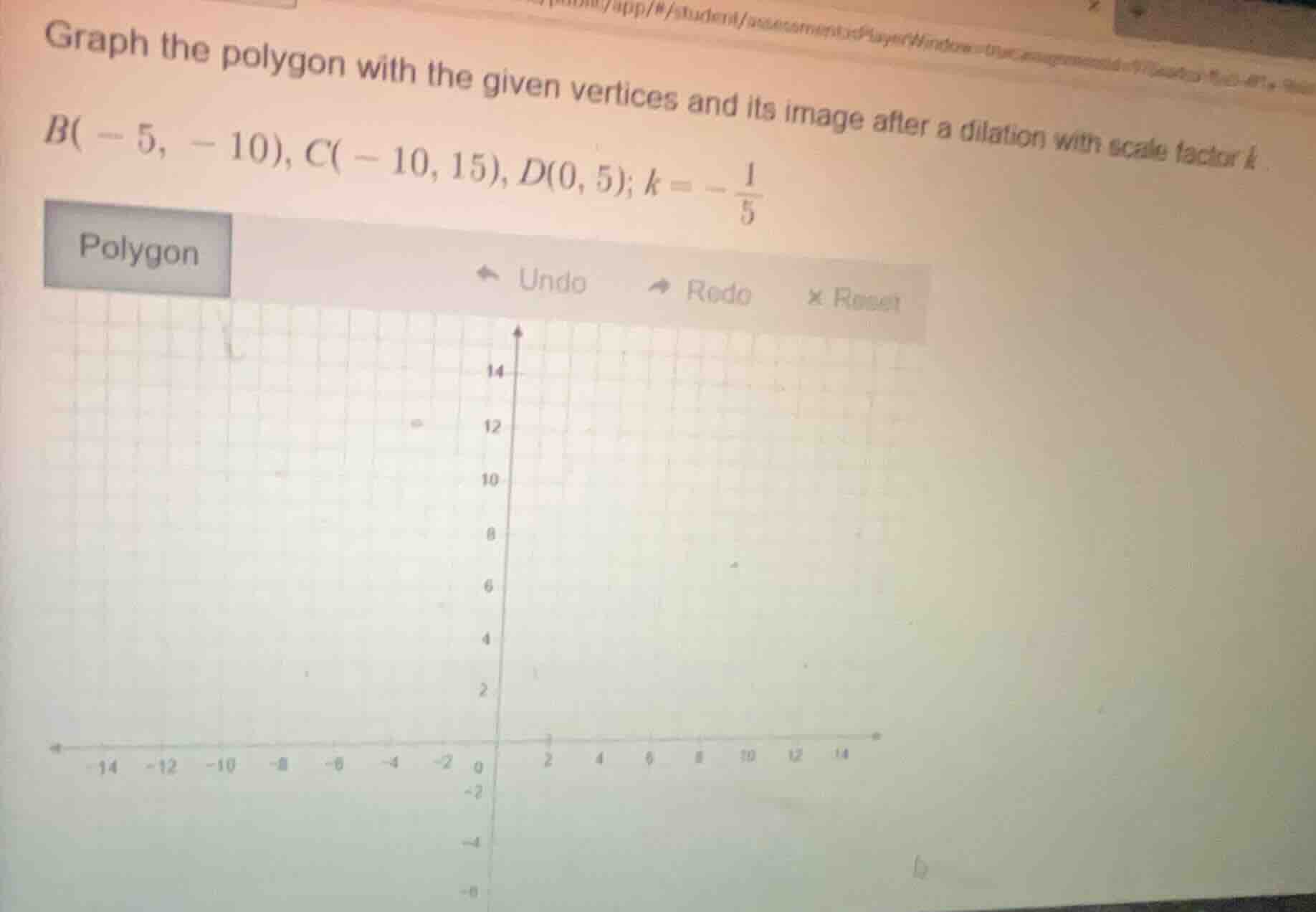
graph the polygon with the given vertices and its image after a dilation with scale factor k. b(-5, -10), c(-10, 15), d(0, 5); k = -\frac{1}{5}
Step1: Recall dilation rule
To find the image of a point \((x,y)\) after a dilation with scale factor \(k\) centered at the origin, we use the rule \((x,y)\to(kx,ky)\).
Step2: Dilate point \(B(-5,-10)\)
For \(B(-5,-10)\) and \(k = -\frac{1}{5}\), we calculate the new coordinates:
\(x\)-coordinate: \(-\frac{1}{5}\times(-5)=1\)
\(y\)-coordinate: \(-\frac{1}{5}\times(-10) = 2\)
So, \(B'\) is \((1,2)\).
Step3: Dilate point \(C(-10,15)\)
For \(C(-10,15)\) and \(k = -\frac{1}{5}\), we calculate the new coordinates:
\(x\)-coordinate: \(-\frac{1}{5}\times(-10)=2\)
\(y\)-coordinate: \(-\frac{1}{5}\times15=-3\)
So, \(C'\) is \((2,-3)\).
Step4: Dilate point \(D(0,5)\)
For \(D(0,5)\) and \(k = -\frac{1}{5}\), we calculate the new coordinates:
\(x\)-coordinate: \(-\frac{1}{5}\times0 = 0\)
\(y\)-coordinate: \(-\frac{1}{5}\times5=-1\)
So, \(D'\) is \((0,-1)\).
(Note: To graph the polygon, first plot the original points \(B(-5,-10)\), \(C(-10,15)\), \(D(0,5)\) (assuming there is a fourth point or it's a triangle, but with the given three points, connect them to form the original polygon). Then plot the dilated points \(B'(1,2)\), \(C'(2,-3)\), \(D'(0,-1)\) and connect them to form the image after dilation.)

Snap & solve any problem in the app
Get step-by-step solutions on Sovi AI
Photo-based solutions with guided steps
Explore more problems and detailed explanations
The image of the polygon after dilation has vertices \(B'(1, 2)\), \(C'(2, -3)\), \(D'(0, -1)\) (and the corresponding fourth vertex if applicable, but with the given three points, these are the dilated vertices). To graph, plot the original points and the dilated points as calculated.