QUESTION IMAGE
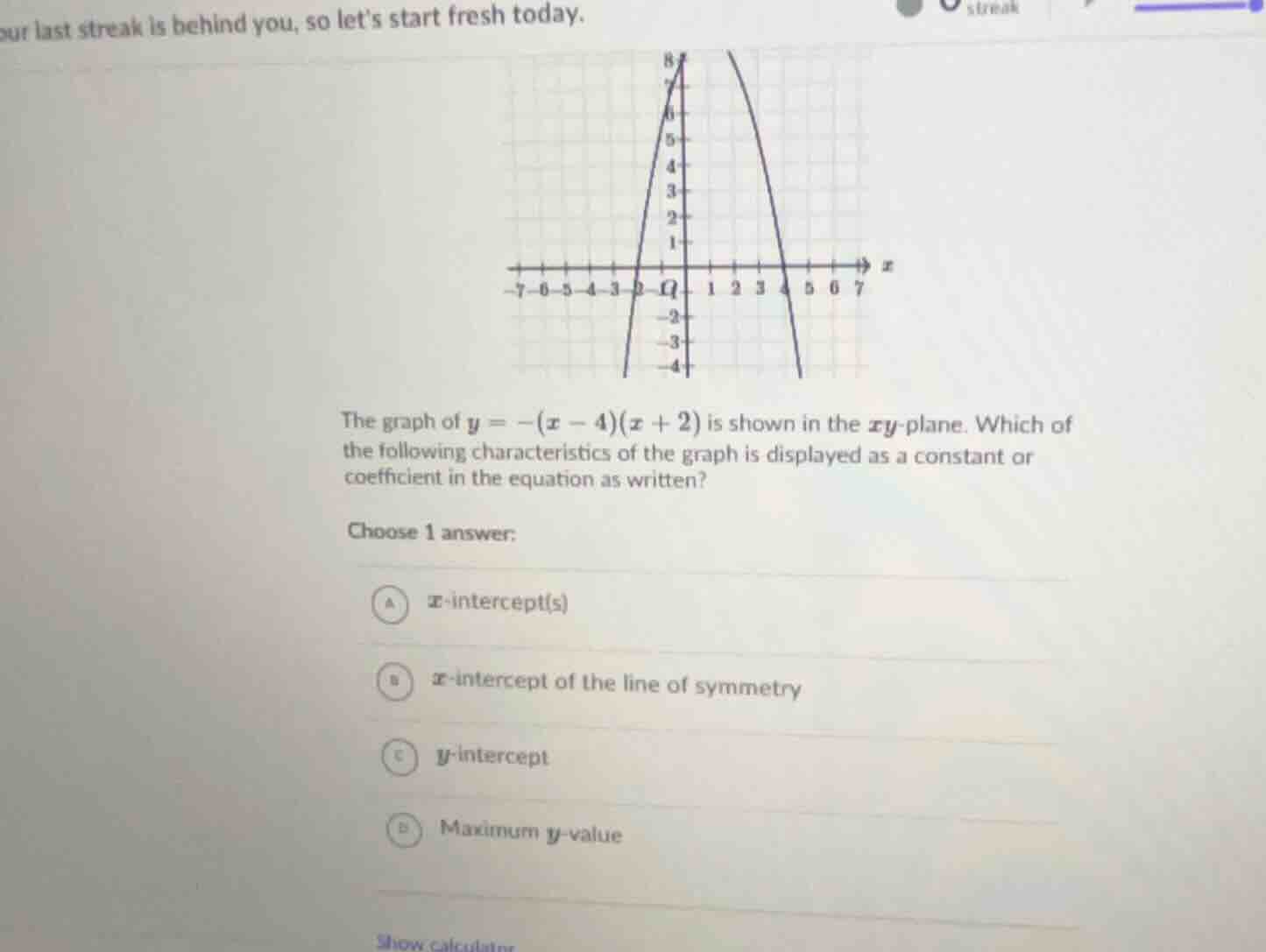
Question
the graph of $y = -(x - 4)(x + 2)$ is shown in the $xy$-plane. which of the following characteristics of the graph is displayed as a constant or coefficient in the equation as written?
choose 1 answer:
a $x$-intercept(s)
b $x$-intercept of the line of symmetry
c $y$-intercept
d maximum $y$-value
Step1: Recall the form of a quadratic equation
The given equation is \( y = -(x - 4)(x + 2) \), which is in factored form. For a quadratic equation in factored form \( y=a(x - r_1)(x - r_2) \), the \( x \)-intercepts occur when \( y = 0 \), so we set each factor equal to zero: \( x - r_1=0 \) or \( x - r_2 = 0 \), giving \( x=r_1 \) and \( x=r_2 \).
Step2: Analyze each option
- Option A: For the equation \( y = -(x - 4)(x + 2) \), setting \( y = 0 \), we get \( x - 4 = 0 \) (so \( x = 4 \)) or \( x + 2 = 0 \) (so \( x=-2 \)). These are the \( x \)-intercepts, and they are directly given by the constants in the factored form (4 and -2).
- Option B: The line of symmetry of a parabola in factored form \( y=a(x - r_1)(x - r_2) \) has an \( x \)-intercept at \( x=\frac{r_1 + r_2}{2} \). Here, \( r_1 = 4 \) and \( r_2=-2 \), so \( x=\frac{4+(-2)}{2}=\frac{2}{2}=1 \). This value is not directly a constant or coefficient in the given equation \( y = -(x - 4)(x + 2) \).
- Option C: To find the \( y \)-intercept, we set \( x = 0 \) in the equation: \( y=-(0 - 4)(0 + 2)=-(-4)(2)=8 \). The \( y \)-intercept is 8, but this is not directly a constant or coefficient in the factored form as written (the factored form has -1, 4, and -2, not 8).
- Option D: The maximum \( y \)-value (vertex's \( y \)-coordinate) can be found by first finding the vertex's \( x \)-coordinate (which is the line of symmetry \( x = 1 \) as calculated above) and then plugging into the equation: \( y=-(1 - 4)(1 + 2)=-(-3)(3)=9 \). This value is not a constant or coefficient in the given equation as written.

Snap & solve any problem in the app
Get step-by-step solutions on Sovi AI
Photo-based solutions with guided steps
Explore more problems and detailed explanations
A. \( x \)-intercept(s)